Monday, 21 June 2021

Heads, Greg Bear

This is a reread of something I must have first (and last) read 30 years ago. It's novella length, but its inventiveness and audacity have kept it memorable when other titles have long since faded away. So it was interesting to see if its legacy holds up.

Entirely Moon-set, it's narrated by Micko, a junior member of a family company (or "Binding Multiple", BM) charged with managing the affairs of his brother-in-law William's low temperature laboratory, the Ice Cave, which is teetering on the brink of an Absolute Zero breakthrough. With excess cooling capacity available, Micko's sister, and William's wife, Rho, brings a pet family history project from Earth: a mixed batch of cryogenically frozen heads from the early 21st century. While effectively dead meat, scientific advances convince Rho the heads can be "read", potentially opening a link to the great-grandparents who founded their BM. But the arrival of the heads triggers unexpected friction with other BMs, including strong pushback from the Moon's president, a member of a religiously-affiliated BM. Micko and the wider BM are caught off-guard by this hostility, until he guesses - correctly - whose head accompanies those of his great-grandparents, triggering revelations but with tragic consequences.

… And it's still excellent. Its length definitely keeps it punchy, but it's really impressive just how much Bear squeezes in. I've not even mentioned the Quantum Logic (QL) thinker - the AI controlling William's experiments - above, but its cool, alien pronouncements are a real joy. And I'm even more impressed on rereading just how vicious it is in its takedown of its thinly-veiled proxies for real-world Scientology. Bear's Logologists are transparently stand-ins for L. Ron Hubbard's cult, and he’s brutal in laying bare the reality of its formation and malevolent perpetuation.

If I had to criticise it at all, the denouement is a little raced-over compared to the preceding. But, otherwise, it stands the test of time, and is easily worth the hour or two needed to read it. It works both as a hard sci-fi yarn on Absolute Zero, and as a devastating strike on a vexatious and malign cult.

Saturday, 5 June 2021

All Her Father's Guns, James Warner

An inconsistent, pleased-with-its-own-cleverness, shambling mess of a novel. Full of characters too caricatured to engage with or to like, its attempt to satirise gun culture, Lacanian psychoanalysis, and the early 21st century GOP basically falls flat on its face. Physically, it's actually a thin novel, but it takes far (far) longer to wade through than you'd expect. By the end of it, I already only barely remembered its twisty, desperately flailing incoherence. And the coda, which tries to reframe one half of the novel as a reconstruction by the other half, felt like a post-modern slap in the face. Embarrassingly, I bought this one as a present - which makes it all the more annoying. One to avoid.

Sunday, 25 April 2021

Love Is Blind, William Boyd

While more restricted in its scale than usual, Love Is Blind sits on the fictional biography shelf of Boyd's canon, taking in much of a single character's life, rather than a more focused, eventful interlude.

This time, it's the life of professional piano tuner, Brodie Moncur, who we first encounter in late 19th century Edinburgh. Charged with helping expand a piano selling business, he's sent to Paris, setting in motion a lifetime on the move, and entwining his path with that of opera singer, Lydia Blum. But Lydia's life is already bound to that of a brilliant, flawed Irish musician, John Kilbarron, forcing Brodie into years of compromise and subterfuge.

An outline of this novel does no justice to the detail Boyd that invests into Brodie's life and times. Whether it's the careful description of how he plies his trade, efficient travelogue on the countries and cities he lives in, or observations on societal change as the pace of life accelerates into the 20th century, Boyd's writing absorbs you into Brodie's world. For one, early on I doubted how interested I could be in the art of piano tuning, but it wasn't long before it became fascinating. I was reminded in this of a similar transformation in Roth's American Pastoral, where glove manufacture is similarly compellingly described.

If it lacks at all, it's only because the focus on characters is narrower, and it's shorter in historical scope than his other biographical works, where wars and larger mass movements come into view. But, as Boyd always is, it's still a very enjoyable and easy read. That's not a criticism, it's testament to his skill at so deftly writing an inviting other world.

Summary: it's been too long Mr Boyd - write faster!

Saturday, 24 April 2021

A Line Of Forgotten Blood, Malcolm MacKay

Hitherto, MacKay's books have taken place in a stripped-back, contemporary Scotland, amped-up by stylish prose and meditative criminal protagonists. So my expectations here were for something similar, but in a more Caithness-ish setting.

However, there's more to the change of scene than just a journey northward.

In outline, it's a well-told crime caper, with good-guy private investigators rubbing up against bad-uns from a centuries-old banking family and their compliant local police force. Unexpectedly, it doesn't really have the distinctive pared-back styling of MacKay's other work. Darian Ross, the PI lead, *is* somewhat in the meditative mode, but the prose is otherwise quite a break with MacKay's earlier, Glasgow-set tales.

And, in what should be an even bigger break with MacKay's other work, this is actually an Alternative History novel. I'd not read its predecessor novel, so it crept up on me gradually, but the deep background is a timeline in which Scotland's failed 17th century Darien Scheme actually worked, aborting the United Kingdom. As it happens, this seismic change in history actually makes for only a slightly tilted version of the present day. This might be MacKay musing on Scottish independence, but, if so, it's very low-key musing, to the point that you wonder what he's trying to say, or why he bothered.

Still, as this is part of a series of novels, he may yet be going places with this idea. In the meantime, this is a perfectly enjoyable novel, if not up to his usual distinctive standard.

Saturday, 3 April 2021

Axiom's End, Lindsay Ellis

Cora is not having a good time. Her low rent existence is already a mess of government intrusion because of her dead-beat and secrets-leaking father. But into this comes a nearby "meteorite crash" that unleashes an alien with an interest in these extraterrestrial secrets and what exactly Cora knows about them. After a rocky start involving Cora's kidnap and fitting with a tracker / mind control technology, a reversal in the fortunes of the alien, dubbed Ampersand, forces a more balanced relationship. But this new bond brings an honesty that reveals the reason for Ampersand's visit and the unwelcome implications for humanity's future.

It'd be a more than a little rude to describe this as a mash-up of a First Contact story and the Mismatched Buddy genre, but that's not entirely inaccurate. What starts as something a little like "Predator" , with Cora stalked by a powerful alien with invisibility technology, becomes more like "Leon", with Cora becoming front-of-house for Ampersand's tetchy stand-off with the US authorities. And it works through all of this, with both leads becoming more filled-out as the novel progresses, and with a solid first contact backstory slowly teased out.

Definitely recommended.

One thing that did slightly irk me is that, for reasons that never became clear, this is also a period piece set towards the end of Dubya's tenure as US President. While this does allow the author to alternative-history defenestrate him, it's never really a big thing in the book, so comes across as merely a quirky choice. Perhaps it's trying to draw a parallel between the fictional government keeping alien secrets, and the real one hiding war-on-terror ones, but, if so, it's never drawn out definitively.

Saturday, 20 March 2021

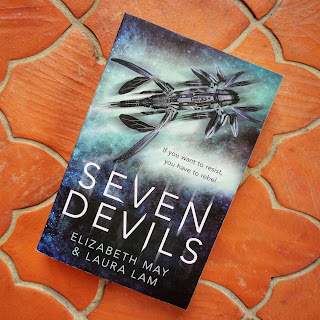
Seven Devils, Elizabeth May & Laura Lam

Having had a great run of sci-fi recently (thanks entirely to C's book-picking skills), a correction was inevitable. Seven Devils, an unusually two-handed affair, delivers this in spades. Its sole distinction is a primarily female cast in what's routinely a male-led genre, but everything else is wholly unoriginal, a poor copy of a copy of a copy. A poly-galactic evil empire, a despotic ruling family, the inevitable sequence of run-ins with scions of said family, lazy archetypal characters that include the plucky one, the clever one, the tortured-by-their-past one, etc. On top of this, it's also profoundly stupid. It has zero consideration or even awareness of scale, with the protagonists hopping between galaxies in minutes, and across which the empire has a mere *hundreds* of colonies. The empire is also said to have killed many billions of people (and aliens), but a key plot device is a so-called super-weapon that kills *individual* enemies (though, via another MacGuffin, ultimately kills more). Further, despite this background of proper genocide, the lead characters somehow find time to agonise endlessly about their individual transgressions. While the authors are clearly investing their own worthy opinions into the characters, they're oblivious as to whether those views plausibly stack up against the horror of the world described. They patently don't, and the novel fails at every turn, talking about Big Issues while floundering around in a breakneck series of weightless and faux-clever episodes. Other crimes include adding "diversity" by having a character speaking with Oor Wullie-style Scottish vernacular (to indicate they come from solid working-class stock), having regular occurrences of convenient, dig-me-out-of-this-plot-hole technology to get around plot ridiculousness, and, I kid not, "auras".

While I am entirely behind the socially-aware, feminist ideas that the authors clearly started from, this is a poor vehicle for promoting them. Vapid, lazy, inconsistent, and just plain stupid. Avoid this book.

Sunday, 7 March 2021

Baghdad Central, Elliott Colla

Having seen the TV series, and being a fan of the crime subgenre "crime drama in an exotic / foreign locale", this was a shoe-in.

It's set in the "wild west" of the aftermath of 2003's falsely-prosecuted and calamitous invasion of Iraq, as the invaders try to rebuild the society they shattered for the sake of its tyrannical leadership. Its moral centre is Muhsin al-Khafaji, a man that the Iraqi state has already robbed of his wife and son, and for whom the US and UK invasion threatens to take much more. After being mistaken for a culpable member of the previous regime and brutalised in prison, he is co-opted into the process of rebuilding Iraq's police service. But, with a growing insurgency, collaboration with the invading coalition is precarious for al-Khafaji and for those around him. Especially when some of them are profiteering from the chaos, while others are using it with a very different endpoint in mind for Iraq.

Overall, this is great. It got a little too complicated for me to completely follow as it approached the end. But everything else works, so this was easy to forgive. I thought that one of its best aspects were the distressing vignettes describing daily life for Iraqis after the invasion. In just a page or two, each one is a study in how lives can be made powerless and desperate by the fallout of war. Alongside the central narrative, they provide a searing commentary on the stupidity, venal arrogance and unforgivable recklessness of "Gulf War II".

Having now read this book and watched its (excellent) adaptation, it's interesting to compare and contrast. On screen, the powerful vignettes are lost, presumably because the faster, rolling narrative of TV doesn't favour brief tangential interludes. But the plot is nicely straightened-out, facilitated by the addition of a snarling British antagonist to stand-in for the worst aspects of the invasion. While I should perhaps be offended - especially when the leading American characters are presented as honourably making the best of their government's mess - this change feels about right: letting us carry the can for a national stain we brought on ourselves.

Saturday, 6 March 2021

The Golden Scales, Parker Bilal

Another day, another crime story set in an exotic foreign locale. This time the Cairo, and surrounds, familiar to its author, Bilal, the alias of Sudan-raised Jamal Mahjoub.

It's an efficient mix of crime sparked by modern money rubbing up against much older cultures, framed around a missing child and a missing footballer. While there's a certain familiarity for the reader in working out how the two strands are entwined, this is offset by solid writing backed-up by Bilal's personal experience.

I'll definitely be following up with its sequels.

Saturday, 20 February 2021

The Second Sleep, Robert Harris

Sent by his Bishop to officiate the funeral of a fellow cleric, Christopher Fairfax discovers a brewing heresy in the impoverished rural backwaters of southwest England. But, contrary to its seeming Dark Ages setting, this heresy involves the mysterious collapse of the unbelieving technological society that came before. His own interest piqued by the heresy, Fairfax quickly finds himself ensnared in an attempt to uncover forbidden knowledge from the past.

A surprising disappointment this one. Surprising because Harris has a knack of taking a high concept idea, and writing an efficient thriller around it. He's probably most famous for Fatherland, his alternative history novel in which a Nazi detective in a victorious Third Reich discovers the suppressed Holocaust. But I also rather liked his AI-infused The Fear Index, in which a hedge fund manager is out-foxed by the awakening of his algorithm.

Here, what seems like a solid gold starting point (especially now, given the pandemic) unravels as Harris fails to approach anything like a satisfying ending. Instead, the novel peters out in a rather incoherent climax that, it seemed to me, he tries to hide under the guise of Fairfax's incomprehension. The concluding revelations also fail to offer anything immediately relevant to Fairfax's world - contrary to the front cover blurb, "what if your future lies in the past?".

Overall, best just read A Canticle For Leibowitz and see how this high concept can be done properly.

Sunday, 14 February 2021

Bone Silence, Alastair Reynolds

This is the third and, for now, concluding novel in Reynolds' spaceships and pirates mash-up series. What seemed (to me) an incongruous and implausible basis for even a single book has now successfully skirted the treacherous shoals for a complete trilogy.

It picks up directly from its predecessor, which concluded with the series' leads, the Ness Sisters, unwittingly triggering a financial disaster that reset the values of the solar system's mysterious currency, quoins. Now even more on the run, and with still larger prices on their heads, their voyage intersects with that of a fugative alien who promises answers in exchange for safe passage. All of which triggers a swashbuckling chain of adventures that ultimately reveals much more about the solar system and its history than the Ness Sisters had bargained on.

A very enjoyable and satisfying "end" to the series. It does tend to accelerate the revelations towards the end, probably not giving them their due, but it's nice to have some mysteries resolved. However, given the novel resolves one suite of mysteries with a "solution" that suggests many new ones (in addition to those, like the Ghosties and Skulls, that still remain), I doubt this is really the last we've seen of Adrana and Arafura. Good!

Recommended, even if you find the pirates-in-space premise absurd.

Monday, 1 February 2021

The Space Between Worlds, Micaiah Johnson

There is a multiverse. The histories of several hundred universes are close enough to our own to permit travel between them. But jumping to a world in which you exist is invariably fatal - the multiverse is unforgiving in this regard. As a result, the most valuable travellers are those already dead in other worlds. Something that's all too easy for the poor and dispossessed in our ruined post-apocalyptic world.

What an excellent debut novel! Every part of it works brilliantly - from its well-drawn (and frequently-duplicated) characters, through the slow-reveal of its setting, to the unfolding of its satisfyingly twisty plot. The author takes what's now become a familiar trope - the parallel world - and spins off their own fresh version, complete with duplicate-prohibition, a travellers mythology of how Mother Nature enforces it, and a zeitgeisty meditation on a class- and race-stratified society.

Early on, I had a feeling of overfamiliarity with its post-apocalyptic dystopian future, but it didn't take long to reveal itself as something more unique, and cleverly so to boot. In particular, its use of duplicated characters - some very familiar between worlds, some very different - is excellent. Both in illuminating the vicissitudes of life's paths, and making for a wonderfully finely-tuned plot as the narrator, Cara, leverages her growing knowledge of the multiverse to topple the tyrant that rules the one she has come to call home.

For sci-fi, it's worth remarking that the writing is well above and beyond too. It's sparing but hits the sweet spot of world building while avoiding "Basil Exposition". Ditto, its characters are far more subtly drawn than the genre typically manages, which works particularly in a plot that requires its actors multiple shades.

Overall, simply excellent. (And a novel that practically screams "make me into a film".)

Monday, 11 January 2021

Mr Loverman, Bernardine Evaristo

It's easy to take pot shots at prizes in the arts. Distilling the distinctive, diaphanous and diverse into a "Best Of" list is crass and hierarchical, and even risks imposing an accepted version of the world using works that are unrepresentative of the wider culture. But, at their best, prizes can work to throw light on an artist hitherto lost in art's ocean. So it is, for me anyway, with Evaristo. Winning the 2019 Booker Prize for Girl, Woman, Other has led me, and probably many others, first to it, and then to her back-catalogue, including Mr Loverman.

This time around, the protagonist is very male, and while the novel's chorus includes his wife and daughters, it's really all about Barrington Jedidiah Walker. Originally from Antigua, Barrington - Barry - is Windrush generation, made good through the 1980s as a property developer, and now successful and semi-retired. Also, Barry is gay, and closeted, something that his long-term beau, Morris, would like them both to rectify. However, after a lifetime of hiding his true self, Barry is struggling with how to change, with the consequences it will wreak for his family, and with the searing memories of less tolerant times. And while Barry procrastinates, his wife, Carmel, reflects on her own life, and how their situation has imprisoned her aspirations and happiness. But change is coming whether Barry is ready for it or not.

What a brilliant book. Principally through the voice that Evaristo gives to Barry’s thoughts, fears and desires. He’s a great character to be in the company of, and credibly well-rounded with his missteps and failings showing. Ditto the supporting cast of Morris, Carmel, Barry’s divergent daughters, and Carmel’s church group. Evaristo sketches the latter well, first as the harridens perceived by Barry, but then more clearly as supportive friends, much put-upon by the men in their lives. But, more or less, this is Barry’s book, and it’s difficult not to warm to, and be both amused and touched by his stumbling emergence from the closet. Even (or especially) as he self-aggrandisingly reports to Morris that, “I ain’t no homosexual, I am a … Barrysexual!”

Sunday, 3 January 2021

Inland, Téa Obreht

Some books you race through, enjoying the whole journey and missing it when it's done. Meanwhile, some books you read to the end because you're hoping it gets better or makes sense there. Set in 19th century America, Inland straddles the divide by alternating the narrative between a straightforward and well-told tale of frontier life, and a largely incoherent but intermittently fascinating parallel tale involving camels. In the former, a wife and mother is stuck waiting at home, slowly coming to the realisation that her husband and sons may not be returning, while steadily falling prey to ghosts from her past. In the latter, an immigrant from the Ottoman Empire falls in with the real-life United States Camel Corps in a trek across the West, largely traced out in conversations with the dromedary camel he befriends. In principle, the latter could have been great (and is, though only sporadically), but Obreht goes out of her way to make it incomprensible, with characters with multiple names, uncertainty about who's a camel and who's a human, and far (far) too much about ghosts. But while reading it, I largely overlooked this in the expectation that the two narratives would come together and make complete sense. They do, but they don't, and the novel ends on a downbeat note, where one narrative strand resolves clearly, the other rather unravels, and the whole is ultimately less than the sum of its parts. But there is great writing most of the way here, but it feels a little wasted by the author's commitment to incoherence (they might say "mystery"). I'd go as far to say that the book would work much better with the second strand entirely expurgated.

Saturday, 21 November 2020

An African In Greenland, Tété-Michel Kpomassie

An unusual (for me) foray into non-fiction with this rather unique ethnographic travelogue. I caught reference to it in a brief magazine report on BBC News 24 a few months ago, but an intriguing enough one to pick up the book.

In outline, a boy in Africa discovers Greenland and its native Inuit in a book, then spends several years steadily travelling through Africa and then Europe before finally taking the final leg to Greenland by sea. It sounds like a work of magical realism, but it's actually a richly detailed description of this journey, and of the author's subsequent time in various Greenland towns on the Labrador Sea coast.

And what detail! Kpomassie has an excellent eye, and a real gift in the telling. Whether it's the range of reactions to his colour and imposing size, the unique Greenlandic living and cultural practices, the extensive friendships he forms, his adventures on the sea or on the ice, or his gruelling (for a vegetarian) descriptions of local cuisine, it's all told with engaging flair. It helps that Kpomassie makes friends easily, bringing him into contact with a range of fascinating (and occasionally alarming) characters. His ability to rock up in a new city, town or fishing village, and then find himself digs with locals at (seemingly) the drop of a hat is really quite something. And his unique heritage and winning ways with local women certainly made me wonder if he made a longer-term mark on the Greenlandic gene pool!

Where the book sags a bit is in its episodic nature and its absence of a strong narrative journey - inevitable given it's a travelogue of a real actual journey. But the tale it tells is so good, the situations, the people, and the society so unique, that the book easily carries you with it. Well worth checking out.

Finally, Kpomassie's journey having taken place in the 1960s, it's also sobering to reflect on the climatic and cultural changes that the intervening decades have wrought.

Sunday, 20 September 2020

Blue Mars, Kim Stanley Robinson

Epic in every way - in complexity, in characterisation, in actual physical weight - it's a strange feeling to finally finish KSR's exceptional future history of Martian terraforming. It's great to turn the last page on something I've been labouring under for weeks (*months* if the two preceding tomes are factored in), but it's been such an all-encompassing and absorbing book that I'm going to miss it a bit too.

In pocket summary, it picks up as the second - and successful - Martian revolution is concluding, on a Mars newly liberated from a flash-flooded Earth. Thanks to anti-aging medical technology, much of the original cast of Red Mars is still with us, together with their first and second generation children. These assorted narrators take us through factional Red (pristine, lifeless) and Green (transformed, bountiful) fights, fumbling efforts to kick-start Martian politics, and the solar system-wide issue of humanity's abundance in the wake of this anti-aging.

However, that description can't touch just how ridiculously broad the canvas here is. As well as the geology of Mars and the science of its transformation (both global *and* local), the socio-economics of its political awakening, and the gathering pace of solar system expansion, the novel finds time to take in (among other things) life in southeast England on a drowned Earth, sex-and-hunting cults on Mars, and the impact of low Martian gravity for regular and extreme sports. KSR can't even leave his convenient narrative trick of anti-aging alone, and embarks on a fully fleshed-out subplot digging into biological senescence and memory.

Inevitably, not all of this works, and I suspect readers will find themselves skim-reading the themes that don't interest them as much. For me, I couldn't care as much about political theory as KSR clearly does. But then I just couldn't get enough of the Red vs. Green tussles of Ann and Sax, or the scientific detail of Mars' animation, from global geoengineering to gardening its microclimates. And there's a great stretch where Nirgal, a first generation child, takes part in a solitary, round-the-world marathon (Mars-athon?), which really opened my eyes to seeing Mars as a (potential) physical, living-and-breathing place.

So almost impossible not to recommend to science fiction fans, but it's a real taskmaster of a trilogy of novels. But, I think, absolutely worth it.

Sunday, 23 August 2020

Daemon's Departure

The Secret Commonwealth, Philip Pullman

Unlike the first volume, which largely tees up His Dark Materials (HDM), this second volume of The Book Of Dust picks up afterwards, and sets a now 20-something Lyra and, more significantly, her daemon Pantalaimon, on another adventure against the revitalised Magisterium.

Motivated by a murder, mysterious goings-on in a distant desert, and the now-fractious relationship between Lyra and Pantalaimon, this is another exceptionally entertaining, fast-paced and highly imaginative journey through Pullman's rich alternative universe. As well as pulling through several other characters from La Belle Sauvage, it fleshes out Lyra's already rich world by sending her and her daemon on separate (!) journeys into Europe and the Middle East. In parallel, friends and foes are hunting them as the Magisterium rallies to counter threats to its theology and control.

Much as in HDM, Pullman continues to needle authoritarian forms of organised religion, but he has a number of enemies in his sights. The troubles in the war-torn Middle East, and the disinterest of Western powers, are laid bare on Lyra's travels. And perhaps surprisingly, the book also takes some well-deserved shots across the bows of the Ultra-rationalists and New Atheists. Even Boris Johnson attracts some of Pullman's ire with a dismissive reference to second-hand water cannons.

The only real downside to the book is that I've unwisely read it when the final volume of the trilogy ("to be concluded") has no official release date in sight, leaving me now chomping at the bit for Book Three.

However, if I can conclude on two niggles, ... Considering the magnitude of the events of HDM, both Lyra and her world are surprisingly unchanged. Confined within her own universe this time, it's largely left unmentioned that she's been to others, even to the Land Of The Dead, that she's met primordial angels and the alien Mulefa, and that she even (if unwittingly) killed "God". It's very easy to forget all this and to enjoy the novel, but it does sometimes feel like an elephant in the room. There's also a slightly queasy feeling around La Belle Sauvage's Malcolm and his attraction to Lyra.

Saturday, 22 August 2020

Feminist Panoply

Girl, Woman, Other, Bernardine Evaristo

A cross between a novel and a short story collection, GWO flits between the diverse lives of an interconnected cast of girls, women and others. Tied - chapter to chapter - to the interior concerns of these dramatists, activists, teachers, students, farmers, ..., the book rounds them out when they drift into the view of other characters.

What results is a fantastic cross-section of lived-in lives, and a tapestry of the struggles and joys - mostly, sadly, the former - from across the spectrum of the black British experience. Or so says this white, cis, hetero male reader - for whom it's a *very* pleasing own-perspective-free read.

As the title implies, the novel takes in identities hitherto unrepresented or actively written-out of the culture. But it does so with a definite lightness and fleetness of foot. The chapter written from the life of its Other character gently articulates their perspective and clearly stakes out their right to exist on their terms. But the novel is also broad and realistic enough to have a later character wryly puncture some of the activist language while still giving the respect due to marginalised identities.

By way of a character-limit-imposed summary, it's a brilliant read that I'd recommend to everyone, and a very worthy winner of the 2019 Booker. Having already read the novel it shared that prize with, Atwood's excellent follow-up to The Handmaid's Tale, while both are inclusive tours de force in their respective genres, it's clearly the more encompassing, overarching and relevant read.

And, against a backdrop of BLM and Trans-activism, and a pop-culture present that includes The Handmaid's Tale, Mrs America, I May Destroy You, and more, it feels giddily zeitgeisty.

Friday, 6 March 2020

Inner voice

The Grauniad asks ...

Describe how you express your inner thoughts - is it an internal monologue or something more abstract like sound or shapes?

My most coherent inner thoughts are expressed, as the question poses, as an internal monologue. While this manifests as if it's sound, i.e. it is not dissimilar to hearing an external voice, there is never any confusion between it and sound. In that sense, it seems a little like sound in dreams, where events are not presented in silence, but somehow there's an indefinite qualitative difference with actual sound. Possibly, at some fundamental level so that, even when deep in a dream, the mind is able to separate internal fiction from a real external danger or alarm. One feeling that I do frequently have when thinking with my inner voice is that there's some nonverbal part of my mind running ahead of the voice. This feels like a symbolic chain of thought, and it's almost as if the narrative part of me is following in its wake, struggling a little to keep up. Sometimes it even feels like my inner voice skips over something that's already been thought by this deeper (and faster) layer, just to keep up with it. None of which particularly surprises me. As a biologist, I'd expect something like this sort of nonverbal chain of thought to be an inheritance from our animal ancestors. I imagine that many of them have a consciousness like our own in many respects (emotions, choices, the eerie sense of being here), but without a verbal layer sitting on top. Although I do wonder if some particularly advanced animals, whales and primates, may have the rudiments of the same. Returning to the question, my perception of conscious words on top of semi-conscious symbols may be a function of my working life. Much of my activity involves words, either as emails, reports, papers or presentations. Perhaps, if you don't need to use words so much moment to moment, you have a better connection with what I've described as symbolic. It's obviously not possible to exist as a modern human without language, but it maybe doesn't have to be as all-encompassing as it is for a now-instinctive writer like me. That said, when I'm doing manual tasks (particularly so when quickly), I don't have an inner voice narrating things. But I know that some people do have a more continuous inner voice, commenting on their conscious experience regardless, or at least so they perceive. In any case, it might be that the majority of responders to this question are precisely those with a more verbal mode of thinking.

Sunday, 1 March 2020

More than nostalgia

The Rotters Club, Jonathan Coe

The first predecessor to Coe's recent Middle England (although more like a prequel to me given I'm reading them in the wrong order), The Rotters Club is a simply brilliant evocation of the political and cultural zeitgeist of England in the 1970s. Filtered largely through the lives of teenagers at high school (all middle-aged, appropriately enough, in Middle England), it's also - by turns - searing and hilarious on this formative life stage. While there are occasional nostalgic interludes, the novel has bigger fish to fry, with the trades unions and Tories, race relations and the IRA all in its sights. But much of its entertainment value comes from recognition of the teenaged incomprehension, self-importance and angst of its primary characters. While more heightened than my own "skooldaze", I definitely recognised the agonised feelings and the japes, and even some of the characters (our Harding was called Haig). And I also had a shuddering familiarity with the general complicity towards racism painfully traced out. On these facets, it's particularly excellent, but it's much more of a solid all-rounder. The steady buildup of its labour relations backdrop, that completes with the ascension of Margaret Thatcher, is another highlight. As does the infusion of the dark IRA thread, and the timely spectre of the Yorkshire Ripper. Overall, it's a novel that's impossible not to recommend.

Finally, one distinction from Middle England is that this book was written from a position of hindsight, while Coe's Brexit novel is practically reportage. This lets the political scaffolding of The Rotters Club sit half-finished, because we know what calamities happen next. It'll be interesting to see how the future treats the later novel. Except for the fact that we'll have to live through it first.

Sunday, 19 January 2020

My First Brexit Novel

Middle England, Jonathan Coe

The first unambiguous Brexit novel that I've read. Running the better part of a decade, mostly before - but also after - the 2016 Brexit referendum, following about a dozen major characters in the approach and aftermath to this rolling, shambolic and toxic national tipping point.

In essence, it's a tragedy (obviously), leavened with many comic moments, and with a smidgen of hope at the end. Perhaps surprisingly, in spite of its subject the novel is a very enjoyable read, in part down to the recognisable, god-awful familiarity of the backdrop, but also Coe's skill with his characters and their narratives. He does a good job focusing on facets of England that illuminate the whole, for instance, a foodbank-using clown and a schoolgirl feud ultimately revealed as "immigrant" UK citizen vs. "native" Irish/EU citizen. He also weaves in an explicitly political strand, has a bit of fun with the literatti (his own tribe), and touches on our still-forming notions of gender. Which all sounds a lot, but it's never rushed, and it juggles these threads skilfully.

While told from a clear Remain perspective, doubtless reflective of the author (and his readers), Leave appears throughout the novel. Not, admittedly, always (ever?) in a favourable light, but my personal Brexit experience largely accords with Coe's handling of Leaver characters (though nowhere near as dramatically). There are doubtless missing Leaver perspectives, but an emphasis on xenophobia, and a minority role for tax-dodging elites, feels pretty reasonable to me.

As I understand it, the characters are drawn from previous novels by the author, but there didn't seem to be any requirement for familiarity with these. Although, based on this book, I will now be digging into his back-catalogue.

While, as noted, this is my first Brexit novel, I expect it's a portent of many more to follow. Something further to fill one with dread.