Showing posts with label environment. Show all posts

Thursday, 6 January 2022

Anti-Dystopian Future History

The Ministry for the Future, Kim Stanley Robinson
The standard model for climate change fiction is a narrative of calamity piling up, or of living among calamity. The fact that our system for living, one we support time and time again through our democracy, embeds us as part of the problem (some, admittedly, much more than others) seems to make divergence from a path to this calamity difficult to imagine.

But mapping out how this divergence could occur - scientifically, technologically, socioeconomically, ethically, and even spiritually - is Robinson's aim here. The central, eponymous concept is the creation, under the Paris Agreement, of a Ministry for the Future, a UN body focused on representing future generations and non-human residents of Earth. In Robinson's telling, this Ministry uses its limited budget in a precisely targeted way, finding the physical and - especially - the financial fulcrums where small changes can exact large gains.

But that's the philosophical backdrop. The novel itself opens with, appropriately for the subgenre, a calamitous near-future heatwave in continental India that, over a few days, kills tens of millions of people. This event unsettles the global order, with India's Hindu nationalist political class toppled, and solar radiation management (SRM) geoengineering unilaterally undertaken by the nation. It also motivates its characters, providing a clear view of the peril for the Ministry's head, Mary Murphy, and fuelling the rage of Frank May, an aid worker survivor of the heatwave. Their paths become entangled as the novel progresses over several decades, but much of the novel is a tapestry woven from parallel stories. These are told both by other inhabitants of the imperiled world and, fancifully, from the perspective of inanimate objects like a photon, a carbon atom and the Market.

While the overarching focus is climate change, as the novel progresses this broadens to encompass two key facets of this: refugees and biodiversity. Many of the strands, and especially those of Frank, deal with the trials, traumas and then resolutions of people forced to migrate directly by climate change, or indirectly because of its downstream societal impacts. In Robinson’s 21st century, after decades of strife, the world ultimately adopts a system explicitly modelled on the Nansen Passport scheme from the early 20th century. In parallel, he creates a Half-Earth movement that slowly but steadily drives societies to cede half of the Earth’s land area to nature, consolidating existing communities in cities, and allowing wildlife to recover in the wake of their retreat.

Wearing my Earth scientist hat, it’s refreshing, if ever so slightly uncomfortable, to read a climate change novel in which science doesn't play the dominant role in its resolution. It’s clearly important in framing the problem, and in monitoring its resolution, but the most successful drivers come from the economic and societal changes that the Ministry (and other bodies) engineer. Markets are tamed and repurposed via a carbon currency, financial transparency is hard-wired via a blockchain that destroys secrecy and corruption, and social media is democratised to put its power back into the hands of its users. And, as readers of his Mars trilogy of novels will attest, Robinson puts a lot of imaginative effort into how exactly these socioeconomic forces might be realised - arguably a little too much effort in some particularly dry segments.

An aspect I found intriguing, and liable to cause Robinson some trouble, is the novel's attitude to geoengineering. As mentioned already, SRM geoengineering plays an early and successful role in the novel, although it's clearly labelled as a temporary, placeholder fix in the narrative. But the novel also runs with icesheet management geoengineering, essentially pumping out the meltwater that lubricates icesheet collapse, and touches briefly on a novel (to me) mode of "staining" the waters of the Arctic Ocean to decrease its warming. These are all presented as successful needs-must approaches - a view of the potential role of geoengineering that I share myself, but a likely contentious one for environmentally-inclined fellow-travellers. For many, the moral hazard argument against geoengineering (sometimes even against just contemplating it) is simply unsurpassable. On a not-dissimilar note, Robinson doesn't shy away from issues of population, particularly where demographic transition in his imagined future brings benefits. Again, liable to upset some in the environmental movement who - with some justification - are ideologically opposed to contemplating this facet of Earth's problems.

Notwithstanding all of the foregoing positives, the novel isn't without its weaknesses. Principally in the character of Frank, whose role in the narrative is just too muddy - particularly so given he's introduced in such a pivotal way, and then precipitates a fateful run-in with Mary. But his arc quickly runs out of steam, and he becomes an ill-defined foil to Mary's more prominent narrative. More generally, the episodic nature of the novel - which has many "ecological sci-fi" precedents, including Brunner's Stand On Zanzibar and Brin's Earth - has a habit here of introducing then dropping threads that were just getting interesting. For instance, the whole "black ops" wing of the Ministry tantalisingly appears and then disappointingly evaporates, lost, seemingly, in a crush of competing threads. Plus, as already noted, Robinson's excitable fleshing out of some of his socioeconomic solutions can be tinder-dry at times.

But the ambition and scale of the novel absolves it of all of these problems. It’s easily the most realistic “climate positive” novel I’ve read. It may sound stupid out of context, but it’s quite the thing to read of atmospheric CO2 not just peaking but actually dropping, and dropping fast (5 ppm per year) by the end of the novel. I had to stop when I read that, as continual CO2 rise is just a simple, lifelong fact. But it’s not exactly a happy-clappy utopian novel, where the penny suddenly drops for everyone and we all start behaving sensibly. Instead, it's much more of an anti-dystopian tale, in which the planetary handbrake turn that’s executed is actually the result of the slow accumulation of multiple credible steps. So this feeds into a sense of realism and, for me at least, a more genuine positivity about the future.

I should conclude by noting that I finished reading it in the same week as I watched the darkly satirical Don’t Look Up. While that’s an excellent howl of a movie, one that doesn’t offer anything by way of a solution (or really intend to), this is much closer to the real deal. But the contrast between them was enjoyable to savour. I’ll be recommending it to my Earth science colleagues, but I think it’d be an enjoyable and informative read for anyone. If - characteristically for Robinson - a long one.


Stray observations:

  • I thought it was only me who was imagining something like the Half-Earth movement. Obviously not. It’s not a concept that I’ve seen written down before, but it seemed like a pretty good idea to me - and clearly to Robinson too. Of course, long-term I’d like to see a Whole-Earth movement in which we abandon the Earth to do interesting things elsewhere, leaving our cradle free for successor species … 
  • Much like the Mars trilogy, Robinson has a nice section near the end where a major character takes a trip that allows the world that he’s built-up to shine. Here, more so than in the Mars triology, this feels necessary - like it shows what our efforts could achieve if we do the right thing, both by the Earth and by those living in it who are less fortunate than ourselves. In a literature dominated by abundant dystopias, giving a vision of how things could be different hit the spot for me. Ditto, as already mentioned, the novel’s late turnaround point when atmospheric pCO2 starts decreasing. 
  • Another intriguing suggestion of Robinson’s is that advances in computing, AI and automation (none of which seem unreasonable) favour a kind of “Red Plenty” economics. Essentially, the market is (I think) streamlined and out-guessed by computing systems to the point that its purported efficiencies are unnecessary. It’s the portion of the novel where it feels closest to utopian thinking, but there’s still at least a veneer of realism. 
  • It’s kind-of funny to contrast how David Brin’s corresponding stab at the future, Earth, treats the Swiss compared to here. For Robinson, they’re kind-of a beacon of sanity - albeit one with flaws - whereas Brin just made them the bad guys, what with their secret banking and mountains of gold. (Admittedly, he does claim that he did it for the surprise value.) 
  • As an oceanographer, I can’t let the novel’s passing reference to the ocean that I’ve reproduced below go unmentioned. While it’s negative about the prospects for us doing anything to help the ocean, I can’t say that I disagree. Absorbing so much heat and CO2, it’s been extensively perturbed, and on a scale that we’d struggle to redress. So I’d agree with Robinson that probably the best we can do is stop making things worse, and allow it to just recover on its own.

  • I mentioned the strange position of Frank in the novel before, but the late and completely unnecessary introduction of a potential romantic partner for Mary is another strange misstep. It’s brief, and just a small part of the “Earth is healing” segment near the end, but it’s pretty glaringly incongruous in a novel that’s otherwise quite disinterested in its characters’ emotional lives.

Sunday, 19 January 2020

Imagining Climate Change

The Wall, John Lanchester

One of the many failures of our culture when it comes to possible climate change futures is in playing out the likely consequences of change. "The future" becomes one purely of temperature extremes, rainfall change and, sometimes, agricultural shortages. Numbers that, while meaningful, don't capture the imagination and aren't extrapolated to day-to-day changes in our lives. This makes the future look like somewhere in which we have to, for instance, make do on 10% less food and spend twice as much time indoors sheltering from excessive heat. This overlooks what such changes will actually mean societally, and how they will play out for the daily lives of people in different places on different means.

The Wall is, arguably, an attempt to put human flesh and feeling around one climate future. It's a relatively slim volume, and focused around a small cast, but it makes great strides in sketching out how climate change can reshape a whole society, and what consequences and choices it might impose.

The book opens, almost with sly nod to Game of Thrones, with its central character, Kavanagh, braced against the cold, up on the Wall and looking for Others. The Wall is Britain's response first to sea level rise, but more significantly to the waves of climate refugees displaced from their homes. Kavanagh's job, as a Defender on a two-year stint, is to stop the Others from breaching the Wall and reaching the relative safety within. In this future, it is the young that serve on the Wall, while the old, whose past inactions have caused the Change which drives it, are cowed and nostalgic for lost beaches. And this service comes with double jeopardy for the Defenders - the risk of harm while serving on the Wall, and the penalty of being cast out to sea if any Others break through on their watch. Both of which become more than mere risks for Kavanagh as his tour of duty unspools.

In spite of its relative brevity, this creates an unnerving future Britain. Through the drama it inflicts on its characters, it shows how, while civilization may not necessarily fall under climate change, its best features can easily be worn away. Kavanagh is a relatable Everyman, but even he stops himself thinking too deeply about the Others or why they are so desperate to break into Britain. However, his resentment at previous generations, including his own parents, for their abject failure to avoid the Change is much clearer. This future Britain may not be (completely) materially ruined, but the isolationism fostered by the Change, and the resulting loss of humanity in its citizens, marks its true devastation.

So not the cheeriest read, but recommended.

Stray observations:

  • The climate future presented in the novel is an interesting one. The reader is first introduced to how cold it is, counter to ongoing global warming. However, it is later made clear that it’s much warmer elsewhere, which is suggestive of the cold in Britain being a result of changes in ocean circulation. The decline in the Atlantic Meridional Overturning Circulation, for instance, is simulated to result in reduced warming in northwestern Europe relative to other locations. I don’t think that (m)any simulations would suggest strong cooling, but there’s something of a basis for the nature of the Change as it appears in the novel.
  • A number of reviews have described The Wall as “this century’s 1984” or similar, presumably latching onto the fact that its future dystopia can be read as a warning for the present. And there’s certainly something prophetic in its world, but in terms of style and narrative the two books really don’t overlap. The Wall is far, far less didactic than 1984, and the better for it. The closer parallel is with Cormac McCarthy’s The Road, with its similarly pared-back text and narrative, although The Wall gets the nod because its particular environmental calamity is more unambiguously related to our own. (The Road still wins out in terms of total doom, however.)
  • In another sly nod, The Wall introduces a politician character with more than a passing resemblance to a certain British Prime Minister known for populism and lying. That said, the narrative ultimately gives him a more noble path than one might expect from this affinity, so perhaps I’m overinterpreting.
  • Intriguingly from a “future technology” perspective, the Britain presented in The Wall runs off of nuclear power. It’s fleetingly mentioned, and never referred to again, so it’s difficult to know if the author means much by this. Admittedly, the changed local climate in Britain sounds less favourable to renewables like solar, but there could be more to this choice by the author.
  • While an underpinning, and largely realised, feature of the world of The Wall is "civilization within, barbarism without", one of my bugbears about the IPCC scenarios that we use in climate change research is that, no matter how bad their futures get, things remain civilised. I think scenario designers might do well to read The Wall and reflect.

Tuesday, 10 September 2013

Earth Abides

What would it be like to be the last person alive on Earth? This theme is one that's drawn so many writers and film directors that it's now very - possibly overly - familiar to readers and viewers of science fiction. But how does one of the classic novels that explores it, 1949's Earth Abides by George R. Stewart, fare against the oversupply of post-apocalyptic genre fare?


It's the middle of the 20th century. Isherwood Williams - Ish - is a graduate student doing ecology field work in Black Creek in backwoods California. Bitten by a rattlesnake, and many miles from any help, he holes up in his spartan cabin until he is well enough to return to civilisation. However, driving out of the sticks, he finds - at first gradually, but later transparently - that it has apparently vanished from the face of the Earth. In his absence, a measles-like disease has struck the world, leaving humanity's works with no hand at the tiller.

As his initial shock wears off, Ish decides to travel America to investigate whether anything, or anyone, has survived the plague. Travelling east, he gradually finds pockets of humanity, some making ends in this new world, some descending into sedate insanity. But it becomes clear that civilisation is at an end, and Ish returns west to his hometown where, dispassionately, he studies how the natural world responds to the absence of its previously most-fêted offspring. Inbetween his efforts to make a comfortable life for himself, he watches the cyclical rise and fall of populations of animals freed of human control, as well as the gradual fall into disrepair and dysfunction of the human-built world. Unexpectedly, he discovers Em, a woman living nearby, similarly scraping a post-civilisation living. In short order they become a couple, and then a nucleus for a small group of survivors - and their children - to condense around.

As the years pass, Ish begins to grow concerned that all of humanity's learning and knowledge will be lost, and he vainly attempts to spark an interest in the next generation. Instead, Generation Post-Apocalypse gradually adopts less sophisticated, but more sustainable, ways of making a hunter-gather living, while simultaneously receding into superstition and mythology. In time, through triumphs and tragedies, this new way of life prevails as Ish's generation gradually fades away, and Ish himself becomes "the Last American", his memory and awareness dimmed by great age. At the end of his life, Ish comes to accept the passing of the old world he knew and sees the new world as just as transitory. In a moment of clarity, he observes that "Men go and come, but earth abides".


The short answer to the question posed in the opening paragraph is that Earth Abides stacks up extremely well against other novels and films (and videogames!) that tackle the end of civilisation. The above outline doesn't really do justice to the detail that Stewart has invested in his vision for the world. Particularly the effort that he puts into imagining the changes - biological and infrastructural - that follow from the loss of humans. In sending Ish across the country, and in playing out across the full length of his life, Stewart covers the full range of changes, from those that would happen immediately, through to those that would only happen gradually over years.

But leaving aside the breadth and depth of Stewart's playing out of the future, what was more impressive to me was the journey that he sends Ish on. Many end-of-the-world tales conjure up a convincingly human-free future, but few transition to mulling-over the limitations of our lives quite so well. While the narrative at first steers the conventional way that would ordinarily lead to the protagonist rebuilding civilisation, Stewart instead gradually makes the utter enormity of the task facing Ish and Em clear. And unlike similarly-themed novels such as The Road or Oryx and Crake, where hope of civilisation's restoration is wholly (or largely) absent from the narrative, here it's first dangled in front of the reader, before being steadily revealed as an impossible mirage. The future faced by the characters in Earth Abides is a sheer cliff of impersonal difficulty that simply cannot be scaled by them.

Beneath the novel's surface interests in civilisation and ecology, there's clearly more going on. It's difficult to miss the prevalent use of biblical themes and names (the novel's title, for instance), but Stewart also threads the novels with a series of philosophical strands. Some of which I picked up on, some of which only dawned on me when I read the novel's Wikipedia entry! As a more personal aside, I came to interpret Ish's struggle with the future of humanity, and then his acceptance of his passing role in steering it, as being a thinly veiled parable of the struggle that we all face in our own lives. At first, when young, the world seems malleable to us, but as time passes we gradually perceive that its course is far more circumscribed by history, inertia and the opposing wishes of others. Stewart, who was in his 50s when he wrote Earth Abides, was perhaps weaving us more than a simple story to divert us from our daily lives.

The novel does, however, have its, well, quirks. Chief among these are a series of anachronistic slip-ups down somewhat politically-incorrect avenues. For instance, early in the novel, Ish runs into an African-American family eking out a modest existence on a farm. His brief report of their quietly dignified stand against the calamity was possibly quite enlightened for its time in pre-civil rights USA, but it certainly raised my 21st century eyebrows. More troubling is the novel's treatment of the character of Evie, a young woman with either congenital or post-calamity mental health issues. Here the characters come across as the worst sort of eugenicists, at first contemplating euthanasia before finally settling on a pact to categorically prevent her from having children. While one can see the logic in the characters' concerns, they contemplate a semi-Nazi "final solution" for altogether too long to my mind. Such issues often arise in novels from the early- or middle-20th century, and, in context of their times, were probably actually liberal positions, but they certainly give the modern reader pause. Of course, in another 50 years, perhaps some of our forward-thinking attitudes will seem similarly neanderthal (to use what is almost certainly an example of this).

Notwithstanding the preceding, it's difficult not to recommend the novel. It does such a good job of the "empty Earth" trope, that it's a must-read for science fiction fans. And its depths reward readers prepared to wade into them. Though, as I've now spoiled for new readers above, the existential irrelevance of humanity and human lives perhaps makes Earth Abides not for the faint-hearted.

Sunday, 7 July 2013

Existence (or something like it)

More than 20 years ago, David Brin wrote his gargantuan, world-encompassing novel, Earth. Similarly to John Brunner's classic novel, Stand On Zanzibar, its central plot was revealed only gradually, built up step-by-step from the perspective of dozens of characters, each with a different view of the world they live in. It took on just about every environmental theme going from climate change to overpopulation to extinction, then threw in space stations, errant micro black holes and the Tunguska event, and a smattering of technological forecasts, including a then-prescient treatment of the world wide web. Epically long, it was also epic in its scale and ambition, and it more or less worked, culminating in an genuinely impressive climax in which the Gaia hypothesis was made flesh.

Flash forward to today, and Brin has written Existence, which is easily as large, and again builds its world from the bottom-up, fragmenting its narrative across a cast that includes - among others - an elderly astronaut now on orbital clean-up detail, a mischievous science fiction writer, a climate-displaced Chinese scavenger and a trust-fund baby with a penchant for illegal space flight. This time, while environmental matters still hover at the edges, the main focus lies with humanity's lonely position in the cosmos. This apparent loneliness doesn't last many pages into the novel, when an unexpected find in Earth orbit answers the question "are we alone?" firmly in the negative. Or seemingly so, at any rate. But the answer comes with caveats, and as the novel progresses it becomes clear that the answer is also plural.

As I was refreshing my memory and writing the above, I was struck how much the two novels share - at least in summary. What they don't share is that while Earth's epic page-count makes it an engrossing page-turner, Existence's comparable length makes it a gruelling chore. In part, I think one of the reasons is that all of Earth's scattered narratives serve the whole: an all-encompassing treatment of environmentalism. By contrast, Existence is much less coherent, and serves up amateur rocketry, (virtual) space aliens, muddled extropian thinking, uplifting animals and settings or situations that, while interesting on their own, read as disconnected in the novel. For instance, the wealth contrast between the scavenging lifestyle of Bin and the super-entitled, playboy adventures of Hacker makes sense at first in world-building, but Brin really doesn't do anything with it. And, by the end, this sort of detail has been completely left behind.

As a result, while Existence is sporadically interesting and enjoyable, it is ultimately a tedious read. Were it about half its length - a feat of editing that wouldn't be as difficult to achieve as one might imagine - its sins would be much more forgiveable. As it stands, Existence is only intermittently clever, and while it has some interesting ideas, it spaces them widely within a plodding millstone of a book. If I turn to Brin again, it will only be when his page count drops to the vicinity of 300.

Monday, 29 October 2012

A child's-eye view of apocalypse

It's safe to say that Beasts of the Southern Wild is a pretty unique film - at the very least in terms of what usually appears in cinemas our way. It's part family drama, part climate change fable and part meditation on community. But its principle strength is viewing all these various facets from the imaginatively-skewed perspective of a child living through them. The child, Hushpuppy, has an amphibious and anarchic childhood in the "Bathtub", an inundated area of swampland at the very edge of (a generally unseen) civilisation. Already largely underwater - hence its name - periodic storms threaten to finish the job, and Hushpuppy's tumultuous, knockabout life with her father is further imperilled by him gradually succumbing to illness. But in Hushpuppy's mind, her world is also threatened by the mysterious, ice-age aurochs that she's heard about at school, and infused with the mystery of her long-departed mother.

The film reviewer's shorthand for a film like this is probably something like "lyrical", but "magical" seems a popular one-word summary judging from the reviews (and posters; see above!) that I've come across. And they're right. It's a thoroughly enjoyable and affecting tale made wholly memorable by the performances of both central actors, particularly the child playing Hushpuppy. She's simply fantastic. And it does a brilliant job of playing the adult world's trouble and strife as the backdrop to the child's world of exploration and imagination. One touch I particularly liked was that the aurochs, though actually wild cattle in reality (now sadly extinct), are imagined by Hushpuppy (and visualised in the film) as something more akin to giant-sized boars because of her family's "pet" boar.

And, of course, any film that attempts to dramatise climate change - especially in a non-preachy way that's doesn't frighten the horses - gets the big thumbs up from me. Yes, it's too soft on the Bathtub's benign anarchy, and a little hard on the heavy-handed efforts of the authorities to help its residents, but it's a pretty honest and fresh presentation of a not unlikely future. A future that, as Hurricane Sandy bears down on the Eastern Seaboard, doesn't seem quite as far off anymore.

Grade: A- (high +2 on the Leeper Scale)

Wednesday, 12 October 2011

"Least Concern"


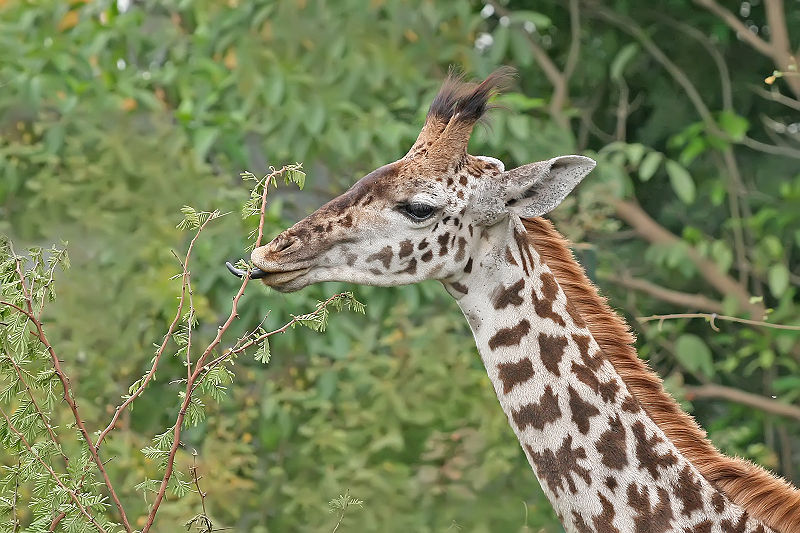
Today's Featured Picture over at Wikipedia shows a giraffe grazing, and discusses adaptations for consuming spiky plants. Not knowing an awful lot about giraffes, but wondering how they were doing extinction-wise, I moseyed on over to the article on them and was duly reassured that they are classified by the IUCN as "Least Concern". However, sticking around to read up on "the tallest of all extant land-living animal species", I discovered that, across the entirety of Africa, there are fewer giraffes (of all species combined) than there are people living in Southampton. In fact, given the uncertainties involved in counting them, there could be considerably fewer.

All of which got me thinking about how the classification of "Least Concern" seems, at best, pretty relative (i.e. of least concern compared to most other species), and may give an overly rosy view of their status to skim-readers such as (usually) myself. I can't establish from Wikipedia how many giraffes were roaming Africa, say, 10,000 years ago, but I'd be surprised if it wasn't an order of magnitude more (for loose comparison, I did discover that there were ~300,000 African Bush Elephants when I was born, but there are only 10,000 now). That said, and knowing next to nothing about it, I would imagine that population viability is probably pretty good at the ~100,000 level (hence, presumably, "Least Concern").

Leaving that genetic aspect aside, given that land-use changes (i.e. more for humans, less for everything else) show no sign of altering direction at any point in the foreseeable (and not-so-foreseeable) future, I seriously doubt that the current giraffe population level is even faintly secure. To be fair, the term "Least Concern" is accurate: relative to many other species, giraffes are not immediately on their way out so, yes, we should be less concerned about them. But given this low population plus likely future change, and given that humans (7,000,000,000 and counting) are also formally classified as "Least Concern", it doesn't strike me as a helpful categorisation.

Wednesday, 20 July 2011

A reminder of risk

From a piece co-authored by Ken Buesseler in this week's Bulletin of the Atomic Scientists ...
It is anticipated that for most locations the doses to humans from naturally occurring radionuclides, even for avid seafood consumers, will exceed those from the radionuclides released by the Fukushima accident. Near Sellafield, for example, doses to humans from naturally occurring radionuclides in seafood caught in the Irish Sea are about an order of magnitude higher than doses from artificial radionuclides. Total collective dose rates from natural radionuclides via marine pathways on a global basis are four orders of magnitude higher than collective doses from Chernobyl radionuclides. Even in the Baltic and Black Seas, the marine waters most contaminated by Chernobyl fallout, natural radionuclides provide a much larger collective dose to seafood consumers than do Chernobyl radionuclides.
Amid all of the justified concern about the meltdown at the reactors, it's been easy to lose sight of the context. While the piece argues for a full scientific assessment of the release of radionuclides (and is a nice summary of what they are, and what the expected risks are), the paragraph above is a particularly helpful reminder of the natural background, and its relationship - for most people and places - with the reactor release.

Not that such context seems to have calmed the leadership in Japan and Germany. If the alternative was plentiful green (or fusion) energy, that'd be one thing. But as the alternative is likely to be fossil fuel energy, the rush to shove in the control rods is dangerously misplaced. While the connection between nuclear power and harm to humans is far more direct than that between climate change and the harm it causes (and will cause), this easy attribution obscures the vast disparity in the total magnitude of harm from these power sources.

It's been almost 66 years since the power of atomic energy was first revealed to the general public. One might think that this would be long enough a period for people to get over their instinctive reaction to this first demonstration. It would seem not.