Showing posts with label short story. Show all posts

Monday, 3 June 2019

Galactic Central Point

Galactic Center Companion, Gregory Benford


It was many years ago, and over many years, that I read the six Galactic Centre novels that form the subject for this compact “study guide”. But despite the passage of time, Benford's galaxy-spanning tale of humanity's struggles against implacably superior “mechanicals”, largely set in the vicinity of the “Eater” at the Milky Way's centre, still sticks in my mind. 

In part background from Benford on his thinking behind his series, in part reviews of the full series by critics, and in part actual scientific work by Benford on the Galactic Centre. But the main reason to recommend is the new (to me, anyway) short stories set within it. Especially “A Hunger For The Infinite”, which revisits my favourite of Benford's creations, the Mantis, a mechanical intelligence that both persecutes the humans it meets while drawing artistic inspiration from them. 

I really rather enjoy Benford's penchant for imagining how non-humans might see the world, and it's nice to be reminded of how far his Galactic Centre series takes this. Particularly in the very strange ecosystems and intelligences around the Centre's dominating black hole. Benford takes the opportunity presented by the new stories here to flesh his ideas on these out a little further than the mech-focused novels could. 

Overall, this companion probably isn't much good for newcomers to his works, but for those familiar with them, it serves as a nice reminder of its pleasures, while offering up a few new nibbles to refresh the taste buds.

Tuesday, 23 April 2019

A Life in Shorts

Olive Kitteridge, Elizabeth Strout


Easily one the best books that I've read in a while, this chronological series of snapshots - some with the eponymous Olive Kitteridge as their subject, some with her in the background - spins a wonderfully humane tapestry of modern life from seemingly quiet domestic lives. Olive herself is by turns droll, annoying, insightful, cruel and caring, with an always-on no-nonsense attitude throughout defining events of her life, that of her husband, Henry, and those of her friends or neighbours. By viewing characters from different perspectives, it underscores how we can easily underestimate or undervalue others around us by only seeing them in one light. It's not always an easy read, though, somewhat to my surprise, it's a little more gentle than the more unsparing miniseries dominated by Frances McDormand in the title role. That's a little more close to the bone in its unvarnished holding of a mirror to the world.

Tuesday, 20 February 2018

Me Talk Pretty One Day

Me Talk Pretty One Day, David Sedaris

A Christmas money purchase this time inspired, in part, by hearing Sedaris read out his now-famous (it has an article on Wikipedia ...) piece, The Santaland Diaries. It's not part of this particular collection, but it didn't need to be, there's plenty more comedy gold in here. A little less on the pathos that Santaland sometimes touches on, but plenty of the laughs. Sedaris has real skill in recounting short tales from his own life that must, at times, be quite mixed experiences into something we can be amused by, while deriving some insight and understanding from. He is, to be fair, often helped by his family, his sister, Amy, in particular. So an excellent read - the super-short Big Boy is almost worth it on its own (if it weren't already available online).

Monday, 19 February 2018

The Iron Tactician

The Iron Tactician, Alastair Reynolds

Despite a novel's price tag, actually a little novella. Without me realising it at first, it's part of an intermittent series I've read by Reynolds on-and-off, about a character named Merlin, navigating the stars on a mission of revenge in a ravaged future galaxy. Usually these tales appear in short story collections, but here it's a separate, super-thin (but full-priced) volume. Leaving aside the pricing policy, this was a pleasing, if brief, read, telling the tale of Merlin's discovery of a damaged hulk, its sole surviving crew member, and how he gets inveigled in, and helps resolve, a nearby solar system's multigenerational war. Easy and enjoyable, though definitely cheekily priced.

Thursday, 28 September 2017

Stories Of Your Life And Others

Stories Of Your Life And Others, Ted Chiang


Though I had minor reservations about the film #Arrival, there was good enough about it to make me track down this volume of short stories by its author, Ted Chiang. As well as the source of Arrival - which is pleasingly similar and different to its adaptation - the tales take in the construction of the Tower of Babylon to reach Heaven, a steampunk tale grounded in performationist biology, and a faux-documentary on a technology that masks the ability to perceive human beauty so that users don't judge people by their appearance. Quite a spread, and all rather unique and enjoyable - I'll definitely be digging deeper into Chiang's back-catalogue.

Thursday, 2 March 2017

This Is How You Lose Her

This Is How You Lose Her, Junot Díaz

This Is How You Lose Her, a most excellent - if philandering - read

Saturday, 1 January 2011

No Revelations

It's 2011 now, but I've a stack of books to write-up from 2010. This is going to be a little cursory, but here goes anyway. First up is a short story collection from blog-favourite, Alastair Reynolds. Not from his Revelation Space series this time, but a series of stories from across his career, 1991 through to 2008, Zima Blue.

Unlike earlier collections, this one is largely made up of discrete stories that aren't united in a common universe, though there are a few that share the same future and a few characters. Considering that Reynolds is probably most famous for his interstellar Space Operas, most of the stories are rather surprisingly low-key, with some even taking place within a recognisable (and very British) near-future.

They range across hopeful post-apocalyptic yarns (Enola); Martian sloths (The Real Story); galactic journeys gone wrong (Beyond the Aquila Rift); explorations of many worlds in Wales (Signal to Noise); an investigation of space-time accompanied by an Elton John AI (Understanding Space and Time); and quantum immortality (Everlasting).

My favourite was the eponymous story, Zima Blue (obviously), which concerns a planetary-scale artist, Zima; the shade of blue that his work utilises; and how he gradually remembers the origin for this aesthetic preference. Which probably makes it sound ridiculous or seriously boring, but I felt that it had some real existential heart. It also pleasingly reminded me of the French artist, Yves Klein, whose rather vivid work we first came across in Barcelona (or was it Nice?), and who invented a particular shade of blue that features prominently in his work. I imagine that Reynolds must also be a fan.

Anyway, while there were one or two stories I was left scratching my head at the end of ("is that it?"), most were really quite good. As well as Zima Blue, I particularly liked Aquila Rift's premise of a routine space voyage gone vastly and terrifyingly wrong, and its introduction of an alien Samaritan picking up the pieces. Reynolds' "many worlds in Wales" tales were really nicely thought through too (a strange fusion between the corresponding works of Greg Egan and Iain Banks), though the Welsh setting made them seem rather mundane to me. It's probably true for other people too, but I tend to be aesthetically prejudiced against UK-set science fiction. It needs to be set somewhere "exciting" and "exotic", like Los Angeles ...

Overall, more solid fare from Reynolds. I'm already looking forwards to getting back to him before too long courtesy of a recent present from C: Terminal World.

Wednesday, 24 February 2010

Many worlds and many minds

After my last few reads of him, I keep saying that I'm going to give Greg Egan a bit of a rest because reading his mind-bending novels is clearly above my pay grade. They're really good, but they're hard, hard reads (in the science fiction sense; we're not in the misery genre here). However, since it's recently been Birthday-Christmas season, I've received quite a pile of new titles, two of which were written by Mr. Egan. So, in order to free up some book shelf space, I'm duty bound to tackle him again. That said, it's a little easier this time since Axiomatic is a collection of Egan's short stories.

The collection is Egan's first, and consists of stories published between 1989 and 1992. Pre-blog, I read his later collection, Luminous (which was also a present from C), and it definitely confirmed him as a must-read for me. The stories here range extremely widely in their subject and intent, although plasticity of mind, body and reality is a recurring theme.

Much as with his novel Quarantine, he visits quantum mechanics in the great opening story, The Infinite Assassin, inventing a special assassin who travels between universes to kill those with similar powers but who are intent to reshaping reality to suit themselves. The Hundred-Light-Year Diary imagines a future where everyone's daily lives are mapped out by diary entries ostensibly from the future. In The Caress, a detective who discovers a human-cheetah chimera is kidnapped to pose in a megalomaniac's reconstruction of Fernand Khnoff's most famous work. The widower protagonist of the eponymous Axiomatic takes an implant to "rewrite" his objections to capital punishment so that he can understand, and avenge, the murder of his wife. Meanwhile, the mind of the narrator in The Safe-Deposit Box flits nightly between different bodies, and uses the titular box to store the scraps of information he collects while unravelling his mysterious condition. Switching to electronic minds, Learning To Be Me concerns jewels, the artificial replacements for human brains that develop alongside them, and the conundrum of where consciousness really lies. The Moral Virologist is a fundamentalist with a training in molecular biology who creates a plague to target the "immoral", but his accuracy is blunted by biology's loopholes. In Closer a couple desire to know each other so completely that they trade bodies and even merge minds, but is perfect harmonisation really what lovers need?

As the selection above suggests, the collection is full of exotic treatments of biology, consciousness and reality. Several of the stories are simply jaw-droppingly imaginative and clever in the development and expansion of their central ideas, and Egan is almost uniformly excellent at wringing the most out of the worlds that he briefly creates. There are a couple of less successful stories, but even these contain the germ of a good idea.

More generally, I find that short stories suit Egan better than full-length novels. While their truncated page-count means that they lack the worked-out detail that his novels contain, this works in Egan's favour since he's forced to rein in his tendency to digress into full-throated dissections of physics. Also, since characterisation generally isn't a strong point of his novels, the necessary abbreviation of the occupants of his short stories obscures this weakness.

Overall, an excellent collection of stories. Not quite as good as the later Luminous I'd have said, but perhaps not surprising given that this contains his first forays into science fiction writing. And undoubtedly a more gentle introduction to Egan's obsession with the nature of reality and consciousness than his more gung-ho novels. A definite incentive to track down more of his short fiction.


Monday, 18 May 2009

A different sort of duck

From the sublimely literary The Poisonwood Bible back to the pulpy science fiction world of Neal Asher ... This time the short story collection The Gabble.

The eponymous Gabble, or Gabbleduck, is a predatory alien species that first appeared in the novel The Line of Polity on the planet Masada. Named for their appearance and for the nonsense speech that they continually spout, they are simply one part of the violent ecology that characterises this world. They feature here in three stories stories, the latter two of which question whether they really are the unthinking animals that they appear. Instead, the human scientists who encounter them gradually uncover evidence that once they were sentient with their own space-faring empire, but that events transpired that forced them to cast aside first their technology and then their civilisation. The nature of these events is darkly hinted at, but Asher seems to be saving his revelations for a further story.

The rest of the stories also take place in Asher's Polity universe, and range over a number of themes and worlds. Common to all is Asher's fascination with body-horror and with fast-paced tales centred around ultra-violent events. In one, a character discovers that the biological agent he contains to digest alien food is actually a corporation-modified parasite that is inexorably shortening his life. In another, a treasure hunter stranded on a world that experiences massive tides is forced to transform himself into a crustacean-like louse in order to survive and exact revenge on his enemies.

Much as with his previous short story collection The Engineer, these stories allow Asher's imagination to run riot while being, by necessity, short enough to prevent his weaknesses from showing. His writing is still pretty perfunctory, with rather cardboard characters that rarely show anything resembling emotions or an inner life, but the stories are strange and diverse enough to hold interest. Much as with the eponymous story from The Engineer, I was most interested and felt most empathy with his aliens. For all of their violence, Asher's uncovering of the history of Gabbleducks, with their casting aside of their civilised nature, made it a lot more easy to sympathise with them than with the assorted gun-toting humans that people these stories.

Asher remains a guilty pleasure.

Saturday, 31 January 2009

A new novelist

Though my fiction reading only rarely returns to the same novelist, my science fiction reading regularly returns to authors I've read before, sometimes for years before (Iain M. Banks, Alastair Reynolds, ...). So it's always interesting to read a new author, in this case Chris Beckett and his short story collection The Turing Test.

The collection of 14 stories ranges quite widely taking in a number of common science fiction themes including artificial intelligence (as the collection title suggests), virtual reality and time-travel. But rather than revel in the high-tech, the stories always focus on individuals and their experience in the worlds that the author creates.

While most explore quite separate universes, a few make repeat returns to the same universe, typically following the same characters. The most intriguing of these is set in a future, abandoned London which is roamed virtually by disembodied minds but also houses a few remaining "physicals". As well as being good science fiction, these stories put real characters at their core; in one, a young boy has his "virtual-ness" demonstrated to him by an elderly physical; in another, the same physical makes a melancholy journey deep into London to reminisce about her childhood.

While all of the stories are entertaining, a number suffer from a common problem. The author doesn't seem content with introducing a single idea which is then explored, the normal pattern for science fiction short stories. Instead, he sets up with one grand idea then, before working this one out, introduces another one but, because these are short stories, is then unable to do either justice. For example, one story ("Jazamine in the Green Wood") gradually sketches out a future in which a disease has killed almost all men. The story begins brilliantly, with the world viewed from the perspective of a boy growing up in this gender-distorted world. Then, just as things are getting interesting, the novelist throws in another character who has travelled to this "reality" by using mind-altering drugs. Huh? In another example ("Valour"), an exploration of virtual relationships in a segregated future suddenly, and unconvincingly, introduces the philosophy of an alien culture, and manages to defeat what was shaping up as an interesting premise. This problem only occurs in a few of the stories, but it's a strange quirk for a short story writer. Introducing such disparate ideas would work well in a novel, especially since they're quite imaginative, but it just doesn't work in the handful of pages available here. It's also a shame to see what were great openings sidelined by inexplicable plotlines.

That said, most of the short stories work well, and all (bar an opaque time-travel one) create really imaginative worlds. I'll definitely be tracking down Beckett's first novel now, and will be on the lookout for more of his short stories.

Tuesday, 29 April 2008

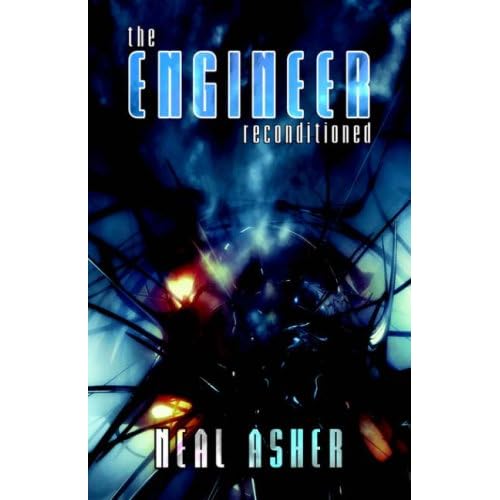
The Engineer

Time for some more Neal Asher. This time short fiction rather than novels. Not too much of a change for him here though.


For starters, many of the stories borrow characters or settings from novels (it could, of course, be the other way around; these are not new stories). But they also more or less continue his interest in fairly grotesque alien biologies. That's no bad thing, but it does mean that his short stories are rather similar to read to his novels.

Still, there are some very enjoyable stories in this collection. The eponymous, The Engineer, is probably the best. While it takes an element of his Polity novels, the extinct aliens known as the Jain, it fashions this into a nice, self-contained novella. Unusually for Asher, it generates a rather sympathetic strand with the resurrection of (apparently) a solitary Jain.

Other stories take in his Spatterjay series, and there's a number of stories that centre around barbarian worlds under the control of a human entity known as the Owner. These were nice because their setting is new to me, although they might become tiresome in a novel.

One aspect of Asher's writing that I both like and dislike is his goading of religious societies. Obviously, I come from the same place on this point, but I find his treatment revels a bit much in being nasty to these ignorant civilisations. While Dawkins is never this rude, I find Asher's works on this subject similar to Dawkins' less tolerant remarks. And, similarly, I suspect that this tone is liable to repel believers rather than engage with them. Hardly what we want.

Anyway, overall an enjoyable collection that sees Asher somewhat stretch his range a bit. Not up with the best of short science fiction, which tends to focus more on ideas than situations, but still good fun.

Sunday, 17 February 2008

Novellas, or long short stories?

In what seems like more of a marketing thing than anything else, two "novellas" of Alastair Reynolds are bundled together in Diamond Dogs, Turquoise Days. A rather unimaginative title for the collection given that it merely incorporates the titles of the two Revelation Space-set novellas. Anyway, they seem just like long short stories to me, but ...


The first novella, Diamond Dogs, follows a group of adventurers brought together under mysterious circumstances by an evasive renegade, Childe. He takes them to an unexplored world, devoid of any interesting features bar an artificial tower. The tower's origins are unknown and it communicates to visitors solely by setting them mathematical puzzles. If they get these correct, they are allowed to proceed further into the tower. If they get them wrong, the tower exacts a punishment. At first the puzzles are straightforward and the punishments mild, but as the team advances through and up the tower, things take a turn for the macabre. Gradually, the team is whittled down until abandoning the quest seems the only sane response, but Childe is never giving up.

This is one of those stories where you're expecting one sort of payoff (an explanation about the tower), but get quite another one (why the team has been assembled). It's not an entirely satisfying trade, and though the novella is constructed well and draws you in, ultimately it is something of a frustrating experience.

The second novella, Turquoise Days, is set on one of the worlds that harbour the so-called Pattern Jugglers, massive seaweed-like colonies that interface, and can change, minds that swim among them. These have been described in several of Reynolds' other novels, but the novella takes in a detailed journey with them. The story involves two sisters who study the Jugglers, and the visit to their world by a team of scientists from a distant colony. When this visit is first announced, several years before it actually arrives, the sisters undertake an ill-advised swim with the Jugglers. Both have swum before, but both have become infected by their contact with the Jugglers. This is often a sign that a person is of particular interest to the Jugglers, and on this occasion one of the sisters, Mina, does not return. Naqi, the other sister, does return and, though nursing grief at the loss of her sister, continues with her studies of the Jugglers, becoming involved in a project to attempt to isolate a sub-colony of the Juggler biomass. Eventually the visitors arrive, but they are not what they first appear to be and instigate chaos on the planet. Threatening the very well-being of the Jugglers, Naqi must again commune with them to attempt to contact her lost sister.

The parameters of this novella are somewhat more straightfoward, and there's no sense of disappointment in how it unfurls. It's actually quite good to finally meet the aliens that one has only heard snippets about in Reynolds novels. Well, "meet" in a special sense. The Jugglers remain mysterious, but their mode of interaction with visitors is now much clearer. I suspect that Reynolds is saving further revelations about them for later works.

Overall, while both novellas are perfectly acceptable stories, they feel like they should be part of a larger collection, and neither is satisfying enough to make this collection worthwhile. A marketing decision indeed. Still, for a primer on the Pattern Jugglers, the collection is worth reading.

Sunday, 27 January 2008

Shorter is better

More Alastair Reynolds. But short stories rather than a novel this time, Galactic North. All set within his Revelation Space universe, but only some with direct connections to existing narratives set there. However, those that aren't directly connected usually shed light on parts of this future history that have hitherto only been hinted at.


Short stories are definitely a strong point for science fiction. They allow the author to explore an interesting idea without the expectation of character development. Several of the stories here go one step further in a way by allowing the author to dispense even further with characterisation since several of the characters are known to readers already (though this does create potentially interesting trade-offs between new and familiar readers). Anyway, the stories here represent excellent examples of the short story form while additionally being satisfying for readers already familiar with Reynolds' Revelation Space.

The first two stories deal with the character Nevil Clavain and his "defection" to the Conjoiner faction of humanity. The stories slot nicely into gaps in Reynolds' novels and flesh out relationships between various characters. They're also good stories in their own right, particularly the second one which approximates a good whodunnit on an alien world. The final story in the collection, Galactic North, initially takes place during the Revelation Space novels but, through time dilation, takes in a much broader sweep of history. It reveals the long term outcome of the conflict between humanity, the Inhibitors and the human-made Greenfly. Possibly a mistake on Reynolds' part to lay out in some detail what might have made for a good novel down the line. Still, he's certainly left himself wriggle room, and I'm sure he's smart enough to milk his future history some more.

Other stories in the collection take the form of a love story set in Revelation Space, Weather; a spy story dealing with modified humans used as slaves in the oceans of Europa, A Spy In Europa; the undoing of a collector of rare and exotic animals, Grafenwalder's Bestiary; and an adventure aboard a ghost ship with a conscience, Nightingale.

For readers unfamiliar with Revelation Space, the stories will likely be particularly exciting since they draw, teasingly, on a rich and carefully thought-through history and geography. However, there's a lot here for readers, such as myself, who are more familiar with this universe. Being short, and not forced to create a grand narrative, they also avoid some of the problems of fatigue that Reynolds' novels suffer to a degree from (Pushing Ice being a notable exception). Avoiding detailed characterisation also works to Reynolds' advantage here (much as it has done for other science fiction authors like Arthur C. Clarke and Isaac Asimov).

Anyway, I'll certainly be keeping an eye out for further volumes like this one by Reynolds.