Showing posts with label publication. Show all posts

Friday, 4 March 2011

Ice-edge blooms

Oooh - fleeting fame on our corporate website's front page! Actually, the fame really belongs to our student, Mahé, whose enthusiasm more than 18 months after leaving us finally got us over the finish line. In spite of the best efforts of GRL to misunderstand basic English. In passing, as with all such press releases, the "quotes" attributed to me are near-lifts from the paper by our press officer. I did not say these things ...

Thursday, 18 February 2010

Front Page Pipes

Courtesy of hard work on the part of my old boss, another paper on ocean pipes has now been published, and its made our institute's front page. My contribution this time extended largely to comments and some discussion, rather than simulation and number-crunching.

I've alluded to this paper before, largely because its results are much more interesting than those that I found. In part, this stems from the use of a more detailed physical model that includes a simplified atmosphere which allows feedbacks that my ocean-only simulation just had to gloss over. The model (UVic for those who care) is also lower resolution than OCCAM, so longer simulations were possible.

Anyway, what happened? In the ocean, the pipes were still largely inefficient at sequestering carbon, although here they were allowed to cleverly alter their lengths here to maximise their use of so-called preformed nutrients (i.e. those that come with no associated carbon). Interestingly, the pipes did slightly counter the slowdown of the THC caused by global warming in the simulation (although in doing so they also brought up more CO2-rich seawater).

However, the real action was on the land. Here, cooler temperatures, driven by the cooling effect of the ocean pipes, led to a drop in the respiration of the land biota (TRIFFID for those who care). In fact, the changes on land were responsible for about 80% of the total sequestration of carbon in the simulation. Not what the proposers of ocean pipes had in mind, and not something that'd be easily verified in the real world to gain carbon credits.

Another interesting result was that switching off the ocean pipes leads to a (slightly) warmer Earth than would happen in the no-pipes control Earth. So, if the pipes are running but start to have some unforeseen negative effect, turning them off comes with an additional climate change penalty. Essentially, you'd have been better off not using them at all. Again, not what the proposers of ocean pipes had in mind.

While there are still some questions that the ocean pipes throw up, this seems another knock to them. Still, the geoengineers are rarely put off by such hurdles ...


P.S. The press release associated with this paper has been cut-and-pasted into (at least) three external blogs (here, here and here). This seems a pretty armchair approach to adding content to your web presence. Perhaps Strange News could bump up its posting-rate this way ...

Thursday, 27 August 2009

Blogosphere fame

How exciting - our pipes paper has been picked up by the online technology blog/journal Ars Technica under the (admittedly obvious) banner of "Latest carbon sequestration idea could be another pipe dream". And they've done a good job of it as well, possibly on account of not having spoken to me about it. Anyway, needless to say, I'm really chuffed.

Friday, 21 August 2009

Pipes published

Finally, after two inexplicably long review-revision-resubmission cycles, our paper on the efficacy (or not) of ocean pipes is finally formally published. I say "inexplicably" because neither review cycle turned up much in the way of major problems with the paper. Reading between the lines, I suspect that difficulties getting reviewers, and getting them to submit reviews on time, has been the main source for our frustrations.

Anyway, what does the paper say? Essentially it explores what the consequences would be if you "plumbed-in" the whole of the ocean (well, wherever it's > 1000 m in depth) with pipes that transfer seawater from its interior to the surface (cf. the figure to the left). The idea behind such pipes is that they would channel high concentrations of deep nutrients to surface waters, where they can fuel the growth of phytoplankton, increase the uptake of CO2, and thus potentially decrease climate change.

In our work we did quite short simulations of the recent past (1995-2004) in which we explored what happened to primary production, export production and the air-sea flux of CO2 when pipes of three lengths (200, 500 and 1000 m) were switched on, relative to a control simulation for the same period.

What we found was that the pipes did the business in terms of primary and export production, with significant increases in both (although we did assume that the pipes were moving a comparable amount of water to that naturally translocated by ocean circulation). However, we also found that, by contrast, the air-sea flux of CO2 was only marginally increased by the pipes. In part, this was because we just ran the pipes everywhere without any consideration as to whether they would bring up more DIC than they'd be able to sequester, and the consequences of this can be seen in the figure below. The big blue areas in the lower row are places where, because of the deep carbon:nutrient ratios, the pipes channel more CO2 to the surface than can be drawn down by the transported nutrients.


However, even factoring out areas where the ocean was turned from a sink of CO2 into a source, we found that for every 100 moles of extra carbon fixed by phytoplankton, there'd be only 2-3 moles extra drawn from the atmosphere. And then, by doing a big back-of-the-envelope calculation, we estimated, based on our results, that to increase the ocean's uptake of CO2 by 50%, we'd need to deploy around 800 million pipes in the oligotrophic tropical ocean. Of course, there are a lot of caveats in our paper that cover what's wrong with our model, our simulation and our assumptions, but we tend to think that our sums are about right to first order (but then we would!).

In the paper, we completely avoided tackling what the "side effects" of the pipes could be (although one of my co-authors finds some really interesting ones in a separate study), just so we could focus on the basic: "do the pipes work?". Taking a somewhat ethical stance, one thing that they would do would be to replace the oligotrophic "desert" communities of the subtropical gyres into the more mesotrophic communities typical of upwelling areas. As a biologist, I don't like the idea of decreasing biodiversity just so that we can avoid the unwanted consequences of our actions, but at the same time I think it's good to know how efficient this sort of geoengineering scheme is just in case we do need a drastic solution to climate change down the line. Though hopefully we'll see sense before then ...

Monday, 18 May 2009

No such thing as free will?

In this week's Nature there's an article entitled "Is free will an illusion?" by a German biologist, Martin Heisenberg. The article makes the oft-repeated assertion that stochastic noise from quantum mechanical processes may be the key to free will in animals such as ourselves. Since it's transparently obvious to me that randomness is no better than pure determinism when it comes to explaining free will (assuming such a thing exists), I fired off a response to Nature. While my suggestion is entirely mechanism-free (I've got nothing on this front), I do think that the appearance our personal reality presents to us is at least suspicious, and hints at some degree of freedom in our actions. I don't entirely buy this myself, principally because I really can't think of anything approaching a plausible mechanism, but I have thought about this on and off for a long time without committing my thoughts to paper or blog. Anyway, seeing as they're so capricious, it's always worth a dabble with Nature, but since the odds of publication are vanishing I thought I may as well reproduce what I submitted here ...

Martin Heisenberg (Nature 459, 164-165)1 makes a number of intriguing points concerning the reality (or illusion) of free will in humans and other animals. However, to my mind (free or otherwise), his review overplays randomness as a route out of slavish determinism. Stochastic noise, quantum mechanical or otherwise, hardly seems the path to a triumphant restoration of self-determination. Instead, while it counts more as a hint or indication rather than hard empirical evidence of an underlying mechanism, the appearance of free will is telling from an evolutionary perspective. Assuming that free will is annulled (and I include Heisenberg’s stochasticism in this class), a biologist might well question why natural selection has gone to the bother of giving organisms the perception that they are ploughing their own furrow. If there is no possibility of any consequences of this perception feeding back to guide events, why has selection acted at all? Furthermore, why has selection furnished the minds of animals like ourselves with all sorts of carrots (pleasure and love) and sticks (fear and pain) to guide us towards goals that service the genes that build us? Heisenberg is right to question overeager neurodeterminists, but he may have chosen (or not, of course) the wrong route for doing so. One question for those who deny a seemingly obvious feature of personal reality is why, given that we are only scratching the surface of neurobiology, that we have yet to determine which flavour of quantum reality is the right one, and that the universe contains as-yet inexplicable entities such as dark matter and dark energy, why we can so quickly preclude free will.

1 Heisenberg, M. (2009). Is free will an illusion? Nature 459, 164-165.
Before I fired this off, I circulated it to a few of my friends at NOCS. While they generally liked it (or perhaps were just very polite), none of them bought it. What's more, it turns out that two of them, APM and BS, physicists to a man, very much subscribe to the "free will as illusion" school of thought. Not entirely to my surprise since there appears to be nothing by way of a mechanism (let alone a plausible mechanism) for material to somehow be both self-aware and capable of channelling this to affect reality. On this I'd completely agree with them, but I do still have a problem swallowing the idea that we're not free (to a degree) on, well, wishful-thinking grounds. Regardless of the subjective fact that I feel free (cf. my articulations in the submitted correspondence), I just don't like the idea that I might not be, and that I am living in a world where it's not possible. APM and BS seem OK with this, but it's not for me. Partly because agreeing with the idea seems somewhat tautological: what, simply, does it mean for me to agree with the proposition that I have no free will, when agreement itself seems to undercut the very notion?

Wednesday, 4 February 2009

Snow smile

At APM's suggestion, I forwarded one of my snowy photographs to the Guardian ...

DSCF3898

They've been producing an interactive country-wide map of snowy photographs sent in by their readers. Anyway, presumably to offset a deficit of photographs outside of London, they used mine ...

Guardian snow pictures

While the road sign made me smile, I doubt that many of the motorists (slowly) passing it were quite so amused.

Monday, 5 January 2009

A "leading climate scientist" speaks

Further to the ocean geoengineering review that I was involved with last year, just before Christmas all of the authors of that paper were invited to take part in a survey and to comment on the topic of geoengineering by The Independent. I didn't hear a peep back from the newspaper, but they published an article on the results of the survey ...
From the numbers, it sounds like I was in the majority: that I thought a "Plan B" was necessary; and that I was less optimistic about the Earth's climate coping with anthropogenic change. As per usual, the survey's questions were to be answered YES/NO when a more nuanced response would have been better. Still, nuance isn't usually very helpful when communicating science, so perhaps it's best to be forced one way or the other.

Aside from the main article, The Independent also published a selection of the comments it got back from "leading climate scientists", and somehow I made the grade. Although I was inexplicably attributed to a different research institute on a different continent ...

Tuesday, 4 November 2008

Off to Kiel

Spent Sunday (2nd) to Tuesday (4th) this week in Germany visiting the PI on my last contract. We've got a couple (ha!) of things to sort out on two papers we're preparing, and since he's been AWOL from NOCS for more than 2 years, a bit of face time was in order.

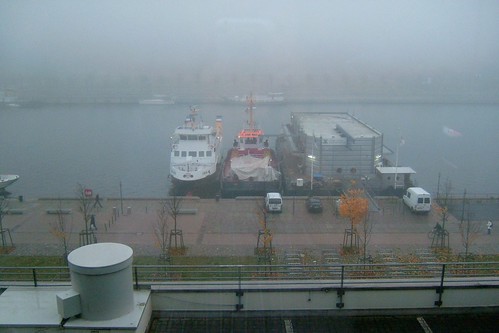
Anyway, my trip took me to IFM-GEOMAR ... ... in foggy Kiel ...
Although this was mostly a work trip, I did get a chance to wander around the city a bit. It's of comparable size to Southampton and shares many other features, like being a working port and having the crap bombed out of it during the Second World War. The latter means that a lot of it is relatively new, but there's still a lot of interesting stuff to see. Here's one of several sculptures I came across ...
There's a more complete set of pictures up on Flickr.

Thursday, 18 October 2007

A.N. Other Nature "publication"

A second post today to note the publication of a letter (in the conventional sense) in the science weekly, Nature. The letter (well, "correspondence") deals with James Lovelock's recent suggestion that "ocean pipes" should be used to funnel nutrients from deep water up to the surface where phytoplankton (finally - plankton make it into the blog!) can consume them and, in doing so, draw anthropogenic CO2 from the atmosphere. It sounds great, until one remembers that it's not just nutrients that come up the pipe.

Anyway, by a rather modest amount of text editing and discussion, I managed to wangle myself onto the author list (JGS, DIR and me), making this my second appearance in Nature this year (bizarrely, my previous appearance spawned two further mini-appearances including an [electronically] published photograph). I might even appear a proper scientist to the untrained eye. Though "correspondence" really doesn't count for much.

Aside from this letter, I'm doing some more work in the background with OCCAM to explore Lovelock's scheme, but it looks a total no-hoper (though slightly less of a no-hoper since I found an error in the underlying assumptions of earlier simulations that I'd done). This work may yet turn into something publishable that'll hopefully put paid to this sort of misguided scheme. Of course, none of this has stopped someone in the US from trying to crank money out of these ocean pipes. Still, their hearts are probably in the right place (with their wallets not far behind).