Showing posts with label cinema. Show all posts

Sunday, 25 August 2024

Ranking the Alien

With the release of a new addition to the Alien canon, Alien: Romulus, I've noticed a number of people have made rankings of the films. Off the bat, I'm not entirely sure how I'd do this myself, but for an obsessive like myself, it seems a reasonable idea. So, here goes (in something of a chronlogical order).

Only the first two films are properly successful, and arguably in separate subgenres, and I'd not want to split them to award gold and silver.

Alien 3 remains an outlier for me. I've only seen it once - back in Los Angeles in 1992 on its original release - and disliked it so much then that I've never gone back. But I think it's probably ripe for a revision - on paper it's not ridiculous. I think the fact that it started from the position of ripping-up Aliens put it in my bad books from the off, but I don't otherwise have any major objections to where it goes.

Alien Resurrection, by contrast, got off on the wrong foot on paper - i.e. a pure exercise in extending the franchise at any cost - but ultimately doesn't do too bad in the end with its theme of motherhood. And, as a biologist, I always liked the way that its scientists were up-front in noticing the problem with Ripley's memories there, and honest in not having an answer for this.

12 years on from my original review, Prometheus is still massively problematic for me. On top of its lame retreading or out-and-out stupidity, it tries to completely rewrite the Alien as a mere weapon in a narrow humanity-centred narrative rather than an example of the nasty surprises that a vast universe could have in store for us. That it then does this in a cack-handed way with no consistency in logic or styling (something Romulus gets very right) just compounds the problem.

Alien: Covenant - as I checked yesterday - gets off to a similarly shitty start, but at least is inventively nasty, so has the edge over Prometheus for me. Although the flute scene is still pretty unforgivable.

Flash-forward to today, Alien: Romulus gets things back on track, particularly with its strong aesthetic callback to Alien / Aliens. A strong heroine, a nicely ambiguous android character (who I really liked), and some great visuals definitely help. However, while its plot is not ridiculous in its general logic, assimilating Prometheus’s black goo bullshit is a major misstep. It could have just stuck with Alien’s presentation of the company as a malign force that's ignorant about the Alien and complacent in handling it. But instead it ret-conns in Prometheus’ stupid themes and makes the company's technical prowess much greater than it should be if you take the first two films (the only really good films) at face value. In fact, by blending-in the black goo as something that company scientists have worked on to the extent of including it in a serum, the film is arguably incoherent - if you got this far with your science, why then have facehuggers in cold storage? But, Romulus, for all its flaws, is still better than Prometheus and Covenant.

Although, to be kind to both of them, both are still so much better than the lowest-common-denominator of the Alien vs. Predator films. Those take what's not a totally terrible idea - as the first comic clearly demonstrated - and make it terrible. Especially Requiem. For detractors, like myself, of the late Ridley Scott films, who see those as largely lazy cash-ins of what's easily one of his best films, the Alien vs. Predator films underscore what truly constitutes creatively bankrupt cashing-in.

Finally, it'd be very remiss not to mention Alien: Isolation here. While "only a videogame", it's a simply first-class example of its form, and makes a number of spot-on choices in how it deals with the canon. First, and most visibly, it leans strongly into the aesthetics of Alien, much like Romulus (which may be where the latter got the idea to do this from). But it also makes excellent use of androids, quite rightly frames capitalism - via the malevolent Company - as an underpinning enemy, is true to the "last person standing" narrative of the original films, and generally doesn't put a foot wrong. Most significantly, though this more of is a gaming thing, it makes an absolutely exceptional enemy out of a single Alien, with a great look and insanely good - and terrifying - artificial intelligence. And, as a hater of all things Prometheus, I can't not mention that it does precisely the right thing with all of that black goo bullshit ... and completely ignores it.

Approximating the above, we have something like ...

  1. Alien (1979), Aliens (1986)
  2. Alien Resurrection (1997)
  3. Alien 3 (1992)
  4. Alien: Romulus (2024)
  5. Alien: Covenant (2017)
  6. Prometheus (2012)
  7. Alien vs. Predator (2004)
  8. Alien vs. Predator: Requiem (2007)

Arguably, the linear scaling of this ranking is too kind to everything after Alien: Romulus.

Sunday, 19 January 2020

Forged Apology

Can You Ever Forgive Me?, Lee Israel

Now, as its cover notes, "A Major Motion Picture", this slim memoir serves as an excellent - and delightfully acid - complement to the fine work of Melissa McCarthy and Richard E. Grant.

For those unfamiliar with the tale, it's a memoir by the biographer Lee Israel of her foray into the forgery of celebrity correspondence. At a low financial ebb after a disastrously rushed biography of Estée Lauder, Israel almost accidentally blunders into this secondary career. Initially through the selling of embellished letters, she ultimately creates them wholesale, for writers including Noel Coward and Dorothy Parker (after whom the book draws its title). With some attention to detail, including period typewriters plus solid impersonation, as well as the insertion of wicked details, her work becomes a money-spinner within the dubious world of celebrity memorabilia. Inevitably, after the rise comes the fall, but not before a highly enjoyable reveal of the tricks of the trade. Israel is absolutely unrepentant in her telling, which makes for a gleeful read, though one that lightly glosses over the straightened circumstances that led her to crime in the first place.

Viewers of the film might be a little annoyed to discover its changes to certain details of Israel's story (most obviously around a feline character), but I think it stands up well despite these minor tweaks. And I'd simply never have read and enjoyed this delicious takedown of the lucrative celebrity memorabilia market / minor meditation on "getting into character" if I hadn't seen the excellent film adaptation first.

Saturday, 22 July 2017

Success and "failure" of Arrival

We finally caught the increasingly non-recent science fiction "thinker" (and 2017 Oscar nominee) Arrival. While I'd whole-heartedly recommend it for fans of the genre, nit-picker that I am, I have a few reservations as well. So this is less a review, more a niggle. Needless to say, spoilers ahead for those who've not made the journey so far.

First, what it gets right. Build-up is great, with only fleeting glimpses of the alien spaceships until the big reveal in a beautiful, cloud-wreathed valley in Montana. Their unworldliness begins with their design, as largely featureless geometric shapes, and is nicely underscored by the short distance they effortlessly "hover" above the Earth's surface. The aliens themselves are also handled well, if a little too much like squid, both in general appearance and in their use of extruded "ink". Making their audio extraneous for communication (an early misstep by their interrogators), and their language written yet initially indecipherable as communication works really well. And I liked what ultimately came to be their "gift" and why they made it, although it's mentioned so fleetingly that many may miss it.

What mostly-works but slightly-doesn't is that the film is one of those that makes more sense when you reflect on it afterwards. That's a good thing in my book, but I can well imagine that most people will leave this film utterly perplexed by what they've just seen. It's all there to make sense of it, but it's presented rather subtly at times, and often in an order that requires reflection to make sense of. For instance, a central conceit of the film (and a very clever one) is that Sapir-Whorf is true at a deep and fundamental level, but it's quite gently introduced to the viewer at a point where its relevance is opaque. And the consequence of this is illustrated by out-of-order glimpses of a child in what appear at first to be past memories, but which turn out latterly to be something else. However, the viewer is slightly misled by the presentation of some of this material upfront, seemingly as backstory, when it would arguably make more sense to introduce it latterly (narratively, perhaps, but maybe not emotionally).

My only "proper" reservation is, as ever, time travel - technically, I guess it's not exactly time travel, but, well, ... It's nowhere near as blunt as Interstellar (a film I forgave on a second viewing), but messing with the space-time continuum is a sure-fire way of getting my hackles raised. Especially here, where the film has its cake and eats it by allowing agency and then kind-of suggesting fatalism. However, it is still one of the cleverest uses of time-bending in film, so despite my hackles, I'm much more forgiving here.

Notwithstanding the foregoing, it really is one of the smartest science fiction films in recent years (or decades, even), presenting the sort of deep ideas that, while not uncommon in literary science fiction, rarely make it off the page. It does all of this gently and subtly without any of the distracting pace and action routinely misused in conventional "science fiction" films. And it does it while blending a human story of love and loss in with the central MacGuffin. Two thumbs up for sure.


P.S. I should just add that, with their relationship with time, the aliens reminded me of my favourite aliens, the Invaders of John Varley's novels. Although the Invaders still win because of their disinterest / disdain in humanity.

Wednesday, 19 February 2014

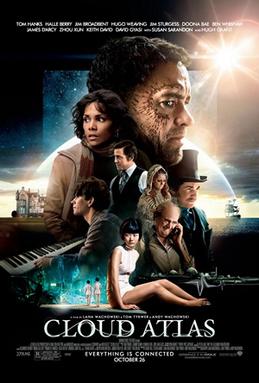
Cloud Atlas

It's common for successful novels to be deemed "unfilmable". Typically, this covers those novels where the "action" largely takes place within the mind of a character, or where a novel's strength is drawn from the voice of a colourful narrator. But the novel Cloud Atlas by the British novelist David Mitchell (no, not that one) presents a different class of problem.

Organised as a disparate sequence of six stories, the novel runs from the 19th century Pacific through to a distant, post-apocalyptic Hawaii. This baroque structure is then further complicated by the ingenious splitting of each story, bar the final one, into two parts hinged on a cliffhanger. And then it's rounded off by having each story take a completely different setting and form, including a austere diary, a pulp thriller, a retirement home-set farce, and a future corporate dystopia. Strangest of all, it somehow hangs together, in spite of the only formal connections being inconsequential cross-references and the possession by certain characters of a comet-shaped birthmark. What it all means is very much left to the reader, but it certainly left me with a pleasing, if passing, sense of the connections between people.

Given the preceding, not the most obvious novel to film, and I was certainly surprised to hear that it was even being considered for translation to the screen. Even more so when I heard that no less than the Wachowskis were helming it. Known best for their rather bombastic Matrix trilogy (one genuinely excellent film, two self-absorbed travesties), they certainly didn't strike me as even on the radar for adapting such a work.

All of which goes to show how one (well, this one) can so easily prejudge, and misjudge, things. The resulting film, while still far from unqualified recommendation, actually hangs together very well, and is probably about as good a version of the book as it is possible to make. One early concern that I had was that the innovative structure of the book was ditched in favour of a narrative that jumped back and forth between the component tales pretty willy-nilly. But since the stories contain connections in content, themes and pacing this actually works pretty well. For instance, the novel's cliffhangers that divide each story into two halves, are interlocked in the film in a way that seems surprisingly natural.

It's not all plain sailing, however. Some of the texture of the novel, in particular the different forms of the original stories (diary vs. letters vs. pulp), gets lost along the way, though that's more a limitation of film in general than this film in particular. The story that arguably loses out most here is the final, post-apocalyptic one, where the voice - and perspective - of the protagonist, Zachry, is pretty pivotal to the arc of the story, but this largely has to be covered by Tom Hanks' adopting an intermittently incoherent dialect for the film. And the film makers have definitely made a few changes that make the conclusions of the stories veer a little more into heart-warming territory. Nothing too serious, mind, but it did serve to make the resolution of the film a little more pat.

Notwithstanding my earlier praise, however, I'm not sure what someone unfamiliar with the original book might make of it all. It is still a pretty confusing film, one that may be extremely difficult to follow except by multiple viewings. So though I left as a qualified fan, the film's reputation as a fiasco is easy to understand. On the one hand, a film should stand or fall based on whether it's accessible, but on the other hand, surely there's a place for films that require a little more dedication from viewers? Of course, if that dedication requires the pre-consumption of the source novel, perhaps not. So, overall, though teetering on the brink of disaster more-or-less throughout its running time, I'd still label it a "secret success". But one might need to read that novel first ...

Saturday, 1 February 2014

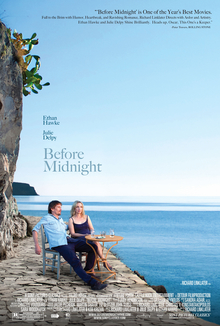
Before Midnight

Sequel to 2004's sequel to 1995's original [*], Before Midnight runs - at least on paper - the risk of all threequels, of wasting the hard-won goodwill and critical spoils of its illustrious predecessors. Thankfully, it doesn't, and it caps off the trilogy (... so far - I won't be surprised if another appears in 2022) extremely satisfyingly. Not, however, for those uncharmed by said ancestors - this will be the same old chatty bore-fest that you suffered through twice already. So give it a skip if you found Céline and Jesse intolerable the last few times around the block.

That said, Before Midnight is much more of a risk than Before Sunset. That film had "only" to re-establish a romance that the audience probably all wanted to see return. Here, we're another 9 years down the line and, unlike the preceding 9 year gap, Jesse and Céline have spent the entire time together. So making their extended romantic interlude interesting for the audience isn't a given. Simply making the film another enjoyably rambling conversation between two people that slowly edges them towards hooking up at the end wouldn't work, and the film's writers - who include its two stars - don't take this path.

To be fair, there is plenty of enjoyably rambling conversation [**], but it's used more sparingly, and positioned between scenes in which the conversation between Céline and Jesse is much more edgy than before. And the conversation doesn't stop at edgy, tipping over into anguish as the fractures in their relationship are first exposed and then explored. As such, it's not an easy watch like its predecessors, but in allowing the stresses and strains of long-term relationships (the demands of children, fading attraction) to be painted in realistically, it's much more grown-up. Satisfyingly so, ultimately.

As such, and much like that towering giant of successful threequels before it, Toy Story 3, Before Midnight shows other films how to do it. Not just a simple, crowd-pleasing retread of its predecessors, but one which retains their charms but finishes them off with a recognition of deeper waters beyond easy film screen romance. Whew - I'm totally glad they pulled it off.


[*] Not forgetting the brief appearance of Jesse and Céline in the also-excellent Waking Life.

[**] "Enjoyable", that is, if you've already bought into the modus operandi of the films of extended, playful and semi-philosophical banter between the leads.


In passing, I can't resist mentioning Jesse's outline of his planned new novel to his holiday friends. In just a few minutes, the film sketches out what could be a great little book (or, arguably, film), based around characters who're all intriguingly cognitively impaired. I'd read it already.

Monday, 29 October 2012

A child's-eye view of apocalypse

It's safe to say that Beasts of the Southern Wild is a pretty unique film - at the very least in terms of what usually appears in cinemas our way. It's part family drama, part climate change fable and part meditation on community. But its principle strength is viewing all these various facets from the imaginatively-skewed perspective of a child living through them. The child, Hushpuppy, has an amphibious and anarchic childhood in the "Bathtub", an inundated area of swampland at the very edge of (a generally unseen) civilisation. Already largely underwater - hence its name - periodic storms threaten to finish the job, and Hushpuppy's tumultuous, knockabout life with her father is further imperilled by him gradually succumbing to illness. But in Hushpuppy's mind, her world is also threatened by the mysterious, ice-age aurochs that she's heard about at school, and infused with the mystery of her long-departed mother.

The film reviewer's shorthand for a film like this is probably something like "lyrical", but "magical" seems a popular one-word summary judging from the reviews (and posters; see above!) that I've come across. And they're right. It's a thoroughly enjoyable and affecting tale made wholly memorable by the performances of both central actors, particularly the child playing Hushpuppy. She's simply fantastic. And it does a brilliant job of playing the adult world's trouble and strife as the backdrop to the child's world of exploration and imagination. One touch I particularly liked was that the aurochs, though actually wild cattle in reality (now sadly extinct), are imagined by Hushpuppy (and visualised in the film) as something more akin to giant-sized boars because of her family's "pet" boar.

And, of course, any film that attempts to dramatise climate change - especially in a non-preachy way that's doesn't frighten the horses - gets the big thumbs up from me. Yes, it's too soft on the Bathtub's benign anarchy, and a little hard on the heavy-handed efforts of the authorities to help its residents, but it's a pretty honest and fresh presentation of a not unlikely future. A future that, as Hurricane Sandy bears down on the Eastern Seaboard, doesn't seem quite as far off anymore.

Grade: A- (high +2 on the Leeper Scale)

Monday, 4 June 2012

Prometheus: the Greek god of pants?

33 years ago, Ridley Scott released Alien. The following two decades saw three sequels - one superlative, two not so much - all independent of Scott. But the film series still managed to carve itself a place in cinema history, and is the touchstone for science fiction / horror crossover. Now Scott has returned to the wellspring, bringing with him understandably high expectations from the fans who've followed the series over four decades (that'll be me then). Can the "Master" bring his winning touch back to the franchise and rejuvenate it for past and present generations of cinema-goers?

The one word answer is: no. The slightly longer answer is: abso-fucking-lutely not - what the hell was he thinking with this gibberish? The film, Prometheus, was always going to be something of a high-wire act - a long-established film series with a legion of fans and a mountain of expectation - but it's still pretty staggering just how misplaced Scott's return is. In constructing this folly, he's certainly brought his full director-as-god weight down on branding the franchise as his - for good or ill - and I think that he's possibly even managed to poison it for good.


Spoilers ahead - not that anything I say could possibly spoil this!


To be fair, the film does have a smattering of good points. Much to its credit, it at least tries to something different. The film series has steadily become swamped in its own history and in particular themes and tropes, and while Prometheus apes some of these, it certainly charts some new (if wholly misconstrued) directions. Given that we live in an era of weapons of mass destruction (most likely phantom ones), I did actually quite like its presentation of the Alien as a biotechnological WMD. For just a moment there it felt like something interesting was being said. Just a moment though. The film even manages to steer surprisingly wide of the actual Alien part of the franchise. Of course, it can't resist a closing nod to the fanboys, but it doesn't rely on the familiar figure of the Alien for almost its whole length. And, finally, the film almost does something interesting and novel with its (requisite) android character. David is quite different from the corporate traitor Ash, the ambiguous-but-good Bishop and the conflicted Call. His kill-your-maker sentiments are much more interesting than the film gives them credit for, and it ultimately leaves exploration of them at skin deep level - Scott showing his hand as a hack who simply can't spot good subplots.

Documenting the bad points of Prometheus is hampered from the get-go: where to start? There are just so many missteps, unfinished thoughts and broken promises. Leaving aside the plot stupidities and holes - which I will touch on shortly - top of the heap is that the film makes the exact same mistake concerning its characters that the franchise's lesser sequels - Alien 3 and Alien Resurrection - make. Namely, a suite of two-dimensional cardboard cut-outs given about two lines apiece to establish themselves before characterisation is firmly transferred to the back-burner. And where character in the film is actually suggested by more than a thin stereotype - basically David and (Ripley stand-in) Elizabeth Shaw - Scott still manages to sabotage things. David's hinted plot arc is largely aborted, while Shaw is an unbelievable and unsympathetic scientist that Scott tries to bludgeon into human shape by giving her a dead dad and an inability to have children (until ... well, until the film needs an unconvincing jolt of body-horror). Given that Scott's original film managed to convey (as much as a science fiction film can) a suite of intellectually and emotionally different characters, one is left with the feeling that this must have all been in the script then, since there's nothing on show here to suggest that he understood what he was doing back in 1979.

Regarding specific stupid points, the most ridiculous - and telling - for me was how the film dispatches Vickers. A large narrow object is collapsing towards you - do you run along the direction of collapse, or turn 90 degrees and run away from it? Is this seriously the best that the writers could do? Actually, that's pretty rhetorical - it seems an entirely fitting response from the writers of this film. Another awful misstep was an Alien birth (by caesarian!) that's a shameless gorefest (and from which the character recovers remarkably quickly). It makes even less sense, both dramatically and scientifically, than that in Alien Resurrection - at least that served the theme of motherhood pretty well, and nicely brought the franchise around full circle. And while making things superficially interesting, Prometheus' alterations to the Alien lifecycle (a "crime" for which Alien 3 was attacked at the time) arguably make it completely incoherent. Gone are the classic anthropomorphic horrors, now replaced by more plastic - but much less iconic - rejects from The Thing. At times, it's almost as if Scott wants to reinvent the whole series again from scratch, dashing even his own contribution from 33 years ago as he goes.

There are also gaping credibility issues like the space jockeys having a "perfect match" with human DNA but looking more like marble gods (Titans, perhaps?) than humans - plus the convenient failure by the writers to remember that humans have a whole slew of inconveniently closely related animal cousins back on Earth. The film also offers only the scantiest of scant hints about what the space jockeys were up to, including what turns out to be a pretty inexplicable opening sequence that seems portentous but winds up pointless. Given that we have a living, breathing space jockey at one point, and given that the film isn't in the least reluctant to spoon-feed the audience exposition from the lips of its characters, this could have been easily rectified. The film makers might well claim that leaving viewers confused preserves some mystery, but I suspect that it instead preserves the illusion that the writers had the first clue what they were doing - this is all straight Chariots of the Gods stuff.

Finally, I can't let pass Prometheus' shameless teeing up of a sequel at the end. Its precursor films always ended fairly definitively, usually accompanied by a sigh of relief from the surviving characters. Sequels weren't precluded (except by Alien 3 - and look how that worked out), but a roadmap to them wasn't sketched out before the credits roll. Here, the film ends with characters heading off with a definite purpose (albeit a misguided one), patently angling for a future cash-injection. Scott has come a long way since the cold and bleak ending of Alien.

Overall, Prometheus further cements my long-standing opinion of Scott as a hack who got lucky. Good scripts occasionally drift over his desk, and he has done a good job in the past of turning some of these into perfectly creditable films (although, as I've noted before, sometimes only with the first cut). This film also cements my annoyance with the equating of the success of a film as a piece of art (high-brow or otherwise) with the director rather than with the writer. To wit, Prometheus - it's got Ridley Scott at the helm, who cares about the writer - what could possibly go wrong? Again and again, all credit for a successful film is delivered with great fanfare at the door of its director, with nary a scrap left for the creator that first breathed life into it. Yes, it's still the case that a good director is needed to turn a great script into a great film, but character and plot are gifts from the writer that a director gives form and shape to. Given this film, as well as some of his earlier efforts, Scott would appear not to know a good script if it jumped out of someone's chest and bit him.

I might be being too harsh here. I might soften in my views as time passes and focus on the places where the film slightly lives up to expectations. But I hope not. It's a wretched film really - largely because of its conception rather than execution. Unfortunately, it will make money, most likely a lot of money, so I fear for another return - but it will be difficult to clear up the mess left by this film regardless of how good the script is. Much as the space jockeys were hoping to do in the film's mythology, perhaps Scott has finally "salted the Earth" on the franchise?


A few curious points also occurred to me about the film.
  • The aged Weyland bears more than a passing resemblance, physically and ethically, to Rupert Murdoch. Coincidence?
  • While Ripley knows to do the right thing in Alien (don't let Kane back onboard the Nostromo) and survives, Vickers does the same but dies.
  • In Alien the space jockey ship carried a warning about its contents, but here it's strongly implied (though we don't know for sure because they never get to tell us) that the space jockeys were up to no good. Which is it Ridley?
  • Much as with other science fiction prequels, the technology on display in this film seems much more advanced (touchscreens, 3D holograms) than that in the earlier films (CRTs, big buttons) that purport to be occurring later. Haven't the continuity supervisors spotted this yet?

Monday, 7 May 2012

Dear Douglas and Whit ...

At the moment, my reading material is Player One by lapsed-favourite Douglas Coupland. Today, I saw the film Damsels in Distress by the inveterately infrequent director Whit Stillman. I've loved the work of both in the past, particularly Coupland's Microserfs and Stillman's Barcelona. And while both of these two recent titles by Coupland and Stillman still have plenty to like about them, both also seems to suffer in comparison to earlier work in quite a similar way. Basically, they seem to have forgotten all about plot.

Not plot in terms of a densely but carefully constructed narrative, nor plot in terms of an enjoyable pot-boiler, but plot in terms of something that does more than intersect with reality at a tangent. In previous works, both Coupland and Stillman coupled their (respectively) philosophical and whimsical sides to narratives that bore more than a fantasy relationship with reality. But here, while both have pleasingly held true to the styles and tropes that first got me hooked, both have abandoned any pretence that the worlds they build and populate have more than a passing correlation with our own.

True, that's laying it on a bit thick, but what was wrong with sticking to situations and characters that touched base with the real at least once in a while?

Sunday, 26 February 2012

Oscars 2012

I've not seen enough of this year's Best Picture nominees to make a good stab at the winner - or my preferred winner - this time around. Unlike last year, where we'd actually seen 7/10 of the nominees by the time the awards rolled round (and we've now seen 9/10), this year we've struck out at only 3/9. In part because some haven't had much of an opening in UK cinemas, and in part because quite a few aren't all that appealing.

That said, none of the unseen 6/9 are really jumping out to be seen to my mind, so I'm going to call it anyway based on the three that we have seen. The Descendants, while a perfectly enjoyable film, just doesn't cut it for me. Midnight in Paris, while easily Woody Allen's most enjoyable film in a while, is just too slight a film to win. But The Artist has much more to recommend it. True, it's largely a light comedy that flatters Hollywood, but it does it so cleverly, so affectionately and with such wit that it's a shoo-in for me (as already noted).

I guess I'll find out how prescient I've been when the radio clicks on first thing tomorrow morning.

Friday, 17 February 2012

Rom-Zom-Com

Another entry in the unsurprisingly under-populated zom-rom-com genre, Zombieland. This time the action takes place in a US devastated by mad cow disease, rechristened by the narrator as Zombieland. Essentially it's a comedic - if post-apocalyptic - road-trip that plays the zombie holocaust as a backdrop for four characters doing whatever they like. It doesn't manage to quite sustain the comedy as well as Shawn of the Dead, but its well-played by its leads, particularly Woody Harrelson, and it doesn't outstay its welcome. The one part I really didn't warm to, but which I've seen flagged up as brilliant in reviews, is the cameo of Bill Murray playing himself. It didn't seem even half as funny to me as it's been praised, and just served to tip the comedy too far into silly. But it's a short interlude (and is terminated nicely disrespectfully), so was eminently tolerable.

Grade: B (low +2 on the Leeper Scale)

Monday, 13 February 2012

Aliens vs. Predator

As well as offering the enticing prospect of graphic ultra-violence between gruesome extraterrestrial intelligences in exotic extraterrestrial locales, the welcome appearance of the most recent Aliens vs. Predator video-game in my Christmas stocking last year (thank you Duncan, Jennifer and Ava) affords the opportunity to gambol briefly across my videogaming history with Aliens and Predators down the years. Sad to say, this is not an especially short history. A fact that I doubt will come as much of a surprise to those who know me offline.


Aliens: Seconds away, and we're off to a great start with a primitive - but exceedingly effective - FPS that sees the player guiding a team made up of the cast of Aliens through the Alien-infested colony. Moving room to room, the player pans their smartgun to locate doors and take care of offending Aliens (see picture) and Facehuggers. Though 8-bit, and more than a little spartan, this did a great job - for its time - of turning the player into a jittery wreck every time the motion sensor screamed that a member of the team was in danger.

Aliens (US Edition): A rather more literal take on the film this time, with a series of very different sub-games taking the player through various scenes from the movie. As some were much better than others - the worst being a PACMAN-esque journey through a crude maze - it was hard to get very excited about this title, even if it did let you use a (poorly-rendered) cargo-loader (see picture).

Predator: With titles like this, one remembers the 8-bit days without the encumbrance of rose-tinted spectacles. A side-scrolling journey through the South American jungle whose flimsy connection to the film consists of occasional "therm-o-vision" sections (see picture) and an unconvincing Predator sprite at the end (who I never did manage to kill). But, sadly, not far off the mark for what passed for video-game tie-ins in the late 1980s. And still there are some who insist there's no such thing as progress ...

Aliens versus Predator: Now we're talking. Though its various missions weren't always tied together especially well in terms of narrative (e.g. the Predator's random stop-off on Fury 161), it was easily a quantum leap forwards for titles including Aliens and/or Predators. Much like the very first title above, it's also extremely effective in the fright department, and makes simply excellent use of light effects and sound to turn the player's nerves to jelly. And it marries Alien-action with Predator-action in a way that makes them seem like they were always meant to be together - something the one film that I've seen singularly failed at. Further, it has the singular honour of being the only game I've ever paid twice for - once when it was originally released, and again when Valve released a patched modern version.

Aliens versus Predator 2: A worthy sequel from a different developer, but just not quite as visceral as its predecessor. This time the narrative is much more coherent, with a much more developed plot that even brings the three storylines together at one point. But the combat feels somehow more at arms length, it's not helped by so-so weapons, and it's simply never as frightening. The Aliens, in particular, aren't done half as well as in the earlier game. That said, it does get extra points for beginning the Alien campaign with a Facehugger section that finishes up with you biting through the chest of an unfortunate colonist.

Aliens versus Predator 2: Primal Hunt: Ouch! A seriously misjudged expansion pack that contains some embarrassingly bad new content in places. The central idea isn't a bad one - basically it neatly ties up a number of loose ends from the earlier game. But the execution is pretty weak - particularly where the Predator campaign takes in some local wild life (see picture). Still, as a £3.99 purchase from eBay, I can't really complain too loudly.


So, after all that, where does the new Aliens vs. Predator release leave us? Nowhere particularly new in terms of Alien and Predator lore. As usual, evil corporate humans are trying to turn the Aliens into weapons, while noble marine humans pick up the pieces. As usual, the Aliens just want to protect their hive, oh, and grab some juicy new hosts along the way. And, as usual, the Predators turn up to clean up the mess caused by the humans and to partake in a spot of hunting along the way. Though it's actually produced by the same developers as the original AvP title, the storyline takes much more of a front seat this time around, and in many respects it feels much more like AvP2. It still isn't quite up to the horrific standards of the original in terms of making the player jump, but it's a definite step up from AvP2 on this point, and it makes none of the glaring mistakes that characterise AvP2:PH.

And, technically, everything is pretty much in place. Everywhere - and everyone - is rendered well (Alien and Predator butchery possible too well!). The range of environments - whether dusty, swampy or corridory - is broad and well-realised, and all of the combatants look the part. The Aliens, in particular, are much better here than they've been before. And combat is doled out in the usual manner between species. With the marine, you try to keep enemies as far from you as possible; as an Alien, you do the complete reverse; and as the Predator, you chop and change with the foes and what they're packing. The latter species is still probably my favourite, as I like alternating between long-range sniping and close-up wrist-blading. And the game's requisite nods to both film series are all present and correct, and appropriate in their number. So all of the usual tropes make solid appearances - arrogant marines, furious fire-fights, ambiguous androids, tense prey-stalking, malevolent corporates, infamous head-bites, honourable Predators, et cetera. No sign of a cargo-loader though.

However, there are a few issues with gameplay that leave a little to be desired. In the case of weaponry, the smartgun is much lamer and far less satisfying than in previous outings. Gone are the days of satisfyingly severing Alien extremities with a convincing-sounding burst of bullets. And the Predator's pistol and, more significantly, his (or is it her?) speargun have been left behind on the home planet. One of the singular joys of earlier titles was the chance to make decapitating head-shots from afar, and then collecting the spherical trophy on the way passed. Not so much here. The Predator makes do instead with a strange lance-like device, but I found it disappointingly over-effective to use - where's the fun in scoring an easy kill over a carefully-targeted head-shot?

Another deficit lies in the intelligence of the human NPCs - or, rather, its opposite. They're alright once they get into combat (i.e. when you're too busy dodging bullets to notice), but they behave shockingly foolishly when they're being stalked. As long as they haven't been attacked in the last 10 seconds, they wander around seemingly with nary a care in the world - not even being especially fazed by the discovery of the corpses of their friends. Occasionally one will be hard-coded to behave differently - for instance, to do something sensible like run away and hide - but generally they behave like fish in a barrel patiently waiting to be shot. The developer's solution to this is to tool the human NPCs up with weaponry that can make short shrift of careless Aliens or Predators, but that doesn't really compensate for some unrealistically dumb foes.

Ultimately, Aliens vs. Predator is not much more than a refreshing dip back into the violently bloodthirsty world(s) of Aliens and Predators. Bar some improved visuals and changed weapons, it's not radically different from the first AvP title I played all those years ago. In fact, compared to most of the other titles that I've played of late, most notably the likes of BioShock and Fallout 3, it's something of a retro-throwback to the last century. There's very little freedom or incentive to explore and nothing like modern levels of characterisation or storytelling. Within the tight confines of a simple, linear structure (both story and map), you run around and shoot, stab or bite things. And that, basically, is it.

But all that said, taken on its own terms, it does still tick the relevant boxes. If you're looking for a straightforward blast with familiar cinematic foes, this is an enjoyable diversion. And it would, to be honest, actually be quite difficult for an Alien versus Predator title to break out of the mould that's been established over the past couple of decades of films and games. The nature of the series is to orbit tightly around a well-defined core of (faux) sci-fi action and horror, with practically no latitude for deviation from the formula. It's difficult to imagine any alternative format that would simultaneously satisfy fans, stay true to canon and avoid causing the licence-holders restless nights. One could imagine a more sprawling gameplay style - Grand Theft Aliens, perhaps - but neither the films nor the games to date probably have enough story content to stretch out to that. An intense burst of hunting, running, shooting and biting is about all that's do-able.

Judged on that basis, the 10-20 hours of gameplay in this Aliens vs. Predator is perfectly acceptably bill-fitting. Just don't buy it full price.


P.S. Actually, one angle that none of the games have yet taken, but which appears in both the original Aliens vs. Predator graphic novel and the first film, is that of the humans and Predators uniting to defeat the common Alien enemy. So perhaps there's still life in the old dog?

Friday, 10 February 2012

Viva La Evolution!


Two of the themes that I find most stirring, whether in the real, books or cinema, are "the evil that humans do" and "the freeing of the oppressed".

By the former, I mean that, as a biologist, I'm routinely appalled by our (= humanity's) self-satisfaction, and by the unthinking view that our lives are, without doubt, the most important aspect of the universe. So I derive a modicum of spiteful satisfaction from reports or tales that show us in our true light, probably completely unreasonably. As regards the latter, I suspect I'm a little more close to the norm in enjoying stories, fictional or otherwise, in which the much-put-upon throw off their shackles and reshape the order of things.

So, playing strongly to both of these themes, tonight's LOVEFiLM DVD, Rise of the Planet of the Apes, was right up my alley. And somewhat unexpectedly so since the Apes series, while occasionally thoughtful, hasn't tended in these directions before. But the film's charting of the rise of Caesar from the capture of his pregnant mother in Africa, through to his triumphant escape from San Francisco definitely ticked my boxes. And the film does, for once, good service by the 1968 original, linking to it unobtrusively while also cleverly creating its own backstory as to how and why Earth came to be ruled by apes.

All that said, and even given its themes, it's probably still one that'll appeal most to science fiction fans.

Grade: A- (high +2 on the Leeper Scale)

Sunday, 22 January 2012

Silence is golden

In the lead up to the Oscars, films sometimes inexplicably float to the fore of public consciousness, get into the running and build up a head of steam towards the finish line. There are many deserving examples - and then there is a more select group of wholly undeserving ones (of which, the strangest recent example for me is The Curious Case of Benjamin Button, a truly terrible film). Of late, the black-and-white, silent picture, The Artist, has been making some impressive running - and lots of friends among critics. But is it among the deserving?

This is an unqualified no-brainer - it totally is. It's simply excellent, both as a loving homage to early Hollywood (or "Hollywoodland", as the film correctly notes), and as an exceptionally enjoyable and well-realised comedy. The homage is brilliantly done, making choice nods to Hollywood clichés - and not just the positive ones - with so many clever "lifts" from early cinema. The details are spot on, with caption cards, framing, the aspect ratio, and even the fonts studiously reproduced. And the makers use all these aspects to perfection in service of a story that's in turns extremely funny and pitch-perfectly melodramatic. And, on top of all this, it has a scene-stealing dog - though it's not the only film this year to have this.

Overall, I'll be delighted if it wins at the Oscars (though, to be fair, we've yet to see what competition it faces). Focusing, as it does, on the cinematic past, it perhaps isn't the most resonant of films, but a film that so completely satisfies on so many other levels would make for a fine winner.

Grade: A (high +3 on the Leeper Scale)

Thursday, 10 November 2011

(Alien) Queen's Silver Jubilee

It's hard to believe that a full 25 years have passed since the first outing for James Cameron's film Aliens. Being underage in 1986 [1], I didn't actually see the film until a year or two later [2], and even then my first screening took place during a party when a whole load of other things were going on (for some of which I can only apologise). So it was later still that I got my first proper viewing. Needless to say, being both a science fiction fan and a teenage boy, I loved it from the get-go.

Last night saw its return to our arts cinema as part of a film studies course run by a local college. Why, exactly, Aliens was picked for this course was not entirely clear, even after a 5 minute introductory speech by the course lecturer (which appeared cribbed from Wikipedia), but the smart money's probably on the film's feminist subtext [3]. Which, given Ripley's dominant presence throughout Aliens, is overtly bordering on being the actual text. Certainly, the only common theme discernible through the films being shown for the course was a central female lead. Anyway, has the passage of 25 years, as well as the widespread appearance of realistic CGI space aliens, taken the shine off the events that take place on LV-426?

Easy - no.

Though I know the film like the back of my hand, familiarly has certainly not bred contempt. If anything, seeing it again has just reminded me how just well executed a film that it is. Cameron may not have dramatic range - as Titanic painfully shows - but so long as he sticks with action, particularly science fiction-flavoured action, he's almost untouchable. He's also pretty skilful and careful with the detail in his films. For instance, knowing the outcome in advance, I now see Cameron's skill at dropping in brief mentions of plot elements that come to play larger roles later on. For example, the cargo loaders and the tracking device. These - and others, I can't remember them now - are kneaded naturally into the flow of the plot without belabouring them or making them obvious foreshadowing.

But Aliens is also still a brilliant ride. After its tense first hour of careful build-up, it just doesn't stop. While repeat viewings have definitely dimmed things somewhat for me, I still found the tension in the film's second half pretty unremitting. But in a good way. Arguably, the film suffers a little bit from Cameron's predilection to prolong the endings of his films - just when you think everyone's safe, they're not - but this serves to nicely pull the rug from beneath first-time viewers.

One niggling aspect, however, was that the cinema chose to show the so-called Director's Cut of the film. At best, this only adds wholly superfluous scenes, such as those with the sentry guns. But in pre-empting the arrival of the Sulaco with scenes of life in the colony on LV-426 before the Aliens turn up, Cameron's extended cut essentially spoils the "surprise" for the audience. Obviously, the film is called Aliens, so the appearance of xenomorphs isn't exactly a complete surprise (except for the most cinematically naive of viewers), but Cameron's cut is illogical and unhelpful. Of more concern is that this might be the cut of the film that future audiences see by default - that really would be unfortunate. But not without precedent.

That said, the one addition that might have been a good idea on the part of Cameron is the short portion dealing with a daughter in Ripley's backstory. This seemed overdone to me when I first saw the Director's Cut, but I now think that it nicely tees up the maternal theme (both Ripley's and, arguably, the Alien Queen's) that the film comes to rely on. A theme that, while absent in Alien (unless the cat, Jones, counts), comes to the fore in later sequels, particularly Alien Resurrection (it's about the only good part of that film).

Overall, it's extremely pleasing to be able to report - once again - that sometimes you can go back.


[1] An inconvenient fact that, somewhat alarmingly, hadn't stopped me seeing its predecessor, the SF-horror film Alien, several times before I was 13 (and my brothers were even younger than that).

[2] It's hard to believe now that, in those days, it took more than a year for a film to translate from cinema to video. These days there's almost an unseemly rush for a film to jump to the small screen.

[3] Arguably, Aliens is alternatively / additionally an allegory about the Vietnam War, essentially the routing of an advanced American combat troops by "primitive" indigenous forces. But given the ultimate victory of said advanced troops, perhaps this doesn't stack up quite so well. Unless, of course, the film is giving the audience the Vietnam outcome that they wanted?

Sunday, 16 October 2011

A week in films

I seem to have seen a lot of films this past week ...

Easy A
Another enjoyable counter-example to my (ill-informed) no-films-for-girls observation from earlier this year. Emma Stone plays a funny (if somewhat unrealistically self-conscious) teenager whose white lie to avoid an undesirable camping trip takes on a life of its own in the gossip of her high school. Turning her new-found, and ill-founded, reputation as a tramp (US-sense) to her advantage, she becomes the go-to girl for boys keen to trade cash to "gain" sexual experience. But with consequences. Anyway, the film is played very well and is wry, witty and full of laughs, particularly when her super-liberal and super-supportive parents get screentime.

Grade: B+ (+2 on the Leeper Scale)

American History X
By contrast, and quite a surprising one, AHX is a badly acted, overly didactic, unrealistic mess of a film. It was well-received in some quarters when originally released (if subject to a hissy fit by its director), but it's difficult to see why, except in that it engages headlong with the theme of racism. But the film does so bluntly (dinner table discussions of racism) and artlessly (black-and-white for the past - I mean, really?), and wastes the talent on show. Very disappointing.

Grade: D+ (high -2 on the Leeper Scale)

His Girl Friday
I'd been waiting to see this film for years, in large part because a favoured author reverentially borrowed the name of its lead female character for his protagonist. It's a screwball comedy telling the story of a newspaper editor's nefarious scheming to win back his journalist ex-wife, played out alongside the events of one night in which a befuddled prisoner on death row escapes and unsettles the re-election prospects of a corrupt, incumbent mayor. But while fast-paced, and full of gallows humour, much of which is at the expense of the press, the film feels seriously dated and rather stagey (which, I've just discovered, is because it's a translated stage-play). It also has a few moments in it that disturb modern sensibilities, such as when the all-white cast nod along ("political correctness gone mad") to the suggestion that the prisoner only got the death penalty because he shot a black police officer. Disappointing, but not a waste.

Grade: C+ (high 0 on the Leeper Scale)

Midnight in Paris
Owen Wilson plays a Hollywood screenwriter, and Woody Allen proxy, who time-shifts to his idolised 1920s Paris, along the way discovering that so-called Golden Ages only appear that way when looked at in the rear mirror. While much of the press is presently gushing about this being a welcome return to past form for Woody Allen, I don't think that he's ever fully dropped the ball. To be fair, I haven't seen all of his films of the past decade, but I've probably seen most of them and none of those have been stinkers. To my mind, he's actually one of the most reliable of directors, even if his films aren't always (or ever?) cutting-edge "high art". Anyway, this was a very enjoyable, and gentle, love letter to Paris, with a central line on nostalgia that's difficult to disagree with, and a lot of good gags about figures of the time. It also made me remember how much I like wandering the streets of Paris - though, unlike the film, I prefer it sans pluie.

Grade: B+ (+2 on the Leeper Scale)

Tron: Legacy
A bit of a lazy delve into the past with this one. It doesn't do anything interesting in sequelising its fictional world, but unlike, say, The Matrix (which arguably borrowed a bit from the original Tron) it doesn't ruin it either (yes, I'm looking at you Reloaded / Revolutions). It's largely a superfluous if mildly entertaining retread of the original, which is only really engaging when Jeff Bridges does his Zen thing (though it does contain a surprising turn from Michael Sheen as an uber-camp entertainment program). The film does miss a trick, however, in failing to connect the real-world malevolence of corporate software giant ENCOM with that of Clu in the virtual-world, a theme that was more important in the original film. But the film isn't derailed by this, and just ambles along in a likeable enough fashion. Given that The Matrix more stylishly treads on similar ground, it's difficult to see what more could be done with Tron's world, but a bit more effort from the writers wouldn't have gone amiss. Amiably dull.

Grade: C (0 on the Leeper Scale)

Monday, 29 August 2011

Down With ... The Fighter

Finally caught up with The Fighter, the only one of this year's Best Picture Oscar nominees that I missed but wanted to see. It's a relatively lo-fi "true story" that charts the rise of the boxer Micky Ward alongside both his brother-trainer Dicky Eklund's struggle with crack addiction, and his own struggle with an overbearing and highly combustible family. It's got some great angles, like the slow realisation that the film crew documenting Dicky are actually interested in his drug problems and not his earlier boxing career, but it really stands out in its performances. In particular Christian Bale, who delivers a pretty remarkable turn as the frazzled but talented Dicky (again in anorexic-method mode à la The Machinist). But the whole cast pulls together to make for a compelling and enjoyable tale, especially in gradually getting the viewer behind characters such as Micky and Dicky's harridan mother, who spends much of the film as a borderline monster. And it doesn't hurt to have another great turn from Amy Adams, though I do say that as someone who has nursed a crush on her since Enchanted.

Grade: B+ (high +2 on the Leeper Scale)

By contrast, I had practically no interest in the less well-received 2003 comedy, Down With Love. We recorded it quite a few months ago on a whim, and finding ourselves in-between DVD series last night, decided to give it the benefit of the doubt ... well, for 10 minutes or so. But how wrong could we be? While it's certainly no work of genius, it was considerably better than we'd expected. Extremely stylishly shot, it lies somewhere in-between a pastiche, a parody and a homage of the 1960s rom-coms of Doris Day and Rock Hudson that play with the rising status of women in society. Renée Zellweger plays a proto-feminist writer whose book, the eponymous Down With Love, aims to elevate the status of women by revealing their subservience to love and marriage, while Ewan McGregor plays a rakish journalist who sets out to seduce her and undermine her book's ethos. As noted above, the film both mocks and celebrates its sources, and it's not absolutely clear to what end (post-feminism?), but it's done pretty infectiously with some wry double entendre and great repartee between the leads. And it's more than ably supported by the likes of David Hyde Pierce (in full Niles-mode). So, I guess the lesson is: don't judge a book from its cover.

Grade: B- (high +1 on the Leeper Scale)

Friday, 12 August 2011

The Infidel

Summary: under-written and over-long. A potentially good idea (Muslim family man finds out that he was born Jewish then adopted), is all but ruined in its execution. Good jokes are thin on the ground, and the film is far too long for the material. Its "surprise" conclusion is quite ridiculously contrived, and its attempts to engage with more weighty issues (racism, Israel) are just fatuously lame. Very disappointing, particularly so given the talented names involved.

Grade: C- (low -1 on the Leeper Scale)

Tuesday, 9 August 2011

Beginners

A quick, easy report this one. What a great little film!

Centred around Oliver, a graphic artist catering to musicians in need of album art, Beginners at first appears to be focused instead on his father, Hal. After the death of his wife of 40 years, retired art historian Hal stuns Oliver with the successive revelations that he is 1. gay; 2. keen to pursue new sexual relationships; and 3. suffering with terminal cancer. The film picks up after Hal's death, but jumps back and forth over the immediately preceding years, and back to Oliver's childhood and relationship with his mother, Georgia. In the "present" (2003, according to Oliver's insistent narration), as well as tying up the loose ends of Hal's life, including adopting his dog, Arthur, Oliver begins a relationship with a French actress, Anna. His previous relationships, documented in his art, have all disintegrated because of his creeping disengagement, and as his romance with Anna blossoms, he begins to fear repetition. But Anna also has inhibitions that stretch back to her relationship with her parents, and, together, they hesitantly piece together a plausible future for themselves.

There's just so much to like about this relatively low-key film. It's played great (though Ewan McGregor still struggles with a US accent); it's not afraid to trust the viewer to follow its novel-like narrative (your hand is not held); it has some great moments of humour in it (e.g. psychoanalysis at a party; consciousness-expanding graffiti vandalism); it has a star-turn from a talking dog (you'll see); it's quietly didactic on the progress that's been made in gay rights (and artfully done too); and it is, ultimately, a crowd-pleasing, feel-good film that is still far from the predictable mainstream. Some might find that elements of the film's cuteness, for instance the talking dog (who's not really talking, just so we're clear), are a little too much, but it suited me just fine and, anyway, it totally earned any excess cuteness. Some might argue that it flatters liberal values too much, but, well, those are fine, progressive things to stand up and be proud of (even while there's still a long way to go). Anyway, to conclude this gush-fest: highly recommended.

Grade: A- (high +2 on the Leeper Scale)

Wednesday, 20 July 2011

Dragon Tattoo, parts II and III

As trailed previously, I've finally gotten around to polishing off the two remaining titles in Stieg Larsson's truncated-by-a-heart-attack Millennium series: The Girl Who Played with Fire and its hard-on-the-heels follow-up The Girl Who Kicked The Hornet's Nest. As both novels are far more tightly coupled to one another in terms of plot line than they are to the original novel, it kind-of makes sense to do them at the same time. Hence the following double-act ...

TGWPWF opens with Salander enjoying the spoils of her hacking from the first novel in an extended holiday/ spending spree, and with Blomkvist collaborating with a young journalist, and his criminology-PhD girlfriend, on an exposé of people-smuggling and prostitution in Sweden. After digging a little too closely to authority figures, the charming, young, investigative couple are murdered, and the police are misdirected into labelling Salander as chief suspect. Separately at first, Blomkvist and Salander begin to investigate this turn of events, sharing information only when it suits the preternaturally suspicious Salander. Gradually the tortuous path of evidence leads back towards a figure from Salander's past, Zalachenko, her father and the man she once set fire to as a child, an act that initiated her life-long abuse at the hands of the Swedish authorities. Discovering the centre of his web in a remote rural location, Salander sets out to finish the job she started years earlier.

But that doesn't entirely work out to plan, and TGWKTHN begins with both Salander and Zalachenko nursing serious injuries in hospital. Eager to clear her name, and now more aware of the circumstances that led to Salander's institutionalisation as a child, Blomkvist begins to investigate how the Swedish state came to ride roughshod over her civil rights while at the same time protecting those of a Russian gangster. Meanwhile, the Section, the invisible branch of Sweden's Security Service that has handled Zalachenko since his original defection from Soviet Russia, swings back into action to covertly discredit Salander and to quietly spirit Zalachenko back into the shadows. However, Zalachenko refuses to conform with the Section's plans, forcing the old Cold Warriors that run the organisation to assassinate him, and to instigate surveillance of Blomkvist to find out what exactly he knows. Unfortunately for them, he has been surreptitiously working with the still-hospitalised Salander and has already pieced enough together to engage the help of friends, colleagues and similarly suspicious police officers to investigate the Section. And the trial of Salander provides an excellent opportunity to reveal and turn the tables on their activities, past and present.

Overall, there's good news and there's bad news. The good news is that my earlier fears of diminishing returns have largely turned out to be misplaced. The successor volumes, while less compelling than the original novel on a number of counts (see below), more or less maintain an even keel, and are about as page-turningly enjoyable as the first encounter with Blomkvist and Salander. They certainly didn't take me a whole lot of time (or pain) to plough through (which is more than can be said for me writing them up here), which is a lot more than can often be said about high-profile, high-page-count, sequels.

Much of the bad news is probably related to this conformity with the first novel. Namely that the actual writing still leaves a lot to be desired - chiefly an editor unafraid to pare Larsson's text down to something less egregiously grating. Much as with the first novel, there are extended descriptions of the utterly mundane, and a plethora of largely unnecessary characters and subplots. And, as before, I don't think that this aspect of the novels can be laid at the door of the translator - I suspect that they've just been too reverent to Larsson's original Swedish prose to wield the knife. All that said, the extraneous components of the novel are less deleterious here than in the first novel, largely because the plotlines are better suited to a broader tapestry of characters and perspectives.

If I can continue being critical, a major weakness is that the two books are co-dependent, and far less stand-alone than the original novel. Unlike that first jaunt, you simply can't just read one of them since the story is very much incomplete at the end of TGWPWF. More annoying still is that the novels commit what to me is the cardinal sin of crime fiction: the story revolves around the investigator. This is more a feature of television crime drama, but it does occur in novels too, including, disappointingly, the very first Rebus novel (as I've moaned on about before). Here, the core of both novels is built on the traumatic backstory of Salander, and while this is somewhat interesting, she was a more compelling character when she was investigating the affairs of others. There's also something more than a little bit silly in how Salander's family is at the focus of a decade-spanning, secretive cabal of spies that threatens the Swedish state. A little like how the galactic scale events of Star Wars revolve, in part, around the dysfunction of a single family. It would have been far more convincing if Blomkvist and Salander uncovered such a scheme while investigating someone else.

But I'm probably being too harsh. Overall I more or less enjoyed both books. I don't think they're as good as the first novel, but I certainly didn't find them a chore to get through. While Larsson may never have learned to write well (to be fair, probably just because he died before he got better at it), he did manage to create an interesting pair of central characters, and wove them into what are quite page-turningly enjoyable books. And, while he doesn't exactly do it with panache, it's pleasingly right-on that Larsson tries to shoehorn feminist themes into the books - though he'd have done much better if he'd eased up on the wish-fulfilment aspects of Blomkvist's love life. Anyhow, by way of summary, largely because of Larsson's clumsy prose and inability to delete redundant storylines, the novels aren't up there with the best of crime fiction, but they're eminently recommendable to genre fans.

Finally, what's a little sad is that TGWKTHN ends in a way that suggests that Salander has finally resolved her issues with Blomkvist, and that the future holds more adventures together for them. Particularly so since, in completing these latter two novels, Larsson has gotten Salander's backstory out of his system, potentially opening the way for more stand-alone and non-cardinal-sin-committing investigations. Tales that, unfortunately, will never be written because of Larsson's premature death. Ho-hum.

Saturday, 25 June 2011

Bridesmaids

A couple of months back I complained (largely without foundation, as readers quickly pointed out) that cinema was lacking in a particular class of coming-of-age film centred around a female character. I should have waited a bit. While Bridesmaids doesn't really fall into this class, being centred specifically around a wedding, it does provide a neat counter-example to my deeper claim that cinema is largely male-focused. Of course, I could still argue that it's a rare exception that proves the rule, but I learnt enough from the good-natured pasting I took last time round not to push it.

Anyway, Bridesmaids, as the name suggests, is built around a small coterie of bridesmaids and the series of familiar rituals (dress-fitting, hen night, bridal shower) that they pass through on the way to the wedding. At least, the structure is familiar, though the detail is definitely not. Things, needless to say, don't go to plan, and much hilarity ensues. But the film is much more than a lowest-common-denominator gagfest. Its central protagonist, Annie, goes on a journey that explores the nature of her friendship with the bride, Lillian, and forces her to confront some downright unhelpful aspects of her character. Actually, describing it as a "journey" might make the film sound far more pedestrian and convention-following than it actually is. It's not a cliché-busting work of genius, but I thought that it genuinely captured something of female friendship (he says, looking in from the outside), as well as more obliquely covering the societal roles of women at the start of the 21st century. Now I'm making it sound like a didactic piece, or, more likely, sounding like I'm travelling up my own backside.

Anyway, by way of summary, I thought it was great. It appealed to my base humour, while leaving plenty for me to mull over afterwards. Which is far, far, far more than can be said for the film that it's frequently compared to, The Hangover. To describe that film, which, though amusing, is pretty cliché-enforcing, as a male Bridesmaids would be a grave disservice. All of which isn't to say that Bridesmaids is perfect. There are a few places where a gag is allowed to drag on too long, a sequence on a plane that would most likely have landed the protagonist in jail, and a particular scene in a dress shop that may, well, stretch the boundaries of some viewers' tastes (sadly, not mine). But, overall, it's pretty great.

Grade: B+ (+2 on the Leeper Scale)