Showing posts with label science fiction. Show all posts

Sunday, 25 August 2024

Ranking the Alien

With the release of a new addition to the Alien canon, Alien: Romulus, I've noticed a number of people have made rankings of the films. Off the bat, I'm not entirely sure how I'd do this myself, but for an obsessive like myself, it seems a reasonable idea. So, here goes (in something of a chronlogical order).

Only the first two films are properly successful, and arguably in separate subgenres, and I'd not want to split them to award gold and silver.

Alien 3 remains an outlier for me. I've only seen it once - back in Los Angeles in 1992 on its original release - and disliked it so much then that I've never gone back. But I think it's probably ripe for a revision - on paper it's not ridiculous. I think the fact that it started from the position of ripping-up Aliens put it in my bad books from the off, but I don't otherwise have any major objections to where it goes.

Alien Resurrection, by contrast, got off on the wrong foot on paper - i.e. a pure exercise in extending the franchise at any cost - but ultimately doesn't do too bad in the end with its theme of motherhood. And, as a biologist, I always liked the way that its scientists were up-front in noticing the problem with Ripley's memories there, and honest in not having an answer for this.

12 years on from my original review, Prometheus is still massively problematic for me. On top of its lame retreading or out-and-out stupidity, it tries to completely rewrite the Alien as a mere weapon in a narrow humanity-centred narrative rather than an example of the nasty surprises that a vast universe could have in store for us. That it then does this in a cack-handed way with no consistency in logic or styling (something Romulus gets very right) just compounds the problem.

Alien: Covenant - as I checked yesterday - gets off to a similarly shitty start, but at least is inventively nasty, so has the edge over Prometheus for me. Although the flute scene is still pretty unforgivable.

Flash-forward to today, Alien: Romulus gets things back on track, particularly with its strong aesthetic callback to Alien / Aliens. A strong heroine, a nicely ambiguous android character (who I really liked), and some great visuals definitely help. However, while its plot is not ridiculous in its general logic, assimilating Prometheus’s black goo bullshit is a major misstep. It could have just stuck with Alien’s presentation of the company as a malign force that's ignorant about the Alien and complacent in handling it. But instead it ret-conns in Prometheus’ stupid themes and makes the company's technical prowess much greater than it should be if you take the first two films (the only really good films) at face value. In fact, by blending-in the black goo as something that company scientists have worked on to the extent of including it in a serum, the film is arguably incoherent - if you got this far with your science, why then have facehuggers in cold storage? But, Romulus, for all its flaws, is still better than Prometheus and Covenant.

Although, to be kind to both of them, both are still so much better than the lowest-common-denominator of the Alien vs. Predator films. Those take what's not a totally terrible idea - as the first comic clearly demonstrated - and make it terrible. Especially Requiem. For detractors, like myself, of the late Ridley Scott films, who see those as largely lazy cash-ins of what's easily one of his best films, the Alien vs. Predator films underscore what truly constitutes creatively bankrupt cashing-in.

Finally, it'd be very remiss not to mention Alien: Isolation here. While "only a videogame", it's a simply first-class example of its form, and makes a number of spot-on choices in how it deals with the canon. First, and most visibly, it leans strongly into the aesthetics of Alien, much like Romulus (which may be where the latter got the idea to do this from). But it also makes excellent use of androids, quite rightly frames capitalism - via the malevolent Company - as an underpinning enemy, is true to the "last person standing" narrative of the original films, and generally doesn't put a foot wrong. Most significantly, though this more of is a gaming thing, it makes an absolutely exceptional enemy out of a single Alien, with a great look and insanely good - and terrifying - artificial intelligence. And, as a hater of all things Prometheus, I can't not mention that it does precisely the right thing with all of that black goo bullshit ... and completely ignores it.

Approximating the above, we have something like ...

  1. Alien (1979), Aliens (1986)
  2. Alien Resurrection (1997)
  3. Alien 3 (1992)
  4. Alien: Romulus (2024)
  5. Alien: Covenant (2017)
  6. Prometheus (2012)
  7. Alien vs. Predator (2004)
  8. Alien vs. Predator: Requiem (2007)

Arguably, the linear scaling of this ranking is too kind to everything after Alien: Romulus.

Sunday, 4 September 2022

Aurora, Kim Stanley Robinson

Interstellar colonisation is a staple of science fiction, both on the page and screen. It's usually presented as a given, with the action unspooling against its long-established background. Robinson's novel, Aurora, instead focuses on the trials of the journey, and the consequences of finding out that your new home isn't what you hoped.

Written largely from the viewpoint of Freya, daughter of the ship's current chief engineer, Devi, the novel starts in the final deceleration phase of the multi-generational voyage to Aurora, a habitable moon of the "nearby" star, Tau Ceti. While her mother nurtures the ship's AI to deal with the ecological difficulties of the journey, Freya's early life is occupied by the traditions and culture that have risen up to cope with its parallel sociological pressures. Arriving at Aurora is an exhilarating - if alien - experience, with the first batch of colonists having to adjust to its empty beauty and challenging climate. However, Aurora is not as lifeless or as habitable as it appears, and a prion-like disease quickly kills these pioneers, forcing Freya and her remaining fellow travellers to reconsider their plans. After an acrimonious and violent dispute, quelled by the AI, they split into Remainers and Returners, with Freya choosing to return to an Earth she has never known. But the ship's ecological problems continue to mount, forcing an emergency adoption of new cryogenic technology from Earth to hibernate its crew. On the long journey back, the AI keeps a careful watch, reflects on the voyage, and plans for a complex reentry to the solar system, largely unassisted by a disinterested Earth. The novel closes with Freya, having survived the return voyage, adjusting to the rest of her life on Earth, with its boundless sky and ocean.

While not a sequel in a straightforward, continuity way, Aurora's story of interstellar colonisation aligns with KSR's Mars trilogy and Icehenge novels which, while not following this path, clearly allude to it. In these other novels, the venture appears as pioneering, future-facing endeavour, but Aurora instead explores the hubris of the idea, and the consequences faced by those caught up in it.

Overall, while I enjoyed completing and reflecting on Aurora, it's a long and occasionally frustrating read. Freya can be annoying, and I was actually quite furious with her when, after the (admittedly crushing) setback on Aurora, she decided to give up and return to Earth. At that point, which is a fair way into the novel, I wanted to know more about the new solar system, and not just head back to Earth, which, in any case, had already lost interest in the colonists. However, KSR's choice to have her return really makes the novel. It takes it from a detailed tale of the technology and challenges of travel and arrival, and adds a consideration of the motivation of the voyage's instigators, and their lack of consideration of the lives of those consigned to live out their pipe dreams. It also brings the ship's AI to the fore, as it picks up the narrative for almost all of the return journey. Easily my favourite character in the whole book, it was a joy to read its thoughts on the endeavour, and I was gutted by its heroic end ensuring that its human charges are safely delivered to Earth (its self-sacrifice softened by its knowledge of a job well done).

Thursday, 6 January 2022

Anti-Dystopian Future History

The Ministry for the Future, Kim Stanley Robinson
The standard model for climate change fiction is a narrative of calamity piling up, or of living among calamity. The fact that our system for living, one we support time and time again through our democracy, embeds us as part of the problem (some, admittedly, much more than others) seems to make divergence from a path to this calamity difficult to imagine.

But mapping out how this divergence could occur - scientifically, technologically, socioeconomically, ethically, and even spiritually - is Robinson's aim here. The central, eponymous concept is the creation, under the Paris Agreement, of a Ministry for the Future, a UN body focused on representing future generations and non-human residents of Earth. In Robinson's telling, this Ministry uses its limited budget in a precisely targeted way, finding the physical and - especially - the financial fulcrums where small changes can exact large gains.

But that's the philosophical backdrop. The novel itself opens with, appropriately for the subgenre, a calamitous near-future heatwave in continental India that, over a few days, kills tens of millions of people. This event unsettles the global order, with India's Hindu nationalist political class toppled, and solar radiation management (SRM) geoengineering unilaterally undertaken by the nation. It also motivates its characters, providing a clear view of the peril for the Ministry's head, Mary Murphy, and fuelling the rage of Frank May, an aid worker survivor of the heatwave. Their paths become entangled as the novel progresses over several decades, but much of the novel is a tapestry woven from parallel stories. These are told both by other inhabitants of the imperiled world and, fancifully, from the perspective of inanimate objects like a photon, a carbon atom and the Market.

While the overarching focus is climate change, as the novel progresses this broadens to encompass two key facets of this: refugees and biodiversity. Many of the strands, and especially those of Frank, deal with the trials, traumas and then resolutions of people forced to migrate directly by climate change, or indirectly because of its downstream societal impacts. In Robinson’s 21st century, after decades of strife, the world ultimately adopts a system explicitly modelled on the Nansen Passport scheme from the early 20th century. In parallel, he creates a Half-Earth movement that slowly but steadily drives societies to cede half of the Earth’s land area to nature, consolidating existing communities in cities, and allowing wildlife to recover in the wake of their retreat.

Wearing my Earth scientist hat, it’s refreshing, if ever so slightly uncomfortable, to read a climate change novel in which science doesn't play the dominant role in its resolution. It’s clearly important in framing the problem, and in monitoring its resolution, but the most successful drivers come from the economic and societal changes that the Ministry (and other bodies) engineer. Markets are tamed and repurposed via a carbon currency, financial transparency is hard-wired via a blockchain that destroys secrecy and corruption, and social media is democratised to put its power back into the hands of its users. And, as readers of his Mars trilogy of novels will attest, Robinson puts a lot of imaginative effort into how exactly these socioeconomic forces might be realised - arguably a little too much effort in some particularly dry segments.

An aspect I found intriguing, and liable to cause Robinson some trouble, is the novel's attitude to geoengineering. As mentioned already, SRM geoengineering plays an early and successful role in the novel, although it's clearly labelled as a temporary, placeholder fix in the narrative. But the novel also runs with icesheet management geoengineering, essentially pumping out the meltwater that lubricates icesheet collapse, and touches briefly on a novel (to me) mode of "staining" the waters of the Arctic Ocean to decrease its warming. These are all presented as successful needs-must approaches - a view of the potential role of geoengineering that I share myself, but a likely contentious one for environmentally-inclined fellow-travellers. For many, the moral hazard argument against geoengineering (sometimes even against just contemplating it) is simply unsurpassable. On a not-dissimilar note, Robinson doesn't shy away from issues of population, particularly where demographic transition in his imagined future brings benefits. Again, liable to upset some in the environmental movement who - with some justification - are ideologically opposed to contemplating this facet of Earth's problems.

Notwithstanding all of the foregoing positives, the novel isn't without its weaknesses. Principally in the character of Frank, whose role in the narrative is just too muddy - particularly so given he's introduced in such a pivotal way, and then precipitates a fateful run-in with Mary. But his arc quickly runs out of steam, and he becomes an ill-defined foil to Mary's more prominent narrative. More generally, the episodic nature of the novel - which has many "ecological sci-fi" precedents, including Brunner's Stand On Zanzibar and Brin's Earth - has a habit here of introducing then dropping threads that were just getting interesting. For instance, the whole "black ops" wing of the Ministry tantalisingly appears and then disappointingly evaporates, lost, seemingly, in a crush of competing threads. Plus, as already noted, Robinson's excitable fleshing out of some of his socioeconomic solutions can be tinder-dry at times.

But the ambition and scale of the novel absolves it of all of these problems. It’s easily the most realistic “climate positive” novel I’ve read. It may sound stupid out of context, but it’s quite the thing to read of atmospheric CO2 not just peaking but actually dropping, and dropping fast (5 ppm per year) by the end of the novel. I had to stop when I read that, as continual CO2 rise is just a simple, lifelong fact. But it’s not exactly a happy-clappy utopian novel, where the penny suddenly drops for everyone and we all start behaving sensibly. Instead, it's much more of an anti-dystopian tale, in which the planetary handbrake turn that’s executed is actually the result of the slow accumulation of multiple credible steps. So this feeds into a sense of realism and, for me at least, a more genuine positivity about the future.

I should conclude by noting that I finished reading it in the same week as I watched the darkly satirical Don’t Look Up. While that’s an excellent howl of a movie, one that doesn’t offer anything by way of a solution (or really intend to), this is much closer to the real deal. But the contrast between them was enjoyable to savour. I’ll be recommending it to my Earth science colleagues, but I think it’d be an enjoyable and informative read for anyone. If - characteristically for Robinson - a long one.


Stray observations:

  • I thought it was only me who was imagining something like the Half-Earth movement. Obviously not. It’s not a concept that I’ve seen written down before, but it seemed like a pretty good idea to me - and clearly to Robinson too. Of course, long-term I’d like to see a Whole-Earth movement in which we abandon the Earth to do interesting things elsewhere, leaving our cradle free for successor species … 
  • Much like the Mars trilogy, Robinson has a nice section near the end where a major character takes a trip that allows the world that he’s built-up to shine. Here, more so than in the Mars triology, this feels necessary - like it shows what our efforts could achieve if we do the right thing, both by the Earth and by those living in it who are less fortunate than ourselves. In a literature dominated by abundant dystopias, giving a vision of how things could be different hit the spot for me. Ditto, as already mentioned, the novel’s late turnaround point when atmospheric pCO2 starts decreasing. 
  • Another intriguing suggestion of Robinson’s is that advances in computing, AI and automation (none of which seem unreasonable) favour a kind of “Red Plenty” economics. Essentially, the market is (I think) streamlined and out-guessed by computing systems to the point that its purported efficiencies are unnecessary. It’s the portion of the novel where it feels closest to utopian thinking, but there’s still at least a veneer of realism. 
  • It’s kind-of funny to contrast how David Brin’s corresponding stab at the future, Earth, treats the Swiss compared to here. For Robinson, they’re kind-of a beacon of sanity - albeit one with flaws - whereas Brin just made them the bad guys, what with their secret banking and mountains of gold. (Admittedly, he does claim that he did it for the surprise value.) 
  • As an oceanographer, I can’t let the novel’s passing reference to the ocean that I’ve reproduced below go unmentioned. While it’s negative about the prospects for us doing anything to help the ocean, I can’t say that I disagree. Absorbing so much heat and CO2, it’s been extensively perturbed, and on a scale that we’d struggle to redress. So I’d agree with Robinson that probably the best we can do is stop making things worse, and allow it to just recover on its own.

  • I mentioned the strange position of Frank in the novel before, but the late and completely unnecessary introduction of a potential romantic partner for Mary is another strange misstep. It’s brief, and just a small part of the “Earth is healing” segment near the end, but it’s pretty glaringly incongruous in a novel that’s otherwise quite disinterested in its characters’ emotional lives.


Monday, 21 June 2021

Heads, Greg Bear

This is a reread of something I must have first (and last) read 30 years ago. It's novella length, but its inventiveness and audacity have kept it memorable when other titles have long since faded away. So it was interesting to see if its legacy holds up.

Entirely Moon-set, it's narrated by Micko, a junior member of a family company (or "Binding Multiple", BM) charged with managing the affairs of his brother-in-law William's low temperature laboratory, the Ice Cave, which is teetering on the brink of an Absolute Zero breakthrough. With excess cooling capacity available, Micko's sister, and William's wife, Rho, brings a pet family history project from Earth: a mixed batch of cryogenically frozen heads from the early 21st century. While effectively dead meat, scientific advances convince Rho the heads can be "read", potentially opening a link to the great-grandparents who founded their BM. But the arrival of the heads triggers unexpected friction with other BMs, including strong pushback from the Moon's president, a member of a religiously-affiliated BM. Micko and the wider BM are caught off-guard by this hostility, until he guesses - correctly - whose head accompanies those of his great-grandparents, triggering revelations but with tragic consequences.

… And it's still excellent. Its length definitely keeps it punchy, but it's really impressive just how much Bear squeezes in. I've not even mentioned the Quantum Logic (QL) thinker - the AI controlling William's experiments - above, but its cool, alien pronouncements are a real joy. And I'm even more impressed on rereading just how vicious it is in its takedown of its thinly-veiled proxies for real-world Scientology. Bear's Logologists are transparently stand-ins for L. Ron Hubbard's cult, and he’s brutal in laying bare the reality of its formation and malevolent perpetuation.

If I had to criticise it at all, the denouement is a little raced-over compared to the preceding. But, otherwise, it stands the test of time, and is easily worth the hour or two needed to read it. It works both as a hard sci-fi yarn on Absolute Zero, and as a devastating strike on a vexatious and malign cult.

Saturday, 3 April 2021

Axiom's End, Lindsay Ellis

Cora is not having a good time. Her low rent existence is already a mess of government intrusion because of her dead-beat and secrets-leaking father. But into this comes a nearby "meteorite crash" that unleashes an alien with an interest in these extraterrestrial secrets and what exactly Cora knows about them. After a rocky start involving Cora's kidnap and fitting with a tracker / mind control technology, a reversal in the fortunes of the alien, dubbed Ampersand, forces a more balanced relationship. But this new bond brings an honesty that reveals the reason for Ampersand's visit and the unwelcome implications for humanity's future.

It'd be a more than a little rude to describe this as a mash-up of a First Contact story and the Mismatched Buddy genre, but that's not entirely inaccurate. What starts as something a little like "Predator" , with Cora stalked by a powerful alien with invisibility technology, becomes more like "Leon", with Cora becoming front-of-house for Ampersand's tetchy stand-off with the US authorities. And it works through all of this, with both leads becoming more filled-out as the novel progresses, and with a solid first contact backstory slowly teased out.

Definitely recommended.

One thing that did slightly irk me is that, for reasons that never became clear, this is also a period piece set towards the end of Dubya's tenure as US President. While this does allow the author to alternative-history defenestrate him, it's never really a big thing in the book, so comes across as merely a quirky choice. Perhaps it's trying to draw a parallel between the fictional government keeping alien secrets, and the real one hiding war-on-terror ones, but, if so, it's never drawn out definitively.

Saturday, 20 March 2021

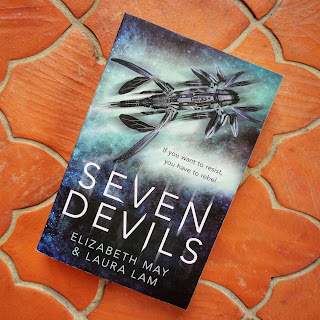
Seven Devils, Elizabeth May & Laura Lam

Having had a great run of sci-fi recently (thanks entirely to C's book-picking skills), a correction was inevitable. Seven Devils, an unusually two-handed affair, delivers this in spades. Its sole distinction is a primarily female cast in what's routinely a male-led genre, but everything else is wholly unoriginal, a poor copy of a copy of a copy. A poly-galactic evil empire, a despotic ruling family, the inevitable sequence of run-ins with scions of said family, lazy archetypal characters that include the plucky one, the clever one, the tortured-by-their-past one, etc. On top of this, it's also profoundly stupid. It has zero consideration or even awareness of scale, with the protagonists hopping between galaxies in minutes, and across which the empire has a mere *hundreds* of colonies. The empire is also said to have killed many billions of people (and aliens), but a key plot device is a so-called super-weapon that kills *individual* enemies (though, via another MacGuffin, ultimately kills more). Further, despite this background of proper genocide, the lead characters somehow find time to agonise endlessly about their individual transgressions. While the authors are clearly investing their own worthy opinions into the characters, they're oblivious as to whether those views plausibly stack up against the horror of the world described. They patently don't, and the novel fails at every turn, talking about Big Issues while floundering around in a breakneck series of weightless and faux-clever episodes. Other crimes include adding "diversity" by having a character speaking with Oor Wullie-style Scottish vernacular (to indicate they come from solid working-class stock), having regular occurrences of convenient, dig-me-out-of-this-plot-hole technology to get around plot ridiculousness, and, I kid not, "auras".

While I am entirely behind the socially-aware, feminist ideas that the authors clearly started from, this is a poor vehicle for promoting them. Vapid, lazy, inconsistent, and just plain stupid. Avoid this book.

Saturday, 20 February 2021

The Second Sleep, Robert Harris

Sent by his Bishop to officiate the funeral of a fellow cleric, Christopher Fairfax discovers a brewing heresy in the impoverished rural backwaters of southwest England. But, contrary to its seeming Dark Ages setting, this heresy involves the mysterious collapse of the unbelieving technological society that came before. His own interest piqued by the heresy, Fairfax quickly finds himself ensnared in an attempt to uncover forbidden knowledge from the past.

A surprising disappointment this one. Surprising because Harris has a knack of taking a high concept idea, and writing an efficient thriller around it. He's probably most famous for Fatherland, his alternative history novel in which a Nazi detective in a victorious Third Reich discovers the suppressed Holocaust. But I also rather liked his AI-infused The Fear Index, in which a hedge fund manager is out-foxed by the awakening of his algorithm.

Here, what seems like a solid gold starting point (especially now, given the pandemic) unravels as Harris fails to approach anything like a satisfying ending. Instead, the novel peters out in a rather incoherent climax that, it seemed to me, he tries to hide under the guise of Fairfax's incomprehension. The concluding revelations also fail to offer anything immediately relevant to Fairfax's world - contrary to the front cover blurb, "what if your future lies in the past?".

Overall, best just read A Canticle For Leibowitz and see how this high concept can be done properly.

Sunday, 14 February 2021

Bone Silence, Alastair Reynolds

This is the third and, for now, concluding novel in Reynolds' spaceships and pirates mash-up series. What seemed (to me) an incongruous and implausible basis for even a single book has now successfully skirted the treacherous shoals for a complete trilogy.

It picks up directly from its predecessor, which concluded with the series' leads, the Ness Sisters, unwittingly triggering a financial disaster that reset the values of the solar system's mysterious currency, quoins. Now even more on the run, and with still larger prices on their heads, their voyage intersects with that of a fugative alien who promises answers in exchange for safe passage. All of which triggers a swashbuckling chain of adventures that ultimately reveals much more about the solar system and its history than the Ness Sisters had bargained on.

A very enjoyable and satisfying "end" to the series. It does tend to accelerate the revelations towards the end, probably not giving them their due, but it's nice to have some mysteries resolved. However, given the novel resolves one suite of mysteries with a "solution" that suggests many new ones (in addition to those, like the Ghosties and Skulls, that still remain), I doubt this is really the last we've seen of Adrana and Arafura. Good!

Recommended, even if you find the pirates-in-space premise absurd.

Monday, 1 February 2021

The Space Between Worlds, Micaiah Johnson

There is a multiverse. The histories of several hundred universes are close enough to our own to permit travel between them. But jumping to a world in which you exist is invariably fatal - the multiverse is unforgiving in this regard. As a result, the most valuable travellers are those already dead in other worlds. Something that's all too easy for the poor and dispossessed in our ruined post-apocalyptic world.

What an excellent debut novel! Every part of it works brilliantly - from its well-drawn (and frequently-duplicated) characters, through the slow-reveal of its setting, to the unfolding of its satisfyingly twisty plot. The author takes what's now become a familiar trope - the parallel world - and spins off their own fresh version, complete with duplicate-prohibition, a travellers mythology of how Mother Nature enforces it, and a zeitgeisty meditation on a class- and race-stratified society.

Early on, I had a feeling of overfamiliarity with its post-apocalyptic dystopian future, but it didn't take long to reveal itself as something more unique, and cleverly so to boot. In particular, its use of duplicated characters - some very familiar between worlds, some very different - is excellent. Both in illuminating the vicissitudes of life's paths, and making for a wonderfully finely-tuned plot as the narrator, Cara, leverages her growing knowledge of the multiverse to topple the tyrant that rules the one she has come to call home.

For sci-fi, it's worth remarking that the writing is well above and beyond too. It's sparing but hits the sweet spot of world building while avoiding "Basil Exposition". Ditto, its characters are far more subtly drawn than the genre typically manages, which works particularly in a plot that requires its actors multiple shades.

Overall, simply excellent. (And a novel that practically screams "make me into a film".)

Sunday, 20 September 2020

Blue Mars, Kim Stanley Robinson

Epic in every way - in complexity, in characterisation, in actual physical weight - it's a strange feeling to finally finish KSR's exceptional future history of Martian terraforming. It's great to turn the last page on something I've been labouring under for weeks (*months* if the two preceding tomes are factored in), but it's been such an all-encompassing and absorbing book that I'm going to miss it a bit too.

In pocket summary, it picks up as the second - and successful - Martian revolution is concluding, on a Mars newly liberated from a flash-flooded Earth. Thanks to anti-aging medical technology, much of the original cast of Red Mars is still with us, together with their first and second generation children. These assorted narrators take us through factional Red (pristine, lifeless) and Green (transformed, bountiful) fights, fumbling efforts to kick-start Martian politics, and the solar system-wide issue of humanity's abundance in the wake of this anti-aging.

However, that description can't touch just how ridiculously broad the canvas here is. As well as the geology of Mars and the science of its transformation (both global *and* local), the socio-economics of its political awakening, and the gathering pace of solar system expansion, the novel finds time to take in (among other things) life in southeast England on a drowned Earth, sex-and-hunting cults on Mars, and the impact of low Martian gravity for regular and extreme sports. KSR can't even leave his convenient narrative trick of anti-aging alone, and embarks on a fully fleshed-out subplot digging into biological senescence and memory.

Inevitably, not all of this works, and I suspect readers will find themselves skim-reading the themes that don't interest them as much. For me, I couldn't care as much about political theory as KSR clearly does. But then I just couldn't get enough of the Red vs. Green tussles of Ann and Sax, or the scientific detail of Mars' animation, from global geoengineering to gardening its microclimates. And there's a great stretch where Nirgal, a first generation child, takes part in a solitary, round-the-world marathon (Mars-athon?), which really opened my eyes to seeing Mars as a (potential) physical, living-and-breathing place.

So almost impossible not to recommend to science fiction fans, but it's a real taskmaster of a trilogy of novels. But, I think, absolutely worth it.

Sunday, 23 August 2020

Daemon's Departure

The Secret Commonwealth, Philip Pullman

Unlike the first volume, which largely tees up His Dark Materials (HDM), this second volume of The Book Of Dust picks up afterwards, and sets a now 20-something Lyra and, more significantly, her daemon Pantalaimon, on another adventure against the revitalised Magisterium.

Motivated by a murder, mysterious goings-on in a distant desert, and the now-fractious relationship between Lyra and Pantalaimon, this is another exceptionally entertaining, fast-paced and highly imaginative journey through Pullman's rich alternative universe. As well as pulling through several other characters from La Belle Sauvage, it fleshes out Lyra's already rich world by sending her and her daemon on separate (!) journeys into Europe and the Middle East. In parallel, friends and foes are hunting them as the Magisterium rallies to counter threats to its theology and control.

Much as in HDM, Pullman continues to needle authoritarian forms of organised religion, but he has a number of enemies in his sights. The troubles in the war-torn Middle East, and the disinterest of Western powers, are laid bare on Lyra's travels. And perhaps surprisingly, the book also takes some well-deserved shots across the bows of the Ultra-rationalists and New Atheists. Even Boris Johnson attracts some of Pullman's ire with a dismissive reference to second-hand water cannons.

The only real downside to the book is that I've unwisely read it when the final volume of the trilogy ("to be concluded") has no official release date in sight, leaving me now chomping at the bit for Book Three.

However, if I can conclude on two niggles, ... Considering the magnitude of the events of HDM, both Lyra and her world are surprisingly unchanged. Confined within her own universe this time, it's largely left unmentioned that she's been to others, even to the Land Of The Dead, that she's met primordial angels and the alien Mulefa, and that she even (if unwittingly) killed "God". It's very easy to forget all this and to enjoy the novel, but it does sometimes feel like an elephant in the room. There's also a slightly queasy feeling around La Belle Sauvage's Malcolm and his attraction to Lyra.

Sunday, 19 January 2020

Imagining Climate Change

The Wall, John Lanchester

One of the many failures of our culture when it comes to possible climate change futures is in playing out the likely consequences of change. "The future" becomes one purely of temperature extremes, rainfall change and, sometimes, agricultural shortages. Numbers that, while meaningful, don't capture the imagination and aren't extrapolated to day-to-day changes in our lives. This makes the future look like somewhere in which we have to, for instance, make do on 10% less food and spend twice as much time indoors sheltering from excessive heat. This overlooks what such changes will actually mean societally, and how they will play out for the daily lives of people in different places on different means.

The Wall is, arguably, an attempt to put human flesh and feeling around one climate future. It's a relatively slim volume, and focused around a small cast, but it makes great strides in sketching out how climate change can reshape a whole society, and what consequences and choices it might impose.

The book opens, almost with sly nod to Game of Thrones, with its central character, Kavanagh, braced against the cold, up on the Wall and looking for Others. The Wall is Britain's response first to sea level rise, but more significantly to the waves of climate refugees displaced from their homes. Kavanagh's job, as a Defender on a two-year stint, is to stop the Others from breaching the Wall and reaching the relative safety within. In this future, it is the young that serve on the Wall, while the old, whose past inactions have caused the Change which drives it, are cowed and nostalgic for lost beaches. And this service comes with double jeopardy for the Defenders - the risk of harm while serving on the Wall, and the penalty of being cast out to sea if any Others break through on their watch. Both of which become more than mere risks for Kavanagh as his tour of duty unspools.

In spite of its relative brevity, this creates an unnerving future Britain. Through the drama it inflicts on its characters, it shows how, while civilization may not necessarily fall under climate change, its best features can easily be worn away. Kavanagh is a relatable Everyman, but even he stops himself thinking too deeply about the Others or why they are so desperate to break into Britain. However, his resentment at previous generations, including his own parents, for their abject failure to avoid the Change is much clearer. This future Britain may not be (completely) materially ruined, but the isolationism fostered by the Change, and the resulting loss of humanity in its citizens, marks its true devastation.

So not the cheeriest read, but recommended.

Stray observations:

  • The climate future presented in the novel is an interesting one. The reader is first introduced to how cold it is, counter to ongoing global warming. However, it is later made clear that it’s much warmer elsewhere, which is suggestive of the cold in Britain being a result of changes in ocean circulation. The decline in the Atlantic Meridional Overturning Circulation, for instance, is simulated to result in reduced warming in northwestern Europe relative to other locations. I don’t think that (m)any simulations would suggest strong cooling, but there’s something of a basis for the nature of the Change as it appears in the novel.
  • A number of reviews have described The Wall as “this century’s 1984” or similar, presumably latching onto the fact that its future dystopia can be read as a warning for the present. And there’s certainly something prophetic in its world, but in terms of style and narrative the two books really don’t overlap. The Wall is far, far less didactic than 1984, and the better for it. The closer parallel is with Cormac McCarthy’s The Road, with its similarly pared-back text and narrative, although The Wall gets the nod because its particular environmental calamity is more unambiguously related to our own. (The Road still wins out in terms of total doom, however.)
  • In another sly nod, The Wall introduces a politician character with more than a passing resemblance to a certain British Prime Minister known for populism and lying. That said, the narrative ultimately gives him a more noble path than one might expect from this affinity, so perhaps I’m overinterpreting.
  • Intriguingly from a “future technology” perspective, the Britain presented in The Wall runs off of nuclear power. It’s fleetingly mentioned, and never referred to again, so it’s difficult to know if the author means much by this. Admittedly, the changed local climate in Britain sounds less favourable to renewables like solar, but there could be more to this choice by the author.
  • While an underpinning, and largely realised, feature of the world of The Wall is "civilization within, barbarism without", one of my bugbears about the IPCC scenarios that we use in climate change research is that, no matter how bad their futures get, things remain civilised. I think scenario designers might do well to read The Wall and reflect.

Sunday, 28 July 2019

Daemon's Return

La Belle Sauvage, Philip Pullman

It's been years since I read Pullman's spectacularly imaginative trilogy, His Dark Materials, but it's still as memorable as ever. With its parallel, if familiar, universes, clever reworking of dark matter, epic (humanist) good vs. (religious) evil narrative, and it's unforgettable daemons, it's not a work that ever quite leaves you. Like The Lord of the Rings, its first world-building volume is its best, and like TLofR, it builds to a satisfying climactic good-vs.-evil showdown. But with less songs, thankfully.

So, it was with some trepidation that I picked up the first volume of a planned successor trilogy. But I needn't have worried - Pullman is as sure-footed as ever, and pulls off a great read even where the main destination of the tale is already known.

Set in "Lyra's Oxford", the version of Oxford in the parallel universe that kicks off Pullman's original trilogy, it centres around the everyday life of Malcolm, son of a publican. Into his life comes baby Lyra, entrusted in mysterious circumstances to a local convent where Malcolm performs odd-jobs. Her arrival sparks interest from both the Magisterium, the ecclesiastical wrong-uns of Pullman's universe, as well as Lyra's somehow distant father, Lord Asriel. Skirmishes between these forces steadily spill into Malcolm's world, ultimately forcing him to rescue Lyra in the face of an epic flood, and sending him and Lyra on a strange journey among the other forces underlying the world.

This latter journey is the only weak spot in what's otherwise a greatly enjoyable tale, and then only because it's arguably a tad too fantastical when set against the rest of the book (which is, of course, saying something). In every other way, La Belle Sauvage satisfies - it fleshes out Lyra's Oxford, and the daily life and politics within it, more completely; it makes Pullman's daemons even more intriguing; it gives the reader some enjoyable tradecraft when Malcolm becomes something of a spy; and it slowly and gently transforms Malcolm's ambivalent relationship with Alice, a seemingly surly girl working at his parents' pub, as they are swept down river with Lyra and forced to become her guardians. Also, while it shares HDM's antipathy to organised religion, here it presents religious characters who are genuinely good, principally the nuns, alongside non-religious ones who are not, making for a more nuanced and less antagonistic relationship with faith.

So, all for the good. Although making the down-river drift of Malcolm's canoe, La Belle Sauvage, a little less jarringly otherworldly might have made it even better for this reader.

In passing, amusingly, and echoing a joke made in the book, my phone autocorrects "La Belle Sauvage" to "La Belle Sausage".

Monday, 3 June 2019

Galactic Central Point

Galactic Center Companion, Gregory Benford


It was many years ago, and over many years, that I read the six Galactic Centre novels that form the subject for this compact “study guide”. But despite the passage of time, Benford's galaxy-spanning tale of humanity's struggles against implacably superior “mechanicals”, largely set in the vicinity of the “Eater” at the Milky Way's centre, still sticks in my mind. 

In part background from Benford on his thinking behind his series, in part reviews of the full series by critics, and in part actual scientific work by Benford on the Galactic Centre. But the main reason to recommend is the new (to me, anyway) short stories set within it. Especially “A Hunger For The Infinite”, which revisits my favourite of Benford's creations, the Mantis, a mechanical intelligence that both persecutes the humans it meets while drawing artistic inspiration from them. 

I really rather enjoy Benford's penchant for imagining how non-humans might see the world, and it's nice to be reminded of how far his Galactic Centre series takes this. Particularly in the very strange ecosystems and intelligences around the Centre's dominating black hole. Benford takes the opportunity presented by the new stories here to flesh his ideas on these out a little further than the mech-focused novels could. 

Overall, this companion probably isn't much good for newcomers to his works, but for those familiar with them, it serves as a nice reminder of its pleasures, while offering up a few new nibbles to refresh the taste buds.

Sunday, 28 April 2019

Green Antarctica

Austral, Paul McAuley


Against the backdrop of a thawed Antarctica, prison guard Austral, herself a former offender and a genetically-modified “huskie”, gazumps her criminal accomplices and kidnaps the niece of a visiting dignitary. Partly to protect her, and partly to negotiate passage off Antarctica with the girl’s uncle, with whom Austral shares a family connection. The novel then follows the pair’s adventures as they cross the Antarctic Peninsula avoiding recapture while meeting up with the assorted people who now make the post-glacial habitat their home.

I really thought that I’d enjoy this novel more. It’s set in the less-explored space of accommodated climate change, it has a rather unexpected take on geoengineering, and presents an arguably positive approach, that of the “Ecopoets”, to adaptation to a warmed world. Of which, it’s a nice idea to present geoengineering as something that just didn’t work fast enough rather than being “Morally Unconscionable”, and I really liked that the novel’s “environmentalists” have worked with the grain of climate change to green Antarctica, and to do so through genetic engineering. And in marrying all this with a narrative fed by a modified human, as well as a wider backdrop of the corporate betrayal of both huskies and Antarctica, I thought it would be more successful than it is. Instead, it’s too much of an episodic “road trip”, where the sequential hook-ups seem a lazy way to explore the world. And where one never quite buys the conceit that the protagonist would be able to escape detection so well.

So, while it’s very nicely ambitious (so far, so McAuley), but just not as narratively satisfying as I’m used to with him.

Friday, 26 April 2019

Canine Noir

Irontown Blues, John Varley


A long time in the making, this is the latest in Varley’s rather loose series of novels and short stories set in the “Eight Worlds”, easily one of my favourite science fiction worlds. Set (almost) entirely on the Moon, or “Luna” as its residents invariably call it, the tale begins as full-on noir with a private detective, Bach, interviewing a seeming femme fatale, under the sleepy gaze of his faithful hound, Sherlock. Most of the rest of the novel serves to reverse the reader’s expectations from this kick-off, with the noir slowly evaporating as the true nature of the “crime” is slowly – very slowly – revealed, and with Sherlock, actually a genetically-enhanced dog, becoming a key narrative voice (aided by an interjecting translator). This latter turn works better than one might expect, and getting into it takes up the time that one might otherwise expect a noir tale to require. Here, the tale is really rather slight in the end, and it leans rather heavily on the heavy-lifting done by earlier novels, although with a contemplation of post-traumatic stress. It’s also disappointingly light on the Invaders, Varley’s mysterious gas giant aliens who’ve effectively evicted humanity from Earth. So a much thinner read than his earlier “Eight Worlds” works, but not without charm, including, most obviously, a real love for dogs.

Wednesday, 24 April 2019

A Parable

The Consuming Fire, John Scalzi


While my last Scalzi was a bit of a disappointment, the predecessor to this novel was a very enjoyable blast. A classic space opera, set in an interstellar empire on the brink of collapse, it was as much about it's colourful cast and their political machinations as it was about the disaster facing them all.

This time, disaster has arrived and the Interdependency is fragmenting, but Emprox Grayland II continues to be threatened as much by grasping political rivals. Underestimated as a naïve ingenue, she marshals her loyal friends to surprise her enemies, while striving to give her citizens the best chance of weathering the storm.

What it lacks in big surprises is more than made up for by Scalzi's inventive twists and turns that keep the reader guessing how (the extremely likeable) Grayland will beat the odds. It's also a joy as a thinly veiled parable for our climate changing times, especially the venality of those characters trying to turn a buck off the unfolding disaster. And it's all done with a brilliant lightness of touch, frequently an enjoyably profane one. Best of all, it's not done yet. Strongly recommended (... for space opera fans).

Monday, 22 April 2019

Crime-lit Rebrand

Elysium Fire, Alastair Reynolds


A return to Reynolds' Revelation Space series, and an unexpected sequel to a previously standalone novel, The Prefect. That was an enjoyable and superior tangent to the main sequence of novels, but with this it seems that a rebranding as science fiction / crime crossover is in the offing. Not unwelcomely, and though it's not as novel as its predecessor, it's still pleasant to be back in the company of Dreyfus and his hyperpig deputy, Sparver. The tale itself, centred around depravity in elite circles and control of the democracy of its setting, Yellowstone and the Glitter Band, has some surely-intended Brexit echoes, and it fairly ticks along. But it's a little short-changed by its lazy use of the twins cliché, and its sidelining of key storylines from the earlier novel that also underscore the lower stakes this time around. But solid Reynolds.

Sunday, 21 April 2019

Slavery 2.0

Underground Airlines, Ben H. Winters


What if, instead of eliminating slavery, America came to an uncomfortable accommodation with it? One where northern state African Americans are free citizens but their Deep South brothers and sisters are held in Apartheid-like bondage as part of an otherwise modern capitalist economy. That's the premise of this rather impressive alternative history / detective novel mash-up.

Intriguingly, it’s told from the perspective of Victor, an African American forced to work as an undercover agent for the US Marshall service to track down escaped southern slaves. Intriguing both because of the conflict that this role understandably creates within him, and because of the resulting slow tease-out of the bureaucratic banality of the monstrous system he serves. In the absence of the Civil War, the Deep South has retained its slaves to become a commercial success, albeit one hemmed-in by the wider world’s ineffectual jitters about slavery.

Victor’s latest case has him seeking a slave called Jackdaw, and quickly brings him into contact with the "Underground Airlines", an organisation that helps escaped slaves disappear into the North. But the case proves much more complicated that usual, with Jackdaw first turning out to be more than a Southern slave on the run, and then winding up dead. But Victor sees an opportunity to leverage Jackdaw into freedom, and with the help from a young white mother, Martha, seeks to finish Jackdaw’s mission - not for the cause, but for himself. But his discoveries in the South change things much further than Victor ever imagined.

After a start which can be a little confusing as you work out what’s what in Victor’s world, this settles down nicely. That said, it misses a few tricks by being a little too thin about this alternative America, and its late introduction of a game-changing MacGuffin is both too out-of-the-blue and far too unexplored to take seriously. But it’s still entertaining and thoughtful, although it’s not in anything like the same league as fellow alternative history novels like Roth’s The Plot Against America or Chabon’s similarly detective-themed The Yiddish Policemen’s Union.

Friday, 19 April 2019

China Moon

Red Moon, Kim Stanley Robinson


With auspicious timing given China's recent far side success, Robinson's new title visits (though more sporadically than one might expect) a near-future Moon dominated by the Red Chinese.

Starting slowly, it quickly becomes an extended chase as a Chinese "princess", daughter of a high-ranking bureaucrat and illegally pregnant on the Moon, hooks up with an imprisoned American contractor, and both are unwittingly drawn into more terrestrially-based power struggles. Elsewhere, they find unexpected help from a famed Chinese poet cum travel journalist, and a Chinese technician responsible for its Great Fire Wall but now raising a helpful general AI.

Broadly an enjoyable ride, with lots of clever and imaginative sights along the way. The Chinese lunar cities built in ancient lava tubes, and the burgeoning baby AI, in particular, are high points. But the ceaseless chase sometimes becomes a thin way to allow Robinson to show off new ideas rather than a compelling narrative in its own right.