Friday, 23 May 2008

Yid Noir

In 1997, the author Michael Chabon wrote an essay on the decline of the Yiddish language. The decline, in part, is a result of the adoption of Hebrew as the language of the state of Israel. During his research for the essay, Chabon unearthed the Slattery Report, a plan hatched in 1938 both to provide a safe home for European Jews threatened by Germany, and to bolster the relatively underpopulated territory of Alaska (then not a fully-fledged US state). The plan never garnered much support from either the US government or the Jewish community, so was never implemented. In The Yiddish Policemen's Union, Chabon writes a "what-if" novel in which the Slattery Report's plan was implemented and Alaska really was settled by European Jews.


Meyer Landsman is a homicide detective in the Jewish homeland of Sitka, Alaska. Down on his luck after the death of his sister, his divorce, and the appointment of his ex-wife as his boss, Landsman's life is thrown into further turmoil when he begins to investigate the death of a junkie in the seedy hotel that he calls "home". Aside from his love of heroin, the dead man seems to have been a major chess player, but rummaging through the mysterious world of chess clubs turns up some more ominous information. The dead man is Mendel Shpilman, son of Rebbe Shpilman, the rabbi and head of the Hasidic Verbover criminal gang. What's more, Shpilman seems to have been feted by some as the next Jewish messiah. As Landsman delves deeper, his investigations take him, his half-Indian partner Berko, and his ex-wife, on a tortuous journey that takes in the Jewish underworld, religious fundamentalists and a mysterious facility deep in the countryside. At the same time, the homeland created by the Slattery Report is being disbanded, and its Jewish tenants are dispersing. But where are they going next?

It's difficult to know quite where to start praising this novel, it simply succeeds on so many different levels. Most obviously, it's successful as a hard-boiled noir novel. Both in terms of style and plotting, it's a fine example of the genre (or, at least, what the genre has become). Although crime fiction only makes up a relatively small fraction of what I read, I'm definitely a sucker for noir's fusion of serious events with ironic detachment and witty rejoinders (c.f. my earlier posting on Century Rain). Were I to be pretentious, I could say something about how this fitted with my generally ironic outlook on life, but that's a bit too "travelling up my own arse". Turning to the noir-ish dialogue, it's filled with great lines like this one (where an Indian sheriff comments to Landsman on the arrival of a new Jewish messiah):

"Not that I'm a religious man, God knows," Dick puts in. "But I feel compelled to point out that the Messiah already came, and you bastards fucking killed the motherfucker." (pg. 295)

As can probably be gathered from the above, Chabon creates some very interesting characters along the way. But more significantly, he breathes a depth into them far beyond that which typifies the crime genre. The central relationships between Landsman, his ex-wife Bine, his partner Berko, and their families are convincingly drawn, and the characters are, well, nice, but retain rough edges shaped by their histories. There's more than simply a crime tale being played out here, and though crime defines the professional lives of the major characters, they have personal lives that are fleshed out more fully and plausibly than one has a right to expect from even a good crime novel.

Another successful facet is the novel's handling of its alternative history. The reader is only drip-fed details of how a Jewish community came to be established in Alaska. To the extent that, for much of the earlier portion of the novel, it's not entirely clear when the novel is set. That it's noir almost preconditions the reader to view it as occurring in the past (though Century Rain and Gun, with Occasional Music provide solid counterexamples), but as the novel proceeds it becomes clearer that the world it presents is an alternative present. This gradual unfurling of the novel's world works brilliantly, with the reader gradually putting details in place and building up a more complete picture of Sitka, Alaska. And the novel doesn't try too hard with this either - aspects of the alternative history are mixed gently into the narrative without "SCENE SETTING" written all over them.

One particularly interesting aspect of the novel is the angle it takes on Israel and Zionism. Although Israel does not exist in the alternative history, the political machinations that drive the novel's plot want things to change on this score. Through his characters' views about this, Chabon appears to present a rather negative view of this latter development. Although not entirely welcomed in Alaska, the "Frozen Chosen" (as the Alaskan Jews are known) are generally happy in their frigid home, and aren't in a rush to reclaim the land that is (ostensibly) promised to them. That Chabon chooses rather evangelical shadowy figures to guide the unfolding plot can be read as a not-so-veiled criticism of similar figures in our own present day, who seek not a homeland for the Jews, but the culmination of a certain theological prophesy. Either way, I'm sure that Chabon made some new friends, and some new enemies, with this part of the novel.

If I were to criticise at all, I'd say that Chabon's use of Yiddish, while completely in tune with the novel's origin and its setting, makes things difficult to follow at times. While some Yiddish expressions are mainstream in modern culture, most aren't, so occasionally one comes across an uninterpretable word or description. Usually context sorts this out, but not always. Another "issue" I'd raise is the messianic status of the murdered junkie at the heart of the story. Most of the characters don't take this at all seriously, but as the novel proceeds there are more and more hints that Mendel Shpilman really is the Messiah (or a messiah; one of the novel's details is that some Jewish groups think a messiah is born every generation, but is never discovered). But these hints are almost completely ignored by most of the characters, who continue to have an entirely secular reading of events. While (obviously) such a reading would appeal to me, there is still the question of the accumulating evidence that Shpilman was more than just a chess player. Still, since this evidence is always presented as hearsay, perhaps I'm just being gullible. Landsman would set me straight on that one.

In passing, while completely different in almost every respect, the novel shares its Jewish alternative history theme with Philip Roth's The Plot Against America (2004). In that novel, history diverges around 1940, when the anti-semitic Charles Lindbergh takes the US Presidency. However, events conspire to push history back on course towards our own. In The Yiddish Policemen's Union, history diverges around the same time, but has continued to diverge to the present day. That said, with the Alaskan Jewish homeland's disassembly and several other events, there's a suggestion that the alternative history presented may gradually converge again with our own.

Anyway, in summary, while not a deep novel of great literary significance, The Yiddish Policemen's Union is a first-rate trans-genre novel. Primarily crime genre, but transcending this with impressive literary fiction flourishes. Brilliant.


As a final aside, according to its Wikipedia entry, The Yiddish Policemen's Union has actually been nominated for a number of science fiction prizes (it has already won the Nebula Award). Although I've bemoaned the fiction/science fiction divide before, I'd argue that this is actually an example of where science fiction has reached over and grabbed something that really belongs to literary and crime fiction. Apart from dealing with a separate history, the novel is ostensibly present day and contains no standard themes or icons of the science fiction genre. I suspect that crime fans might bemoan this novel as an example of a literary fiction author romping all over their genre (much as I've whined about over at science fiction), but labelling this as science fiction is a little cheeky.

Tuesday, 20 May 2008

Who to hate in May

Which ideological foe is doing best at the moment?

Duck in peril

Today found us with two mother duckers with four chicks apiece. However, we eventually spotted a solitary chick sitting in the far corner of the quad. After determining that it could move around a bit, Adrian and I popped down to the quad to see if we could put it back with the other chicks. Although we were able to satisfy ourselves that it was healthy enough to cry for help and run away from us, we mostly succeeded in making it run for cover under one of the denser bushes. However, later in the day we were able to confirm that one of the mother ducks now had a flotilla of five chicks, suggesting that our straggler had founds its way back to mum. Still, the numbers are dropping off: we now have half the number of chicks that we started off with.

Monday, 19 May 2008

Down the pan

I've just received an e-mail about my fateful NERC Fellowship application. No dice apparently. Much as I anticipated after the interview process. Oh well, a career outside of science beckons after all.

Mostly, I don't feel too bad about this. I've largely enjoyed being at NOCS, both scientifically and socially, but I'm fairly sure I'm not cut out for a science career in the long-term. It requires a degree of self-starting and self-belief that's gradually left me over the years. That said, it's going to be something of a major life event switching out of it.

Still, worse things happen to people all the time, so I really shouldn't get too fazed by it. Although that's rather easy to say at the moment when I'm still gainfully employed!

Monday's duck update

Very little duck news today. One male is still hanging around and hogging the small pond. Only one mother duck spotted - six chicks counted. No sign of the other mother thus far. In lieu of duck stats, here are some duck photos from Friday ...


Friday, 16 May 2008

Malthus bites

A short duck-update before the weekend. With the arrival of another mating pair, plus a further male duck (there were two in the quad this morning), it's become more difficult for the original two mothers and their chicks to secure access to the quad's watering holes. In turn, this has made it more difficult for us to count chick numbers. We've just seen one mother with seven chicks, but we're uncertain if this is mother 1 (with seven chicks) or mother 2 (with eleven, then nine, chicks). Furthermore, we've just watched this same mother attack one of the other mother's chicks. It may have been more of a warning shot, but it's difficult not to read more into it. In passing, the mother ducks themselves have also been attacked by the visiting males, though the males have shown less interest in the chicks. Anyway, we'll see what the weekend brings.

P.S. Update: one mother has six chicks, the other seven. Although, being bird-spotting amateurs, we're unable to work out which mother is which, so can't tell if mother 1 has lost one chick, or mother 2 has lost three.

Wednesday, 14 May 2008

Quaternary Park

As I bemoaned here last week, Iain Banks doesn't produce novels at a fast enough rate. Another science fiction novelist that this applies to is John Varley. But while Banks cranks out a new science fiction novel every two years or so, Varley's batting average evens out at about four to five years. Similarly to Banks with his Culture, Varley is perhaps best known for his work set within the fictional universe known as the Eight Worlds. While not directly precluded from this series, Mammoth is a standalone work that has no obvious connection to the Eight Worlds.


Mammoth opens with the discovery of the frozen remains of a mammoth in North America. This discovery is part of a research project run by Howard Christian, a super-rich entrepreneur, to clone a mammoth from frozen DNA. However, it is overshadowed by the more significant discovery of two humans with the mammoth, one of whom is wearing a wristwatch. Further investigation finds a strange accompanying machine, presumed to be a time machine. Howard then hires Matt Wright, a brilliant but frazzled theoretical physicist, to study and replicate the machine. Working alongside the mammoth cloning project, Matt meets Susan Morgan, an experienced elephant trainer, hired by Howard to ensure the successful birth of a cloned mammoth from an elephant mother. The disruptive intervention of incompetent anti-cloning activists somehow jars the uncompliant time machine into operation, sending Matt and Susan 10,000 years back in time to encounter Little Fuzzy, a baby mammoth ...

Mammoth is a rather fast-paced science fiction techno-thriller which, at a first glance, resembles works by renowned hack writer Michael Crichton (specifically the reasonably good Jurassic Park, and the apparently risible Timeline). However, this comparison is rather unfair. While it doesn't really reach the heights of Varley's other works, Mammoth is clearly separated from Crichton's novels by more intelligent plotting and credible characters. For Crichton, characters are essentially talking heads that act to advance the action. Varley invests a lot more time building his up, and weaving them into plausible relationships. Given the relatively rollercoaster nature of the plot, we're not talking about characters in the literary fiction sense, but these are on the well-developed side of science fiction.

The time travel plot is rather playfully handled by Varley. This playfulness begins with the machine itself, which is described as a superficially simple device containing a matrix of caged spheres (= marbles). Varley leaves its mode of operation fairly mysterious - in fact, the closest he gets to explaining how it works is when the matrix of spheres reorganises itself and some appear to disappear. This is explained by the suggestion that the spheres are now in another dimension. Varley also throws in some discussion of the paradoxes of time travel, which includes an amusingly dismissive reference to his own earlier novel, Millennium. As for the origin of the time machine, well, Varley creates quite a paradox there too. Although Matt builds a functional time machine based on the remnant discovered with the frozen mammoth, and although the route by which the remnant got to where it was found is outlined, there's nothing to say where, or when, or via whom, the machine came into existence in the first place. All things considered, this is probably the most satisfactory way to tidy up time travel stories - that is, not to tidy them up.

In passing, in what's quite a nice touch, Varley uses a children's storybook describing the adventures of Little Fuzzy to frame the novel. Rather than use a heavy-handed talking head (as Crichton would do), this approach allows Varley to use a completely different voice (so, OK, it may just be a "talking head") to summarise and simplify parts of the story. Since these parts often deal solely with mammoths, this permits their anthropomorphisation, without it being clumsy. It's a children's book after all.

As will come as no surprise to readers of Varley's website, he also slips a large dose of anti-Bush criticism into the novel. Mostly via the interrogation scenes that follow Matt's return to the present day. Perhaps reluctant to come over as an unthinking critic of Bush, Varley qualifies this criticism with a degree of realism. While critical of the current government, he certainly has no truck with those who would put the government on the same footing as terrorists. There's something in that, of course, but it perhaps isn't as effective as Varley intended.

Anyway, overall it's an enjoyable, fairly pulpy romp. Hopefully Varley will be returning to his Eight Worlds before too long, however.

Avian interloper

Another duck update. Chick numbers appear to be holding steady today, with all but one chick accounted for. Mother 1 has at least six chicks, with the other probably just missed in the count. Mother 2 still has nine chicks. However, there's a pair of interlopers in the quad. A new mating pair has arrived, though there's no sign of chicks just yet (which the male's continued presence is supportive of). At the moment the new pair are hogging the quad's small pond, and I've just seen the male chase off Mother 1 and her chicks. For a moment, I wondered if the male would attack the chicks, which would make sense as they're liable to compete with any of his own. However, he focused on their mother and left them more or less alone. So far.

P.S. Mother 1 has now been confirmed with seven chicks.

Tuesday, 13 May 2008

Ducks on film

Or, at least, on the digital equivalent. Snapped off some pictures of the ducks yesterday through the long lens. It looks like the brood of 11 has been thinned somewhat to 9 chicks, but the other brood seems to still have 7 members.


Above: mum number 1 watches over while the chicks play in their pond.


Above: mum number 2, and brood, await their turn in the pond.


Above: mum number 1 and her brood rest away from the students in the quad.


Above: mum number 1 and her brood (I think) - these ducks seem to do a lot of resting.

More duck news as it comes in.

Friday, 9 May 2008

Duck crazy

In a further update on our quad's duck situation, it now transpires that we have two mother ducks (or "mother duckers" to quote APM) that between them have eighteen (seven plus eleven) chicks. While all eighteen have yet to be seen at exactly the same time, the larger brood is at least eight chicks in strength. Thus far, there have been no obvious duck-on-duck hostilities, but eighteen chicks represent a substantial duck footprint on the quad's ecosystem (although their diets are augmented by a daily feed from a NOCS staffmember). More as it comes in ...

Thursday, 8 May 2008

Duck update

Despite several weeks of apparent absence, the ducks are back, and they have lots of chicks! Yesterday it appeared that we had a single mother in the quad with a record (in our somewhat limited experience) seven chicks. However, today it appears that we have a second mother in the quad, with an as-yet-unknown number of chicks. We've heard them, we know roughly which bush they're in, but we haven't been able to count them yet. It could just be that, statistically, we've not been looking for long enough, but it may be that the second batch of chicks are too still young to follow their mother out of the nest. Anyway, thus far it doesn't appear that anyone's feeding them, so deleterious competition for resources may result. And we've suspicions about where that led last year. Also, the mother whose chicks we've seen occupies the sector of the quad that affords her easy access to both of the ponds. A definite disparity there. So it's all still to play for.

Wednesday, 7 May 2008

Rendezvous with the Book Group

Almost immediately after my interrogation by the NERC Fellowship panel, I spent the evening with C's book group in London (at the Royal Festival Hall) discussing their latest (and anomalous) pick, Arthur C. Clarke's Rendezvous with Rama. I was essentially drafted in as the guest "science fiction expert" for the evening. The book was picked in response to Clarke's recent death.


Although I had read the book many years ago (probably close to 20), since I was supposed to represent something approaching an "expert", I thought that I'd better read it again.

The novel is set several centuries in the future, and focuses on the arrival to the solar system of what appears to be an alien spaceship. At first mistaken for an asteroid, the ship is finally resolved as an unmarked cylinder, approximately 50 km in length by 20 km in diameter. Christened "Rama", the closest team of engineers and scientists is sent by the "United Planets" to intercept and, if necessary, explore the ship. Upon reaching Rama, they find no evidence of its habitation so dock with it and begin their exploration. Inside, they find a dark, frigid landscape, with hints of former habitation but little direct evidence of this now. However, as Rama continues to approach the sun, it begins a process of seeming activation. It becomes illuminated, its frozen sea melts and it appears to spawn biological robots, biots, to service and repair itself. However, neither Rama's builders nor its controlling intelligence ever reveal themselves to the visiting scientists, nor does Rama even acknowledge humanity. After a number of adventures inside Rama, the scientists are forced to abandon it as it appears to be settling into a threatening orbit around the sun. However, Rama continues to surprise when, after more course alterations, it plunges into the sun, seemingly restoring itself, before activating a star-drive to begin its voyage out of the solar system to an unknown destination. Leaving all of the important questions unanswered, Rama does give one scientist a lingering thought: systems and structures were triplicated throughout the cylinder - could this visit be the first of three?

Somewhat to my surprise, I thought that the novel actually both bears a second reading, and has survived the test of time. Certainly, it bears some of the hallmarks of classic science fiction: weak characterisation, dodgy technological extrapolation and potentially ruinous sociology. But, as classic science fiction goes, it doesn't suffer much from these. Characterisation, while still relatively weak, doesn't distract from the novel, which manages to deftly focus attention on Rama itself. In what I now realise is a nice touch, Clarke avoids much description of the technology of the future. Computers, etc., are mentioned in passing, but detail is almost completely omitted, avoiding clunky anachonisms and allowing the reader to fill things in for themselves. And though it introduces some odd sociological developments, for instance polygamy, it balances this with polyandry and a generally progressive politics (but more later). Compared with another so-called science fiction classic that I reviewed earlier, Ringworld, Rendezvous with Rama feels like it was written in much more enlightened times (in reality, only three years separate them).

Reading again, I was struck by how Clarke gradually ratchets up the sense of mystery surrounding Rama, and draws the reader through by gradually revealing more and more about the cylinder. I think it's something of a masterstroke to leave things completely unexplained, especially when he put in so much groundwork that it must have been tempting to explain away everything. But it allows the reader to fill things in for themselves, while underscoring (for this reader) the lack of interest the wider universe has for humanity. Away from the deeper philosophical angles of the novel, I liked the interludes away from Rama that deal with the efforts of government experts to interpret what the scientists aboard Rama are encountering. These sections are written with quite a light touch, and are quite amusing at times. Even if they do stereotype the residents of planet Mercury somewhat! I was also impressed with the attention to detail in describing the interior of Rama (but see below). Without it being obtrusive, he carefully introduces all of the concepts needed to understand how Rama works, and how it would appear to a visitor. That said, the book group's consensus was that he spends a little too much time describing how the explorers move up and down the series of staircases from the centre of the cylinder to its inner surface. Repeated descriptions of climbing stairs is not something one expects in a novel.

Much to both my surprise, and that of the book group's members, Rendezvous with Rama was something of a surprise success with the readers. While almost all of them qualified their opinion by noting that it wasn't anywhere near as bad as they had expected, this low expectation seems to have won the day for the book, leading to an average score around 6/10 (which, for context, puts it to the fore of the books that the group has discussed - much to the surprise of the group's members!). The book also spawned a lot of discussion about the structure of Rama itself, its purpose and topics such as its gender politics (the book group, bar me, was exclusively female).

The structure of Rama is something that caused a lot of the book group a lot of trouble. Although Clarke describes the interior of Rama in some length, people had a lot of trouble envisioning how it was organised and where important features were located. I think even imagining that the ground would wrap up and over a standing observer caused trouble - let alone that everywhere on the interior surface would feel "down", but that the centre of the cylinder would be weightless. While adding diagrams to the novel would be a huge mistake (though some novels do commit this), a better cover image would definitely have helped here. Clarke certainly put in the spadework with his descriptions, but they're clearly not sufficient for many people. With my long experience of science fiction structures like Halo, I'm probably not a good person to judge here though.

One interesting point that came up in discussion was whether Clarke was putting any religious interpretations onto Rama. One reader thought that Clarke, by introducing an odd Christ-the-Astronaut sect, was being dismissive of religion. Thinking about it myself, the book does almost completely avoid discussing this dimension of Rama. The appearance of such an obviously alien artifact should have profound implications for religious people, so it seems odd that there's no mention of this. It might be that Clarke preferred to let readers mull this over for themselves, but it could also be that, by marginalising religion to an obscure sect, Clarke intended to suggest the withering of religion in the future. Certainly, he consistently paints a universe in which humanity is presented with its unimportance, but he may just have been leaving this for his readers to sort out for themselves. The sequels are, to near-fatal cost, far less mysterious on this point. But the less said about those, the better.

Regarding the purpose of Rama, the group didn't have a strong consensus. However, in the context of explaining why the sequels shouldn't really be read, I gave my interpretation and that seemed to be generally favourably viewed (though that could have just been "anything for a quiet life"). As I've already suggested above, my take is that Rama is on a voyage, but needs to stop at stars along the way. Its inhabitants who, the novel hints, may be stored in some electronic format, aren't woken up at these junctures, and may just await Rama's arrival at its final destination. Read this way, the novel aims to illustrate humanity's rather limited importance in the cosmos. Much as science has time and time again revealed facts that downplay human significance, the novel describes a further interstellar slap in the face, where aliens are so uninterested in humanity that they don't bother to communicate with them. A corollary from this is that the aliens don't bother because intelligent life isn't so rare in the universe, although this idea isn't pursued in the novel (much like the previous statement!).

Anyway, in the end I gave the novel 8 out of 10. It deserves a 9 in a science fiction context, but relative to the range of literature I've read, it needs to drop a point. Were I holding my hand on my heart, and comparing to all of the novels that I've ever read, it'd probably have to drop to a 7 or a 6.5, but the pressure of being the "science fiction expert" at a literary fiction book group got to me, and I had to defend the genre.

I should add in passing that the book group was a lot of fun. Aside from its entertainment value, it's a really nice way to get a wider perspective on a novel. I had thought that Rendezvous with Rama was fairly straightforward, but was impressed with how much other people got from it. It certainly made me think more critically about my own interpretation of the book.

Monday, 5 May 2008

A harbringer of summer

For future reference, this post serves to note the arrival of the first symptoms of hay fever for this year. Only itchy eyes so far, but if past form is anything to go by more (and more irritating) symptoms should be arriving forthwith. And I was just beginning to think that I'd dodged that bullet this year.

Wednesday, 30 April 2008

Does it Matter?

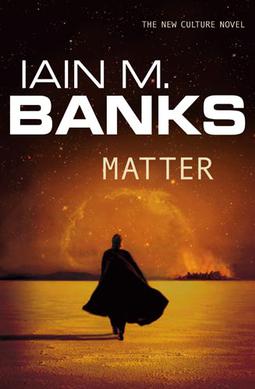
Iain Banks' latest novel, Matter, returns to his fictional utopia, the Culture. Similarly to earlier Culture works, it is a standalone novel, taking in events, places and characters that are new to the wider Culture universe.


Particularly new is the majority setting of the novel, Sursamen, an ancient and bizarre shellworld. These worlds consist of a series of concentric spheres, Russian doll style, over which different civilizations have dominion. The shellworlds are the remains of a galaxy-wide system of unknown purpose, whose builders have almost completely left the galactic stage. On Sursamen, the humanoid Sarl live a pre-industrial and feudal existence, dimly aware of the more powerful civilizations around them. However, as the story unfolds, these civilizations have goals in which the Sarl are merely pawns.

The novel centres on the royal family of Sarl, two brothers and a sister. In a move befitting her lowly female status, the sister, Djan, has been bartered away to an advanced civilization by the king, and has left the shellworld. As the novel opens, the two remaining brothers find their society victorious in a war over another humanoid faction. However, at the moment of victory, their father is murdered by his trusted second-in-command, tyl Loesp, an event accidentally witnessed by the older brother, Ferbin. Forced to flee, he and his manservant gradually ascend the levels of the shellworld in search of Djan, who he knows will have the technology to help him. Meanwhile, his younger brother, Oramen, oblivious to tyl Loesp's treachery, awaits his coming of age and his ascendence of the throne. Against this backdrop, the Oct, a more advanced civilization who assisted the Sarl in their victory, use them to excavate a drowned city on the level captured by the Sarl. They are single-mindedly seeking evidence of their bloodline with the builders of the shellworld, but are blind to those others who have different plans. Far off in her work with the Culture, Djan hears of the events in the shellworld, and begins her own return to Sursamen.

The novel follows the paths of the three siblings as they gradually come together, and as they become embroiled in the larger-scale events that the actions of the Oct have triggered.

In respect of its pre-industrial setting, the novel is a more satisfying version of Banks' earlier novel Inversions. That suffered from focusing far too heavily on the primitive civilization, to the extent that the direct connection with the Culture boiled down to a few sentences and a subtext. Here, Banks places the events with the Sarl in the wider context, allowing him to bring in the usual Culture "treats" (drones, Minds and aliens) and to further expand the universe of the Culture.

That said, while enjoyable, it's difficult to discern any meaning to the events in the novel. While the Oct's intervention with the Sarl could be viewed through the prism of the West's interference in the developing world, the malign turn of events that the Oct precipitate is more clearly "a bad thing", and has no strong parallel. This is unlike the previous Culture novel, Look to Windward, where, alongside the "treats", Banks wove a much more interesting moral tale that explicitly dealt with the negative, and the positive, sides of the Culture's own interventions. This novel is much more of a rollercoaster ride.

Nonetheless, Banks again reveals himself as a master storyteller. The backdrop of the shellworlds is handled brilliantly, with their scale and history gradually drawn out as the novel progresses. Banks also succeeds in populating his universe even more fully than normally with a succession of competing and political civilizations. He also invests in his characters, with the spoilt brothers gradually evolving responsibility and facing up to their challenges. Djan, who has long since had her eyes opened by her adoption in the Culture, is at once a more sympathetic character, though her worldliness means that character growth is less pronounced.

Anyway, as noted here before, Banks is really the author to beat in Space Opera. Asher et al. don't really come close (no matter how much they adopt his material). If only Banks wrote more frequently.

Tuesday, 29 April 2008

The Engineer

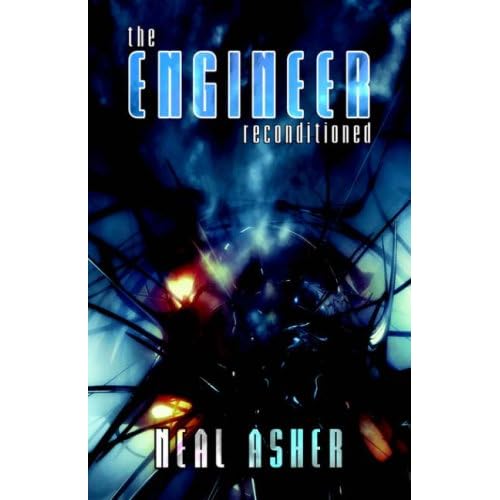
Time for some more Neal Asher. This time short fiction rather than novels. Not too much of a change for him here though.


For starters, many of the stories borrow characters or settings from novels (it could, of course, be the other way around; these are not new stories). But they also more or less continue his interest in fairly grotesque alien biologies. That's no bad thing, but it does mean that his short stories are rather similar to read to his novels.

Still, there are some very enjoyable stories in this collection. The eponymous, The Engineer, is probably the best. While it takes an element of his Polity novels, the extinct aliens known as the Jain, it fashions this into a nice, self-contained novella. Unusually for Asher, it generates a rather sympathetic strand with the resurrection of (apparently) a solitary Jain.

Other stories take in his Spatterjay series, and there's a number of stories that centre around barbarian worlds under the control of a human entity known as the Owner. These were nice because their setting is new to me, although they might become tiresome in a novel.

One aspect of Asher's writing that I both like and dislike is his goading of religious societies. Obviously, I come from the same place on this point, but I find his treatment revels a bit much in being nasty to these ignorant civilisations. While Dawkins is never this rude, I find Asher's works on this subject similar to Dawkins' less tolerant remarks. And, similarly, I suspect that this tone is liable to repel believers rather than engage with them. Hardly what we want.

Anyway, overall an enjoyable collection that sees Asher somewhat stretch his range a bit. Not up with the best of short science fiction, which tends to focus more on ideas than situations, but still good fun.

God bothering

Attended another of the Christians in Science series of seminars last night. This one was by someone I'd not heard of before, a mathematician from Oxford University called John Lennox. Obviously, this immediately added a dose of confirmation to the theory that mathematicians are more religious than physicists, who are more religious than chemists, who are more religious then biologists. Although the evil Alister McGrath does disrupt this somewhat by, once upon a time, being a biochemist.

Anyway, much like one of the previous speakers, John Polkinghorne, Lennox was a rather affable and capable speaker [*], and similarly he covered much of the same ground, ending up on familiar topics such as the fine-tuned universe and information theory. An important thrust of his seminar was that theism is the most rational standpoint to take on ultimate questions.

This latter point was quite deftly pulled off in the seminar given that it's total bunk. But Lennox was very good on a form of agreeable sophistry. A few rhetorical flourishes and he had the audience laughing and nodding along with him while accepting quite debatable points. While naturalism happily admits that it (currently) stops short of ultimate origins, Lennox (and fellow travellers) are happy to postulate an omnipotent creator god out of nowhere (and in the absence of any evidence), and then go on to describe this as some sort of null hypothesis with the minimum of assumptions. It's a pretty neat trick to be able to pull this sort of stunt off, although his audience was more or less willing him on.

As more-or-less normal for this sort of seminar, the debate was framed as atheism versus theism, with the specifics of Lennox's religion quietly ignored. Given that Polkinghorne practically went from sensible to crazy-talk within a single sentence when he introduced Jesus, this was probably a smart move from Lennox. It also means that he avoided any chance of offending members of other faiths in attendance. They could draw similar comfort from the seminar as their Christian neighbours. That said, it feels to me like it would be churlish to bring this up as a post-seminar question. It shouldn't, since it's a perfectly valid point, but it strikes me as seemingly giving up ground by attacking on another front. Also, having seen the evil McGrath questioned this way, I've seen how easily a sufficiently fork-tongued speaker can obfuscate and dodge this sort of question.

One point I'm always less clear on is whenever information theory is dragged into these sorts of discussion. It's not because I'm not well-versed in it (though I'm not), but more because my instinctive reaction is to view the statements of information theorists (who may or may not be being misquoted) as clever-sounding nonsense. Similarly to the concept of entropy in ecology, statements on information theory always sound superficially convincing (usually a speaker will venerate Gödel in there somewhere) but are too vacuous or intangible to follow easily. Lennox spoke at length about the complexity of DNA and the seeming impossibility of "creating information", but it sounded bogus from start to finish. Partly, I think, because it seems pretty obvious to me that, given enough time and a large enough planet, trillions of chance events between trillions of molecules can lead to the assembly of some form of minimally complex replicator. Evolutionary processes (duplication, mutation, natural selection) can then operate upon these replicators to generate the sort of complexity that Lennox et al. think is so difficult to explain. Or perhaps I'm just completely missing the point?

Anyway, in summary, having seen yet another of these Christians in Science seminars, I'm beginning to discern a pattern:

1. frame the debate as atheism against theism (act as if agnosticism doesn't exist)

2. use lots of quotations from famous thinkers (the argument from authority works in these seminars), and from both sides as well to give some impression of balance

3. avoid taking the seminar into a discussion of a particular faith (avoiding the Polkinghorne crazy-talk trap)

4. introduce the fine-tuned universe and the physical constants involved (the charge on a proton sounds a concrete thing)

5. information theory, fledgling though it may well be, is your friend (it's complicated enough to sound convincing, but too complicated to follow)

6. steer carefully around the mysterious, but confidently talk as though theism is the only rational response to the world

Stick to these points and, with a lay audience, you're onto a winner!

[*] Since I hadn't started this blog when I saw him, I should add that McGrath, by contrast, was a rather disreputable and disingenuous speaker who carefully misrepresented the arguments of others. That said, he did it very well, and quite convincingly, I'm sure, to some people. Definitely something of the corrupt defence lawyer about him. I spent much of his seminar rolling my eyes at his audaciousness.

Monday, 28 April 2008

Cameron George Scott ...

... has arrived. And weighs in at an impressive 10 pounds and 6 ounces (ouch!). So, Iona has a brother. I'm not sure about the name though, what with it being a little too close to the surname of a potential Tory (= evil) PM. Still, Monsieur Cameron is liable to be history by the time CGS gives a hoot about politics. Anyway, doubtless photographs will follow in abundance ...

P.S. In passing, and despite the Imperial units that Graham gave the weight in, I note that Cameron's initials are CGS, the abbreviation we use in work for centimetres, grams, seconds.

Saturday, 26 April 2008

End of the line

Had an interview for my NERC Fellowship this week. The end of the line for this procedure. I've been here once before, which was highly unsuccessful. This time was a lot better, though the smart money is on the same result.

The presentation and most of the technical questions went well, but the latter, general questions were much more difficult and I don't think I did a good job on several of them. As usual, one thinks of much better answers out of the interview room, but these questions may have been too critical to garble in the room.

The result should be known from mid-May. More on this topic then I suppose.

Wednesday, 2 April 2008

Who's watching you?

The latest novel by Jonathan Raban takes its title and narrative from a very contemporary theme: Surveillance.


The novel follows the entwining stories of several characters living in and around Seattle in the "post-9/11" world. The central character, Lucy Bengstrom, is a journalist specialising in interviewing famous subjects. Her latest is August Vanags, a former university professor now feted for an autobiography of his childhood in Second World War Europe. Lucy lives with her daughter, Alida, a high school student coming to grips with the world. Their neighbour, Tad Zachary, is one of Lucy's best friends and acts as a surrogate father to Alida, but he harbours a deep resentment of the post-9/11 changes to the political landscape, venting this in online conspiracy theory forums. Finally, Lucy and Tad find the fabric of their world upset by the arrival of a new owner for the building they share, a Chinese immigrant with plans.

As the novel progresses, Lucy and Alida gain entry into the home life of Vanags, while through her investigations Lucy gradually comes to suspect that his biography is actually a work of plagiarism or fiction. Meanwhile, as Chick plans the expansion of his property empire, and the removal of his current tenants, he decides that marriage to Lucy (completely undiscussed with Lucy) is a necessary next step. Tad, suspicious of Chick's plans for their building, uses his internet skills to investigate Chick's origins and legal status.

As with his earlier novel, Waxwings, the novel is extremely well written, and successfully embraces the different narrative viewpoints. In fact, it's going great guns until, suddenly, it finishes. The novel moves from "full speed ahead" to "dead stop" in about 15 rather unconvincing pages. All of the novel's threads are suddenly wrapped up, disregarded or (almost literally) swamped by a deus ex machina. While there's a sense in which this event is perhaps fitting (i.e. an overwhelming natural event overshadows the lives of the protagonists), it mostly feels like the author had reached a final publishing deadline.

I've consulted with C and with JA, who've also read the novel, and they too found its sudden conclusion both surprising and unsatisfying. Especially given that the novel was proceeding very promisingly just 20 or so pages earlier. So, for all its quality, a rather inconclusive and faintly negative review from me. I'd love to know what Raban was thinking.

As an aside, although not billed as such (at least on our copy), the novel is apparently part of a loose trilogy, started by Raban's previous novel, Waxwings. This shares a location and the present day setting with ''Surveillance'', but also the character of the Chinese immigrant, Chick. In ''Surveillance'' Chick has risen up the commercial foodchain, graduating from odd jobs to property management. Where next?

Tuesday, 1 April 2008

More ducks

We now have two pairs of ducks in the quadrangle. Last week a male joined the solitary female, and then yesterday a second male arrived (much, apparently, to the annoyance of the already ensconced male). Today we appear to have another female, bringing our total to four ducks, and possibly settling down any competitions for mates.

Reading the Wikipedia, however, we've found out a number of disturbing sociopathic tendencies in ducks. Firstly, males tend only to hang around until their current mate lays her eggs. Buggering off is then the favoured strategy. Presumably they're off to find a further mate, but it hardly seems fair to their current one (in terms of loyalty and resources, this seems a tad selfish). Secondly, while raising their broods, female ducks will seek out and kill the ducklings of neighbouring females. We think this might even have happened last year, although we've no hard evidence of this beyond the disappearance (they could have fledged) of one of our two females and her brood. Given that female ducks have to raise 3 or 4 ducklings on their own, and will ordinarily encounter adverse resource conditions, this perhaps isn't surprising, but it's not quite what one expects from seemingly placid and docile birds.

Anyway, we'll continue to keep an eye out for appearance of ducklings. Philanderers and child murderers the ducks may well be, but they provide a measure of entertainment to this office at any rate.