


Thursday, 8 May 2008
Duck update
Despite several weeks of apparent absence, the ducks are back, and they have lots of chicks! Yesterday it appeared that we had a single mother in the quad with a record (in our somewhat limited experience) seven chicks. However, today it appears that we have a second mother in the quad, with an as-yet-unknown number of chicks. We've heard them, we know roughly which bush they're in, but we haven't been able to count them yet. It could just be that, statistically, we've not been looking for long enough, but it may be that the second batch of chicks are too still young to follow their mother out of the nest. Anyway, thus far it doesn't appear that anyone's feeding them, so deleterious competition for resources may result. And we've suspicions about where that led last year. Also, the mother whose chicks we've seen occupies the sector of the quad that affords her easy access to both of the ponds. A definite disparity there. So it's all still to play for.


Wednesday, 7 May 2008
Rendezvous with the Book Group
Almost immediately after my interrogation by the NERC Fellowship panel, I spent the evening with C's book group in London (at the Royal Festival Hall) discussing their latest (and anomalous) pick, Arthur C. Clarke's Rendezvous with Rama. I was essentially drafted in as the guest "science fiction expert" for the evening. The book was picked in response to Clarke's recent death.

Although I had read the book many years ago (probably close to 20), since I was supposed to represent something approaching an "expert", I thought that I'd better read it again.
The novel is set several centuries in the future, and focuses on the arrival to the solar system of what appears to be an alien spaceship. At first mistaken for an asteroid, the ship is finally resolved as an unmarked cylinder, approximately 50 km in length by 20 km in diameter. Christened "Rama", the closest team of engineers and scientists is sent by the "United Planets" to intercept and, if necessary, explore the ship. Upon reaching Rama, they find no evidence of its habitation so dock with it and begin their exploration. Inside, they find a dark, frigid landscape, with hints of former habitation but little direct evidence of this now. However, as Rama continues to approach the sun, it begins a process of seeming activation. It becomes illuminated, its frozen sea melts and it appears to spawn biological robots, biots, to service and repair itself. However, neither Rama's builders nor its controlling intelligence ever reveal themselves to the visiting scientists, nor does Rama even acknowledge humanity. After a number of adventures inside Rama, the scientists are forced to abandon it as it appears to be settling into a threatening orbit around the sun. However, Rama continues to surprise when, after more course alterations, it plunges into the sun, seemingly restoring itself, before activating a star-drive to begin its voyage out of the solar system to an unknown destination. Leaving all of the important questions unanswered, Rama does give one scientist a lingering thought: systems and structures were triplicated throughout the cylinder - could this visit be the first of three?
Somewhat to my surprise, I thought that the novel actually both bears a second reading, and has survived the test of time. Certainly, it bears some of the hallmarks of classic science fiction: weak characterisation, dodgy technological extrapolation and potentially ruinous sociology. But, as classic science fiction goes, it doesn't suffer much from these. Characterisation, while still relatively weak, doesn't distract from the novel, which manages to deftly focus attention on Rama itself. In what I now realise is a nice touch, Clarke avoids much description of the technology of the future. Computers, etc., are mentioned in passing, but detail is almost completely omitted, avoiding clunky anachonisms and allowing the reader to fill things in for themselves. And though it introduces some odd sociological developments, for instance polygamy, it balances this with polyandry and a generally progressive politics (but more later). Compared with another so-called science fiction classic that I reviewed earlier, Ringworld, Rendezvous with Rama feels like it was written in much more enlightened times (in reality, only three years separate them).
Reading again, I was struck by how Clarke gradually ratchets up the sense of mystery surrounding Rama, and draws the reader through by gradually revealing more and more about the cylinder. I think it's something of a masterstroke to leave things completely unexplained, especially when he put in so much groundwork that it must have been tempting to explain away everything. But it allows the reader to fill things in for themselves, while underscoring (for this reader) the lack of interest the wider universe has for humanity. Away from the deeper philosophical angles of the novel, I liked the interludes away from Rama that deal with the efforts of government experts to interpret what the scientists aboard Rama are encountering. These sections are written with quite a light touch, and are quite amusing at times. Even if they do stereotype the residents of planet Mercury somewhat! I was also impressed with the attention to detail in describing the interior of Rama (but see below). Without it being obtrusive, he carefully introduces all of the concepts needed to understand how Rama works, and how it would appear to a visitor. That said, the book group's consensus was that he spends a little too much time describing how the explorers move up and down the series of staircases from the centre of the cylinder to its inner surface. Repeated descriptions of climbing stairs is not something one expects in a novel.
Much to both my surprise, and that of the book group's members, Rendezvous with Rama was something of a surprise success with the readers. While almost all of them qualified their opinion by noting that it wasn't anywhere near as bad as they had expected, this low expectation seems to have won the day for the book, leading to an average score around 6/10 (which, for context, puts it to the fore of the books that the group has discussed - much to the surprise of the group's members!). The book also spawned a lot of discussion about the structure of Rama itself, its purpose and topics such as its gender politics (the book group, bar me, was exclusively female).
The structure of Rama is something that caused a lot of the book group a lot of trouble. Although Clarke describes the interior of Rama in some length, people had a lot of trouble envisioning how it was organised and where important features were located. I think even imagining that the ground would wrap up and over a standing observer caused trouble - let alone that everywhere on the interior surface would feel "down", but that the centre of the cylinder would be weightless. While adding diagrams to the novel would be a huge mistake (though some novels do commit this), a better cover image would definitely have helped here. Clarke certainly put in the spadework with his descriptions, but they're clearly not sufficient for many people. With my long experience of science fiction structures like Halo, I'm probably not a good person to judge here though.
One interesting point that came up in discussion was whether Clarke was putting any religious interpretations onto Rama. One reader thought that Clarke, by introducing an odd Christ-the-Astronaut sect, was being dismissive of religion. Thinking about it myself, the book does almost completely avoid discussing this dimension of Rama. The appearance of such an obviously alien artifact should have profound implications for religious people, so it seems odd that there's no mention of this. It might be that Clarke preferred to let readers mull this over for themselves, but it could also be that, by marginalising religion to an obscure sect, Clarke intended to suggest the withering of religion in the future. Certainly, he consistently paints a universe in which humanity is presented with its unimportance, but he may just have been leaving this for his readers to sort out for themselves. The sequels are, to near-fatal cost, far less mysterious on this point. But the less said about those, the better.
Regarding the purpose of Rama, the group didn't have a strong consensus. However, in the context of explaining why the sequels shouldn't really be read, I gave my interpretation and that seemed to be generally favourably viewed (though that could have just been "anything for a quiet life"). As I've already suggested above, my take is that Rama is on a voyage, but needs to stop at stars along the way. Its inhabitants who, the novel hints, may be stored in some electronic format, aren't woken up at these junctures, and may just await Rama's arrival at its final destination. Read this way, the novel aims to illustrate humanity's rather limited importance in the cosmos. Much as science has time and time again revealed facts that downplay human significance, the novel describes a further interstellar slap in the face, where aliens are so uninterested in humanity that they don't bother to communicate with them. A corollary from this is that the aliens don't bother because intelligent life isn't so rare in the universe, although this idea isn't pursued in the novel (much like the previous statement!).
Anyway, in the end I gave the novel 8 out of 10. It deserves a 9 in a science fiction context, but relative to the range of literature I've read, it needs to drop a point. Were I holding my hand on my heart, and comparing to all of the novels that I've ever read, it'd probably have to drop to a 7 or a 6.5, but the pressure of being the "science fiction expert" at a literary fiction book group got to me, and I had to defend the genre.
I should add in passing that the book group was a lot of fun. Aside from its entertainment value, it's a really nice way to get a wider perspective on a novel. I had thought that Rendezvous with Rama was fairly straightforward, but was impressed with how much other people got from it. It certainly made me think more critically about my own interpretation of the book.

Although I had read the book many years ago (probably close to 20), since I was supposed to represent something approaching an "expert", I thought that I'd better read it again.
The novel is set several centuries in the future, and focuses on the arrival to the solar system of what appears to be an alien spaceship. At first mistaken for an asteroid, the ship is finally resolved as an unmarked cylinder, approximately 50 km in length by 20 km in diameter. Christened "Rama", the closest team of engineers and scientists is sent by the "United Planets" to intercept and, if necessary, explore the ship. Upon reaching Rama, they find no evidence of its habitation so dock with it and begin their exploration. Inside, they find a dark, frigid landscape, with hints of former habitation but little direct evidence of this now. However, as Rama continues to approach the sun, it begins a process of seeming activation. It becomes illuminated, its frozen sea melts and it appears to spawn biological robots, biots, to service and repair itself. However, neither Rama's builders nor its controlling intelligence ever reveal themselves to the visiting scientists, nor does Rama even acknowledge humanity. After a number of adventures inside Rama, the scientists are forced to abandon it as it appears to be settling into a threatening orbit around the sun. However, Rama continues to surprise when, after more course alterations, it plunges into the sun, seemingly restoring itself, before activating a star-drive to begin its voyage out of the solar system to an unknown destination. Leaving all of the important questions unanswered, Rama does give one scientist a lingering thought: systems and structures were triplicated throughout the cylinder - could this visit be the first of three?
Somewhat to my surprise, I thought that the novel actually both bears a second reading, and has survived the test of time. Certainly, it bears some of the hallmarks of classic science fiction: weak characterisation, dodgy technological extrapolation and potentially ruinous sociology. But, as classic science fiction goes, it doesn't suffer much from these. Characterisation, while still relatively weak, doesn't distract from the novel, which manages to deftly focus attention on Rama itself. In what I now realise is a nice touch, Clarke avoids much description of the technology of the future. Computers, etc., are mentioned in passing, but detail is almost completely omitted, avoiding clunky anachonisms and allowing the reader to fill things in for themselves. And though it introduces some odd sociological developments, for instance polygamy, it balances this with polyandry and a generally progressive politics (but more later). Compared with another so-called science fiction classic that I reviewed earlier, Ringworld, Rendezvous with Rama feels like it was written in much more enlightened times (in reality, only three years separate them).
Reading again, I was struck by how Clarke gradually ratchets up the sense of mystery surrounding Rama, and draws the reader through by gradually revealing more and more about the cylinder. I think it's something of a masterstroke to leave things completely unexplained, especially when he put in so much groundwork that it must have been tempting to explain away everything. But it allows the reader to fill things in for themselves, while underscoring (for this reader) the lack of interest the wider universe has for humanity. Away from the deeper philosophical angles of the novel, I liked the interludes away from Rama that deal with the efforts of government experts to interpret what the scientists aboard Rama are encountering. These sections are written with quite a light touch, and are quite amusing at times. Even if they do stereotype the residents of planet Mercury somewhat! I was also impressed with the attention to detail in describing the interior of Rama (but see below). Without it being obtrusive, he carefully introduces all of the concepts needed to understand how Rama works, and how it would appear to a visitor. That said, the book group's consensus was that he spends a little too much time describing how the explorers move up and down the series of staircases from the centre of the cylinder to its inner surface. Repeated descriptions of climbing stairs is not something one expects in a novel.
Much to both my surprise, and that of the book group's members, Rendezvous with Rama was something of a surprise success with the readers. While almost all of them qualified their opinion by noting that it wasn't anywhere near as bad as they had expected, this low expectation seems to have won the day for the book, leading to an average score around 6/10 (which, for context, puts it to the fore of the books that the group has discussed - much to the surprise of the group's members!). The book also spawned a lot of discussion about the structure of Rama itself, its purpose and topics such as its gender politics (the book group, bar me, was exclusively female).
The structure of Rama is something that caused a lot of the book group a lot of trouble. Although Clarke describes the interior of Rama in some length, people had a lot of trouble envisioning how it was organised and where important features were located. I think even imagining that the ground would wrap up and over a standing observer caused trouble - let alone that everywhere on the interior surface would feel "down", but that the centre of the cylinder would be weightless. While adding diagrams to the novel would be a huge mistake (though some novels do commit this), a better cover image would definitely have helped here. Clarke certainly put in the spadework with his descriptions, but they're clearly not sufficient for many people. With my long experience of science fiction structures like Halo, I'm probably not a good person to judge here though.
One interesting point that came up in discussion was whether Clarke was putting any religious interpretations onto Rama. One reader thought that Clarke, by introducing an odd Christ-the-Astronaut sect, was being dismissive of religion. Thinking about it myself, the book does almost completely avoid discussing this dimension of Rama. The appearance of such an obviously alien artifact should have profound implications for religious people, so it seems odd that there's no mention of this. It might be that Clarke preferred to let readers mull this over for themselves, but it could also be that, by marginalising religion to an obscure sect, Clarke intended to suggest the withering of religion in the future. Certainly, he consistently paints a universe in which humanity is presented with its unimportance, but he may just have been leaving this for his readers to sort out for themselves. The sequels are, to near-fatal cost, far less mysterious on this point. But the less said about those, the better.
Regarding the purpose of Rama, the group didn't have a strong consensus. However, in the context of explaining why the sequels shouldn't really be read, I gave my interpretation and that seemed to be generally favourably viewed (though that could have just been "anything for a quiet life"). As I've already suggested above, my take is that Rama is on a voyage, but needs to stop at stars along the way. Its inhabitants who, the novel hints, may be stored in some electronic format, aren't woken up at these junctures, and may just await Rama's arrival at its final destination. Read this way, the novel aims to illustrate humanity's rather limited importance in the cosmos. Much as science has time and time again revealed facts that downplay human significance, the novel describes a further interstellar slap in the face, where aliens are so uninterested in humanity that they don't bother to communicate with them. A corollary from this is that the aliens don't bother because intelligent life isn't so rare in the universe, although this idea isn't pursued in the novel (much like the previous statement!).
Anyway, in the end I gave the novel 8 out of 10. It deserves a 9 in a science fiction context, but relative to the range of literature I've read, it needs to drop a point. Were I holding my hand on my heart, and comparing to all of the novels that I've ever read, it'd probably have to drop to a 7 or a 6.5, but the pressure of being the "science fiction expert" at a literary fiction book group got to me, and I had to defend the genre.
I should add in passing that the book group was a lot of fun. Aside from its entertainment value, it's a really nice way to get a wider perspective on a novel. I had thought that Rendezvous with Rama was fairly straightforward, but was impressed with how much other people got from it. It certainly made me think more critically about my own interpretation of the book.
Monday, 5 May 2008
A harbringer of summer
For future reference, this post serves to note the arrival of the first symptoms of hay fever for this year. Only itchy eyes so far, but if past form is anything to go by more (and more irritating) symptoms should be arriving forthwith. And I was just beginning to think that I'd dodged that bullet this year.
Wednesday, 30 April 2008
Does it Matter?
Iain Banks' latest novel, Matter, returns to his fictional utopia, the Culture. Similarly to earlier Culture works, it is a standalone novel, taking in events, places and characters that are new to the wider Culture universe.

Particularly new is the majority setting of the novel, Sursamen, an ancient and bizarre shellworld. These worlds consist of a series of concentric spheres, Russian doll style, over which different civilizations have dominion. The shellworlds are the remains of a galaxy-wide system of unknown purpose, whose builders have almost completely left the galactic stage. On Sursamen, the humanoid Sarl live a pre-industrial and feudal existence, dimly aware of the more powerful civilizations around them. However, as the story unfolds, these civilizations have goals in which the Sarl are merely pawns.
The novel centres on the royal family of Sarl, two brothers and a sister. In a move befitting her lowly female status, the sister, Djan, has been bartered away to an advanced civilization by the king, and has left the shellworld. As the novel opens, the two remaining brothers find their society victorious in a war over another humanoid faction. However, at the moment of victory, their father is murdered by his trusted second-in-command, tyl Loesp, an event accidentally witnessed by the older brother, Ferbin. Forced to flee, he and his manservant gradually ascend the levels of the shellworld in search of Djan, who he knows will have the technology to help him. Meanwhile, his younger brother, Oramen, oblivious to tyl Loesp's treachery, awaits his coming of age and his ascendence of the throne. Against this backdrop, the Oct, a more advanced civilization who assisted the Sarl in their victory, use them to excavate a drowned city on the level captured by the Sarl. They are single-mindedly seeking evidence of their bloodline with the builders of the shellworld, but are blind to those others who have different plans. Far off in her work with the Culture, Djan hears of the events in the shellworld, and begins her own return to Sursamen.
The novel follows the paths of the three siblings as they gradually come together, and as they become embroiled in the larger-scale events that the actions of the Oct have triggered.
In respect of its pre-industrial setting, the novel is a more satisfying version of Banks' earlier novel Inversions. That suffered from focusing far too heavily on the primitive civilization, to the extent that the direct connection with the Culture boiled down to a few sentences and a subtext. Here, Banks places the events with the Sarl in the wider context, allowing him to bring in the usual Culture "treats" (drones, Minds and aliens) and to further expand the universe of the Culture.
That said, while enjoyable, it's difficult to discern any meaning to the events in the novel. While the Oct's intervention with the Sarl could be viewed through the prism of the West's interference in the developing world, the malign turn of events that the Oct precipitate is more clearly "a bad thing", and has no strong parallel. This is unlike the previous Culture novel, Look to Windward, where, alongside the "treats", Banks wove a much more interesting moral tale that explicitly dealt with the negative, and the positive, sides of the Culture's own interventions. This novel is much more of a rollercoaster ride.
Nonetheless, Banks again reveals himself as a master storyteller. The backdrop of the shellworlds is handled brilliantly, with their scale and history gradually drawn out as the novel progresses. Banks also succeeds in populating his universe even more fully than normally with a succession of competing and political civilizations. He also invests in his characters, with the spoilt brothers gradually evolving responsibility and facing up to their challenges. Djan, who has long since had her eyes opened by her adoption in the Culture, is at once a more sympathetic character, though her worldliness means that character growth is less pronounced.
Anyway, as noted here before, Banks is really the author to beat in Space Opera. Asher et al. don't really come close (no matter how much they adopt his material). If only Banks wrote more frequently.
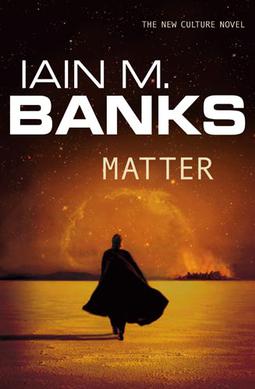
Particularly new is the majority setting of the novel, Sursamen, an ancient and bizarre shellworld. These worlds consist of a series of concentric spheres, Russian doll style, over which different civilizations have dominion. The shellworlds are the remains of a galaxy-wide system of unknown purpose, whose builders have almost completely left the galactic stage. On Sursamen, the humanoid Sarl live a pre-industrial and feudal existence, dimly aware of the more powerful civilizations around them. However, as the story unfolds, these civilizations have goals in which the Sarl are merely pawns.
The novel centres on the royal family of Sarl, two brothers and a sister. In a move befitting her lowly female status, the sister, Djan, has been bartered away to an advanced civilization by the king, and has left the shellworld. As the novel opens, the two remaining brothers find their society victorious in a war over another humanoid faction. However, at the moment of victory, their father is murdered by his trusted second-in-command, tyl Loesp, an event accidentally witnessed by the older brother, Ferbin. Forced to flee, he and his manservant gradually ascend the levels of the shellworld in search of Djan, who he knows will have the technology to help him. Meanwhile, his younger brother, Oramen, oblivious to tyl Loesp's treachery, awaits his coming of age and his ascendence of the throne. Against this backdrop, the Oct, a more advanced civilization who assisted the Sarl in their victory, use them to excavate a drowned city on the level captured by the Sarl. They are single-mindedly seeking evidence of their bloodline with the builders of the shellworld, but are blind to those others who have different plans. Far off in her work with the Culture, Djan hears of the events in the shellworld, and begins her own return to Sursamen.
The novel follows the paths of the three siblings as they gradually come together, and as they become embroiled in the larger-scale events that the actions of the Oct have triggered.
In respect of its pre-industrial setting, the novel is a more satisfying version of Banks' earlier novel Inversions. That suffered from focusing far too heavily on the primitive civilization, to the extent that the direct connection with the Culture boiled down to a few sentences and a subtext. Here, Banks places the events with the Sarl in the wider context, allowing him to bring in the usual Culture "treats" (drones, Minds and aliens) and to further expand the universe of the Culture.
That said, while enjoyable, it's difficult to discern any meaning to the events in the novel. While the Oct's intervention with the Sarl could be viewed through the prism of the West's interference in the developing world, the malign turn of events that the Oct precipitate is more clearly "a bad thing", and has no strong parallel. This is unlike the previous Culture novel, Look to Windward, where, alongside the "treats", Banks wove a much more interesting moral tale that explicitly dealt with the negative, and the positive, sides of the Culture's own interventions. This novel is much more of a rollercoaster ride.
Nonetheless, Banks again reveals himself as a master storyteller. The backdrop of the shellworlds is handled brilliantly, with their scale and history gradually drawn out as the novel progresses. Banks also succeeds in populating his universe even more fully than normally with a succession of competing and political civilizations. He also invests in his characters, with the spoilt brothers gradually evolving responsibility and facing up to their challenges. Djan, who has long since had her eyes opened by her adoption in the Culture, is at once a more sympathetic character, though her worldliness means that character growth is less pronounced.
Anyway, as noted here before, Banks is really the author to beat in Space Opera. Asher et al. don't really come close (no matter how much they adopt his material). If only Banks wrote more frequently.
Tuesday, 29 April 2008
The Engineer
Time for some more Neal Asher. This time short fiction rather than novels. Not too much of a change for him here though.

For starters, many of the stories borrow characters or settings from novels (it could, of course, be the other way around; these are not new stories). But they also more or less continue his interest in fairly grotesque alien biologies. That's no bad thing, but it does mean that his short stories are rather similar to read to his novels.
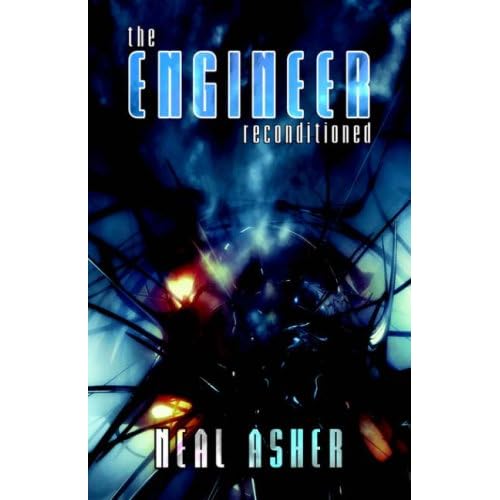
Still, there are some very enjoyable stories in this collection. The eponymous, The Engineer, is probably the best. While it takes an element of his Polity novels, the extinct aliens known as the Jain, it fashions this into a nice, self-contained novella. Unusually for Asher, it generates a rather sympathetic strand with the resurrection of (apparently) a solitary Jain.
Other stories take in his Spatterjay series, and there's a number of stories that centre around barbarian worlds under the control of a human entity known as the Owner. These were nice because their setting is new to me, although they might become tiresome in a novel.
One aspect of Asher's writing that I both like and dislike is his goading of religious societies. Obviously, I come from the same place on this point, but I find his treatment revels a bit much in being nasty to these ignorant civilisations. While Dawkins is never this rude, I find Asher's works on this subject similar to Dawkins' less tolerant remarks. And, similarly, I suspect that this tone is liable to repel believers rather than engage with them. Hardly what we want.
Anyway, overall an enjoyable collection that sees Asher somewhat stretch his range a bit. Not up with the best of short science fiction, which tends to focus more on ideas than situations, but still good fun.
For starters, many of the stories borrow characters or settings from novels (it could, of course, be the other way around; these are not new stories). But they also more or less continue his interest in fairly grotesque alien biologies. That's no bad thing, but it does mean that his short stories are rather similar to read to his novels.
Still, there are some very enjoyable stories in this collection. The eponymous, The Engineer, is probably the best. While it takes an element of his Polity novels, the extinct aliens known as the Jain, it fashions this into a nice, self-contained novella. Unusually for Asher, it generates a rather sympathetic strand with the resurrection of (apparently) a solitary Jain.
Other stories take in his Spatterjay series, and there's a number of stories that centre around barbarian worlds under the control of a human entity known as the Owner. These were nice because their setting is new to me, although they might become tiresome in a novel.
One aspect of Asher's writing that I both like and dislike is his goading of religious societies. Obviously, I come from the same place on this point, but I find his treatment revels a bit much in being nasty to these ignorant civilisations. While Dawkins is never this rude, I find Asher's works on this subject similar to Dawkins' less tolerant remarks. And, similarly, I suspect that this tone is liable to repel believers rather than engage with them. Hardly what we want.
Anyway, overall an enjoyable collection that sees Asher somewhat stretch his range a bit. Not up with the best of short science fiction, which tends to focus more on ideas than situations, but still good fun.
God bothering
Attended another of the Christians in Science series of seminars last night. This one was by someone I'd not heard of before, a mathematician from Oxford University called John Lennox. Obviously, this immediately added a dose of confirmation to the theory that mathematicians are more religious than physicists, who are more religious than chemists, who are more religious then biologists. Although the evil Alister McGrath does disrupt this somewhat by, once upon a time, being a biochemist.
Anyway, much like one of the previous speakers, John Polkinghorne, Lennox was a rather affable and capable speaker [*], and similarly he covered much of the same ground, ending up on familiar topics such as the fine-tuned universe and information theory. An important thrust of his seminar was that theism is the most rational standpoint to take on ultimate questions.
This latter point was quite deftly pulled off in the seminar given that it's total bunk. But Lennox was very good on a form of agreeable sophistry. A few rhetorical flourishes and he had the audience laughing and nodding along with him while accepting quite debatable points. While naturalism happily admits that it (currently) stops short of ultimate origins, Lennox (and fellow travellers) are happy to postulate an omnipotent creator god out of nowhere (and in the absence of any evidence), and then go on to describe this as some sort of null hypothesis with the minimum of assumptions. It's a pretty neat trick to be able to pull this sort of stunt off, although his audience was more or less willing him on.
As more-or-less normal for this sort of seminar, the debate was framed as atheism versus theism, with the specifics of Lennox's religion quietly ignored. Given that Polkinghorne practically went from sensible to crazy-talk within a single sentence when he introduced Jesus, this was probably a smart move from Lennox. It also means that he avoided any chance of offending members of other faiths in attendance. They could draw similar comfort from the seminar as their Christian neighbours. That said, it feels to me like it would be churlish to bring this up as a post-seminar question. It shouldn't, since it's a perfectly valid point, but it strikes me as seemingly giving up ground by attacking on another front. Also, having seen the evil McGrath questioned this way, I've seen how easily a sufficiently fork-tongued speaker can obfuscate and dodge this sort of question.
One point I'm always less clear on is whenever information theory is dragged into these sorts of discussion. It's not because I'm not well-versed in it (though I'm not), but more because my instinctive reaction is to view the statements of information theorists (who may or may not be being misquoted) as clever-sounding nonsense. Similarly to the concept of entropy in ecology, statements on information theory always sound superficially convincing (usually a speaker will venerate Gödel in there somewhere) but are too vacuous or intangible to follow easily. Lennox spoke at length about the complexity of DNA and the seeming impossibility of "creating information", but it sounded bogus from start to finish. Partly, I think, because it seems pretty obvious to me that, given enough time and a large enough planet, trillions of chance events between trillions of molecules can lead to the assembly of some form of minimally complex replicator. Evolutionary processes (duplication, mutation, natural selection) can then operate upon these replicators to generate the sort of complexity that Lennox et al. think is so difficult to explain. Or perhaps I'm just completely missing the point?
Anyway, in summary, having seen yet another of these Christians in Science seminars, I'm beginning to discern a pattern:
1. frame the debate as atheism against theism (act as if agnosticism doesn't exist)
2. use lots of quotations from famous thinkers (the argument from authority works in these seminars), and from both sides as well to give some impression of balance
3. avoid taking the seminar into a discussion of a particular faith (avoiding the Polkinghorne crazy-talk trap)
4. introduce the fine-tuned universe and the physical constants involved (the charge on a proton sounds a concrete thing)
5. information theory, fledgling though it may well be, is your friend (it's complicated enough to sound convincing, but too complicated to follow)
6. steer carefully around the mysterious, but confidently talk as though theism is the only rational response to the world
Stick to these points and, with a lay audience, you're onto a winner!
[*] Since I hadn't started this blog when I saw him, I should add that McGrath, by contrast, was a rather disreputable and disingenuous speaker who carefully misrepresented the arguments of others. That said, he did it very well, and quite convincingly, I'm sure, to some people. Definitely something of the corrupt defence lawyer about him. I spent much of his seminar rolling my eyes at his audaciousness.
Anyway, much like one of the previous speakers, John Polkinghorne, Lennox was a rather affable and capable speaker [*], and similarly he covered much of the same ground, ending up on familiar topics such as the fine-tuned universe and information theory. An important thrust of his seminar was that theism is the most rational standpoint to take on ultimate questions.
This latter point was quite deftly pulled off in the seminar given that it's total bunk. But Lennox was very good on a form of agreeable sophistry. A few rhetorical flourishes and he had the audience laughing and nodding along with him while accepting quite debatable points. While naturalism happily admits that it (currently) stops short of ultimate origins, Lennox (and fellow travellers) are happy to postulate an omnipotent creator god out of nowhere (and in the absence of any evidence), and then go on to describe this as some sort of null hypothesis with the minimum of assumptions. It's a pretty neat trick to be able to pull this sort of stunt off, although his audience was more or less willing him on.
As more-or-less normal for this sort of seminar, the debate was framed as atheism versus theism, with the specifics of Lennox's religion quietly ignored. Given that Polkinghorne practically went from sensible to crazy-talk within a single sentence when he introduced Jesus, this was probably a smart move from Lennox. It also means that he avoided any chance of offending members of other faiths in attendance. They could draw similar comfort from the seminar as their Christian neighbours. That said, it feels to me like it would be churlish to bring this up as a post-seminar question. It shouldn't, since it's a perfectly valid point, but it strikes me as seemingly giving up ground by attacking on another front. Also, having seen the evil McGrath questioned this way, I've seen how easily a sufficiently fork-tongued speaker can obfuscate and dodge this sort of question.
One point I'm always less clear on is whenever information theory is dragged into these sorts of discussion. It's not because I'm not well-versed in it (though I'm not), but more because my instinctive reaction is to view the statements of information theorists (who may or may not be being misquoted) as clever-sounding nonsense. Similarly to the concept of entropy in ecology, statements on information theory always sound superficially convincing (usually a speaker will venerate Gödel in there somewhere) but are too vacuous or intangible to follow easily. Lennox spoke at length about the complexity of DNA and the seeming impossibility of "creating information", but it sounded bogus from start to finish. Partly, I think, because it seems pretty obvious to me that, given enough time and a large enough planet, trillions of chance events between trillions of molecules can lead to the assembly of some form of minimally complex replicator. Evolutionary processes (duplication, mutation, natural selection) can then operate upon these replicators to generate the sort of complexity that Lennox et al. think is so difficult to explain. Or perhaps I'm just completely missing the point?
Anyway, in summary, having seen yet another of these Christians in Science seminars, I'm beginning to discern a pattern:
1. frame the debate as atheism against theism (act as if agnosticism doesn't exist)
2. use lots of quotations from famous thinkers (the argument from authority works in these seminars), and from both sides as well to give some impression of balance
3. avoid taking the seminar into a discussion of a particular faith (avoiding the Polkinghorne crazy-talk trap)
4. introduce the fine-tuned universe and the physical constants involved (the charge on a proton sounds a concrete thing)
5. information theory, fledgling though it may well be, is your friend (it's complicated enough to sound convincing, but too complicated to follow)
6. steer carefully around the mysterious, but confidently talk as though theism is the only rational response to the world
Stick to these points and, with a lay audience, you're onto a winner!
[*] Since I hadn't started this blog when I saw him, I should add that McGrath, by contrast, was a rather disreputable and disingenuous speaker who carefully misrepresented the arguments of others. That said, he did it very well, and quite convincingly, I'm sure, to some people. Definitely something of the corrupt defence lawyer about him. I spent much of his seminar rolling my eyes at his audaciousness.
Monday, 28 April 2008
Cameron George Scott ...
... has arrived. And weighs in at an impressive 10 pounds and 6 ounces (ouch!). So, Iona has a brother. I'm not sure about the name though, what with it being a little too close to the surname of a potential Tory (= evil) PM. Still, Monsieur Cameron is liable to be history by the time CGS gives a hoot about politics. Anyway, doubtless photographs will follow in abundance ...
P.S. In passing, and despite the Imperial units that Graham gave the weight in, I note that Cameron's initials are CGS, the abbreviation we use in work for centimetres, grams, seconds.
P.S. In passing, and despite the Imperial units that Graham gave the weight in, I note that Cameron's initials are CGS, the abbreviation we use in work for centimetres, grams, seconds.
Saturday, 26 April 2008
End of the line
Had an interview for my NERC Fellowship this week. The end of the line for this procedure. I've been here once before, which was highly unsuccessful. This time was a lot better, though the smart money is on the same result.
The presentation and most of the technical questions went well, but the latter, general questions were much more difficult and I don't think I did a good job on several of them. As usual, one thinks of much better answers out of the interview room, but these questions may have been too critical to garble in the room.
The result should be known from mid-May. More on this topic then I suppose.
The presentation and most of the technical questions went well, but the latter, general questions were much more difficult and I don't think I did a good job on several of them. As usual, one thinks of much better answers out of the interview room, but these questions may have been too critical to garble in the room.
The result should be known from mid-May. More on this topic then I suppose.
Wednesday, 2 April 2008
Who's watching you?
The latest novel by Jonathan Raban takes its title and narrative from a very contemporary theme: Surveillance.

The novel follows the entwining stories of several characters living in and around Seattle in the "post-9/11" world. The central character, Lucy Bengstrom, is a journalist specialising in interviewing famous subjects. Her latest is August Vanags, a former university professor now feted for an autobiography of his childhood in Second World War Europe. Lucy lives with her daughter, Alida, a high school student coming to grips with the world. Their neighbour, Tad Zachary, is one of Lucy's best friends and acts as a surrogate father to Alida, but he harbours a deep resentment of the post-9/11 changes to the political landscape, venting this in online conspiracy theory forums. Finally, Lucy and Tad find the fabric of their world upset by the arrival of a new owner for the building they share, a Chinese immigrant with plans.
As the novel progresses, Lucy and Alida gain entry into the home life of Vanags, while through her investigations Lucy gradually comes to suspect that his biography is actually a work of plagiarism or fiction. Meanwhile, as Chick plans the expansion of his property empire, and the removal of his current tenants, he decides that marriage to Lucy (completely undiscussed with Lucy) is a necessary next step. Tad, suspicious of Chick's plans for their building, uses his internet skills to investigate Chick's origins and legal status.
As with his earlier novel, Waxwings, the novel is extremely well written, and successfully embraces the different narrative viewpoints. In fact, it's going great guns until, suddenly, it finishes. The novel moves from "full speed ahead" to "dead stop" in about 15 rather unconvincing pages. All of the novel's threads are suddenly wrapped up, disregarded or (almost literally) swamped by a deus ex machina. While there's a sense in which this event is perhaps fitting (i.e. an overwhelming natural event overshadows the lives of the protagonists), it mostly feels like the author had reached a final publishing deadline.
I've consulted with C and with JA, who've also read the novel, and they too found its sudden conclusion both surprising and unsatisfying. Especially given that the novel was proceeding very promisingly just 20 or so pages earlier. So, for all its quality, a rather inconclusive and faintly negative review from me. I'd love to know what Raban was thinking.
As an aside, although not billed as such (at least on our copy), the novel is apparently part of a loose trilogy, started by Raban's previous novel, Waxwings. This shares a location and the present day setting with ''Surveillance'', but also the character of the Chinese immigrant, Chick. In ''Surveillance'' Chick has risen up the commercial foodchain, graduating from odd jobs to property management. Where next?

The novel follows the entwining stories of several characters living in and around Seattle in the "post-9/11" world. The central character, Lucy Bengstrom, is a journalist specialising in interviewing famous subjects. Her latest is August Vanags, a former university professor now feted for an autobiography of his childhood in Second World War Europe. Lucy lives with her daughter, Alida, a high school student coming to grips with the world. Their neighbour, Tad Zachary, is one of Lucy's best friends and acts as a surrogate father to Alida, but he harbours a deep resentment of the post-9/11 changes to the political landscape, venting this in online conspiracy theory forums. Finally, Lucy and Tad find the fabric of their world upset by the arrival of a new owner for the building they share, a Chinese immigrant with plans.
As the novel progresses, Lucy and Alida gain entry into the home life of Vanags, while through her investigations Lucy gradually comes to suspect that his biography is actually a work of plagiarism or fiction. Meanwhile, as Chick plans the expansion of his property empire, and the removal of his current tenants, he decides that marriage to Lucy (completely undiscussed with Lucy) is a necessary next step. Tad, suspicious of Chick's plans for their building, uses his internet skills to investigate Chick's origins and legal status.
As with his earlier novel, Waxwings, the novel is extremely well written, and successfully embraces the different narrative viewpoints. In fact, it's going great guns until, suddenly, it finishes. The novel moves from "full speed ahead" to "dead stop" in about 15 rather unconvincing pages. All of the novel's threads are suddenly wrapped up, disregarded or (almost literally) swamped by a deus ex machina. While there's a sense in which this event is perhaps fitting (i.e. an overwhelming natural event overshadows the lives of the protagonists), it mostly feels like the author had reached a final publishing deadline.
I've consulted with C and with JA, who've also read the novel, and they too found its sudden conclusion both surprising and unsatisfying. Especially given that the novel was proceeding very promisingly just 20 or so pages earlier. So, for all its quality, a rather inconclusive and faintly negative review from me. I'd love to know what Raban was thinking.
As an aside, although not billed as such (at least on our copy), the novel is apparently part of a loose trilogy, started by Raban's previous novel, Waxwings. This shares a location and the present day setting with ''Surveillance'', but also the character of the Chinese immigrant, Chick. In ''Surveillance'' Chick has risen up the commercial foodchain, graduating from odd jobs to property management. Where next?
Tuesday, 1 April 2008
More ducks
We now have two pairs of ducks in the quadrangle. Last week a male joined the solitary female, and then yesterday a second male arrived (much, apparently, to the annoyance of the already ensconced male). Today we appear to have another female, bringing our total to four ducks, and possibly settling down any competitions for mates.
Reading the Wikipedia, however, we've found out a number of disturbing sociopathic tendencies in ducks. Firstly, males tend only to hang around until their current mate lays her eggs. Buggering off is then the favoured strategy. Presumably they're off to find a further mate, but it hardly seems fair to their current one (in terms of loyalty and resources, this seems a tad selfish). Secondly, while raising their broods, female ducks will seek out and kill the ducklings of neighbouring females. We think this might even have happened last year, although we've no hard evidence of this beyond the disappearance (they could have fledged) of one of our two females and her brood. Given that female ducks have to raise 3 or 4 ducklings on their own, and will ordinarily encounter adverse resource conditions, this perhaps isn't surprising, but it's not quite what one expects from seemingly placid and docile birds.
Anyway, we'll continue to keep an eye out for appearance of ducklings. Philanderers and child murderers the ducks may well be, but they provide a measure of entertainment to this office at any rate.
Reading the Wikipedia, however, we've found out a number of disturbing sociopathic tendencies in ducks. Firstly, males tend only to hang around until their current mate lays her eggs. Buggering off is then the favoured strategy. Presumably they're off to find a further mate, but it hardly seems fair to their current one (in terms of loyalty and resources, this seems a tad selfish). Secondly, while raising their broods, female ducks will seek out and kill the ducklings of neighbouring females. We think this might even have happened last year, although we've no hard evidence of this beyond the disappearance (they could have fledged) of one of our two females and her brood. Given that female ducks have to raise 3 or 4 ducklings on their own, and will ordinarily encounter adverse resource conditions, this perhaps isn't surprising, but it's not quite what one expects from seemingly placid and docile birds.
Anyway, we'll continue to keep an eye out for appearance of ducklings. Philanderers and child murderers the ducks may well be, but they provide a measure of entertainment to this office at any rate.
Friday, 28 March 2008
Interview
I got notification a while back now but, somewhat to my surprise, I'm to be interviewed for my fellowship proposal after all. Tuesday, April 22nd at 1:30pm, probably for less than a hour. I'm to prepare a short presentation (10 minutes) that covers the "thrust" of the proposal, and them I'm to submit myself to 20 or so minutes of Q & A (i.e. grilling). Quite exciting really ... up until about 1:29pm on that Tuesday I'd imagine.
Thursday, 27 March 2008
The Sunshine State (1st to 24th March)
What to say about Florida? Quickfire impressions may work best.
The best thing about Florida: the Everglades. Though significantly smaller in extent (< 30%) Everglades National Park, together with the neighbouring Big Cypress National Preserve, provide an excellent overview of subtropical wetlands. I'd never visited such swamp ecosystems before. I was particularly impressed by the coastal mangrove areas and by flooded big cypress forests. The latter were especially beautiful - although we did encounter our first snake there. I'm hoping that some of the photographs we took convey something of these areas. And, hopefully, the plans for at least partially restoring the regional runoff patterns will come to pass.
The worst thing about Florida: urban sprawl. This is a problem throughout much of the US (and the world in general), but the combination of a relatively long period of settlement with a relatively high state population had led to large parts of Florida displaying the worst aspects of US city "planning". Many of the towns we visited sprawled over several miles of low density shopping and housing districts. The ugliness of the sprawl was compounded by typically huge advertising billboards, which often spilled out of the towns into neighbouring rural or natural areas. The most striking example is the continuous urban strip running from Miami (which, to be fair, is structured like a "normal" high density city) up to West Palm Beach. Aside from the sprawl, this strip is also characterised by large numbers of gated communities, another of my personal bugbears.
Lots more to say about our trip, but I'll wait till I have photographs to add to the words.
The best thing about Florida: the Everglades. Though significantly smaller in extent (< 30%) Everglades National Park, together with the neighbouring Big Cypress National Preserve, provide an excellent overview of subtropical wetlands. I'd never visited such swamp ecosystems before. I was particularly impressed by the coastal mangrove areas and by flooded big cypress forests. The latter were especially beautiful - although we did encounter our first snake there. I'm hoping that some of the photographs we took convey something of these areas. And, hopefully, the plans for at least partially restoring the regional runoff patterns will come to pass.
The worst thing about Florida: urban sprawl. This is a problem throughout much of the US (and the world in general), but the combination of a relatively long period of settlement with a relatively high state population had led to large parts of Florida displaying the worst aspects of US city "planning". Many of the towns we visited sprawled over several miles of low density shopping and housing districts. The ugliness of the sprawl was compounded by typically huge advertising billboards, which often spilled out of the towns into neighbouring rural or natural areas. The most striking example is the continuous urban strip running from Miami (which, to be fair, is structured like a "normal" high density city) up to West Palm Beach. Aside from the sprawl, this strip is also characterised by large numbers of gated communities, another of my personal bugbears.
Lots more to say about our trip, but I'll wait till I have photographs to add to the words.
Friday, 22 February 2008
A biologist writes
I first came across Barbara Kingsolver pre-blog via her 2000 novel, Prodigal Summer. The first thing to strike me was her, at times, lyrical use of prose, and her skill at capturing the colloquialisms and truncations of spoken language. She didn't need to describe where a character came from or what their background was, it was obvious from what they said and the way in which they said it. The second thing to strike me was her fluency with ecology, and with the issues where this subject butts up against humans. Prodigal Summer has three distinct strands each of which has strong ecological undertones that strengthen and enrich its narrative. This fluency isn't too much of a surprise when one discovers that Kingsolver is a former ecologist, but it's still a rarity in my experience (certainly for literary fiction; less so for science fiction, although it's usually bludgeoned in there). Anyway, for my birthday/Christmas, C bought me her earlier novel, Animal Dreams.

The narrative centre of the novel is Codi, a former trainee doctor now returning to her hometown of Grace, Arizona, after an extended absence. She is returning in part to care for her doctor father, Homero, a standoffish pillar of the local community, who his patients fear is beginning to suffer from dementia. However, Codi is also returning amidst troubles in her own life, and with ghosts from her past in Grace to exorcise. In a backdrop to events in Arizona, and communicated in the novel by way of letters, Codi's sister Hallie works in Nicaragua teaching sustainable agriculture.
As the plot strands unfurl, Codi gradually comes to find her place in Grace, somewhere she never fitted into while growing up. Acting as a teacher, she enthuses her students, ultimately leading them in a local crusade to counter the water pollution that is slowly killing the town. However, slowly slotting back into the town creates a tension for Codi, one that is bound up in past events involving her Native American, former boyfriend, Loyd, now a train driver. Years on, they are gradually spiralling together again, but Codi, still carrying a secret from the past, is applying the brakes to retain her distance.
The novel features several Hispanic and Native American themes, but weaves them in carefully, making them almost flow naturally from the narrative of Codi's gradual absorption into Grace. There are political themes too: Codi's sister, Hallie, moves to Nicaragua to teach local people more sustainable farming techniques and dies after having been captured by the Contras. Although only noted in passing, that the paymaster of the Contras is the US is remarked upon angrily. Another political theme in the novel is the town's fight against the mining interests whose polluted water will eventually force residents to abandon it. In this the novel paints a positive picture of the role of both individual and community activism. What starts as a science project for Codi expands into something much more significant.
In passing, the novel's treatment of Homero's illness is handled very convincingly. The gradual fragmentation of his mind, and the merging of his past with the present is very skillfully done. Kingsolver isn't content to merely describe how others see Homero, and instead animates his inner life in a way that is both moving and confusing at the same time. This confusion for the reader follows that of Homero himself.
While not quite as effective as Prodigal Summer, in part because of the ambition of its themes, Animal Dreams is another solid novel by Kingsolver, admirable for both its literary/lyrical flourishes, and for its command of narrative and themes. Doubtless the rest of Kingsolver's back-catalogue will find its way into the blog at some point.
P.S. I can't help but remark at the shockingly poor Photoshopping of the novel's front cover. It's clearly a landscape shot onto which the silhouettes of a station wagon and woman have been crudely plastered. One might have expected better from a professional publishing company well-versed in the carefully winning presentation of product, but I guess not.

The narrative centre of the novel is Codi, a former trainee doctor now returning to her hometown of Grace, Arizona, after an extended absence. She is returning in part to care for her doctor father, Homero, a standoffish pillar of the local community, who his patients fear is beginning to suffer from dementia. However, Codi is also returning amidst troubles in her own life, and with ghosts from her past in Grace to exorcise. In a backdrop to events in Arizona, and communicated in the novel by way of letters, Codi's sister Hallie works in Nicaragua teaching sustainable agriculture.
As the plot strands unfurl, Codi gradually comes to find her place in Grace, somewhere she never fitted into while growing up. Acting as a teacher, she enthuses her students, ultimately leading them in a local crusade to counter the water pollution that is slowly killing the town. However, slowly slotting back into the town creates a tension for Codi, one that is bound up in past events involving her Native American, former boyfriend, Loyd, now a train driver. Years on, they are gradually spiralling together again, but Codi, still carrying a secret from the past, is applying the brakes to retain her distance.
The novel features several Hispanic and Native American themes, but weaves them in carefully, making them almost flow naturally from the narrative of Codi's gradual absorption into Grace. There are political themes too: Codi's sister, Hallie, moves to Nicaragua to teach local people more sustainable farming techniques and dies after having been captured by the Contras. Although only noted in passing, that the paymaster of the Contras is the US is remarked upon angrily. Another political theme in the novel is the town's fight against the mining interests whose polluted water will eventually force residents to abandon it. In this the novel paints a positive picture of the role of both individual and community activism. What starts as a science project for Codi expands into something much more significant.
In passing, the novel's treatment of Homero's illness is handled very convincingly. The gradual fragmentation of his mind, and the merging of his past with the present is very skillfully done. Kingsolver isn't content to merely describe how others see Homero, and instead animates his inner life in a way that is both moving and confusing at the same time. This confusion for the reader follows that of Homero himself.
While not quite as effective as Prodigal Summer, in part because of the ambition of its themes, Animal Dreams is another solid novel by Kingsolver, admirable for both its literary/lyrical flourishes, and for its command of narrative and themes. Doubtless the rest of Kingsolver's back-catalogue will find its way into the blog at some point.
P.S. I can't help but remark at the shockingly poor Photoshopping of the novel's front cover. It's clearly a landscape shot onto which the silhouettes of a station wagon and woman have been crudely plastered. One might have expected better from a professional publishing company well-versed in the carefully winning presentation of product, but I guess not.
Monday, 18 February 2008
Return of the ducks
Well, return of the duck, singular. Today is the first day that we've had a duck in the quadrangle that our office looks down into. Last year we had two mother ducks and chicks throughout the summer. Watching the chicks grow up was easily our (then) new office's best feature. We never actually saw them leave, that probably happened at a weekend or overnight, but we've been waiting their return since then. Anyway, the arrival of one seems notable enough for a mention here. At some point I'll try to snap off a picture or two for here.
Sunday, 17 February 2008
Novellas, or long short stories?
In what seems like more of a marketing thing than anything else, two "novellas" of Alastair Reynolds are bundled together in Diamond Dogs, Turquoise Days. A rather unimaginative title for the collection given that it merely incorporates the titles of the two Revelation Space-set novellas. Anyway, they seem just like long short stories to me, but ...

The first novella, Diamond Dogs, follows a group of adventurers brought together under mysterious circumstances by an evasive renegade, Childe. He takes them to an unexplored world, devoid of any interesting features bar an artificial tower. The tower's origins are unknown and it communicates to visitors solely by setting them mathematical puzzles. If they get these correct, they are allowed to proceed further into the tower. If they get them wrong, the tower exacts a punishment. At first the puzzles are straightforward and the punishments mild, but as the team advances through and up the tower, things take a turn for the macabre. Gradually, the team is whittled down until abandoning the quest seems the only sane response, but Childe is never giving up.
This is one of those stories where you're expecting one sort of payoff (an explanation about the tower), but get quite another one (why the team has been assembled). It's not an entirely satisfying trade, and though the novella is constructed well and draws you in, ultimately it is something of a frustrating experience.
The second novella, Turquoise Days, is set on one of the worlds that harbour the so-called Pattern Jugglers, massive seaweed-like colonies that interface, and can change, minds that swim among them. These have been described in several of Reynolds' other novels, but the novella takes in a detailed journey with them. The story involves two sisters who study the Jugglers, and the visit to their world by a team of scientists from a distant colony. When this visit is first announced, several years before it actually arrives, the sisters undertake an ill-advised swim with the Jugglers. Both have swum before, but both have become infected by their contact with the Jugglers. This is often a sign that a person is of particular interest to the Jugglers, and on this occasion one of the sisters, Mina, does not return. Naqi, the other sister, does return and, though nursing grief at the loss of her sister, continues with her studies of the Jugglers, becoming involved in a project to attempt to isolate a sub-colony of the Juggler biomass. Eventually the visitors arrive, but they are not what they first appear to be and instigate chaos on the planet. Threatening the very well-being of the Jugglers, Naqi must again commune with them to attempt to contact her lost sister.
The parameters of this novella are somewhat more straightfoward, and there's no sense of disappointment in how it unfurls. It's actually quite good to finally meet the aliens that one has only heard snippets about in Reynolds novels. Well, "meet" in a special sense. The Jugglers remain mysterious, but their mode of interaction with visitors is now much clearer. I suspect that Reynolds is saving further revelations about them for later works.
Overall, while both novellas are perfectly acceptable stories, they feel like they should be part of a larger collection, and neither is satisfying enough to make this collection worthwhile. A marketing decision indeed. Still, for a primer on the Pattern Jugglers, the collection is worth reading.

The first novella, Diamond Dogs, follows a group of adventurers brought together under mysterious circumstances by an evasive renegade, Childe. He takes them to an unexplored world, devoid of any interesting features bar an artificial tower. The tower's origins are unknown and it communicates to visitors solely by setting them mathematical puzzles. If they get these correct, they are allowed to proceed further into the tower. If they get them wrong, the tower exacts a punishment. At first the puzzles are straightforward and the punishments mild, but as the team advances through and up the tower, things take a turn for the macabre. Gradually, the team is whittled down until abandoning the quest seems the only sane response, but Childe is never giving up.
This is one of those stories where you're expecting one sort of payoff (an explanation about the tower), but get quite another one (why the team has been assembled). It's not an entirely satisfying trade, and though the novella is constructed well and draws you in, ultimately it is something of a frustrating experience.
The second novella, Turquoise Days, is set on one of the worlds that harbour the so-called Pattern Jugglers, massive seaweed-like colonies that interface, and can change, minds that swim among them. These have been described in several of Reynolds' other novels, but the novella takes in a detailed journey with them. The story involves two sisters who study the Jugglers, and the visit to their world by a team of scientists from a distant colony. When this visit is first announced, several years before it actually arrives, the sisters undertake an ill-advised swim with the Jugglers. Both have swum before, but both have become infected by their contact with the Jugglers. This is often a sign that a person is of particular interest to the Jugglers, and on this occasion one of the sisters, Mina, does not return. Naqi, the other sister, does return and, though nursing grief at the loss of her sister, continues with her studies of the Jugglers, becoming involved in a project to attempt to isolate a sub-colony of the Juggler biomass. Eventually the visitors arrive, but they are not what they first appear to be and instigate chaos on the planet. Threatening the very well-being of the Jugglers, Naqi must again commune with them to attempt to contact her lost sister.
The parameters of this novella are somewhat more straightfoward, and there's no sense of disappointment in how it unfurls. It's actually quite good to finally meet the aliens that one has only heard snippets about in Reynolds novels. Well, "meet" in a special sense. The Jugglers remain mysterious, but their mode of interaction with visitors is now much clearer. I suspect that Reynolds is saving further revelations about them for later works.
Overall, while both novellas are perfectly acceptable stories, they feel like they should be part of a larger collection, and neither is satisfying enough to make this collection worthwhile. A marketing decision indeed. Still, for a primer on the Pattern Jugglers, the collection is worth reading.
Saturday, 16 February 2008
Sans the "M."
The Steep Approach to Garbadale is Iain Banks' latest non-"M." novel, and another title of his to prominently feature games (c.f. The Player of Games and Complicity).

The novel follows its central protagonist, Alban McGill, from self-imposed exile in a squalid flat in Perth, back into the fold of his extended and wealthy family, the Wopulds. The family owes its wealth to a game, Empire!, created by an ancestor at the height of the British Empire. Times have changed however, and now an American corporation wishes to buys the Wopuld family out. As a nominal shareholder, but a noted family firebrand, Alban is being brought back to galvanise the family to retain ownership.
However, as the novel unfolds it becomes clear that three women in Alban's life are exerting a strong pull over him. Foremost is Sophie, his first cousin and first love. A torrid teenage affair, broken up by the family, still haunts Alban. Then there is his mother, a victim of suicide when he was still a child. Family whispers suggest there is more to this story than Alban is aware of. Finally there is Verushka, a mathematician, and his on-again-off-again, part-time lover. Constantly drawn to one another, they seem unable to commit fully to each other.
After initial scene-setting involving the Wopuld family, resolving Alban's relations to these three women becomes the dominant strand of the novel. And Banks does a good job at keeping them ticking over during the novel such that resolution for all of them only occurs at its end. There's what appears to be a bit of a twist going on there, but Banks lets perhaps too much out of the bag along the way. Most of the family revelations at the end didn't come as a surprise to this reader at least.
Overall, an engaging Iain Banks tale. Not up with his best fiction, but an improvement over his previous two titles, The Business and Dead Air. For better or for worse, however, Banks' best work still seems to be his science fiction. Of which, more in the near-future - Amazon delivered his latest there, Matter, earlier this week.

The novel follows its central protagonist, Alban McGill, from self-imposed exile in a squalid flat in Perth, back into the fold of his extended and wealthy family, the Wopulds. The family owes its wealth to a game, Empire!, created by an ancestor at the height of the British Empire. Times have changed however, and now an American corporation wishes to buys the Wopuld family out. As a nominal shareholder, but a noted family firebrand, Alban is being brought back to galvanise the family to retain ownership.
However, as the novel unfolds it becomes clear that three women in Alban's life are exerting a strong pull over him. Foremost is Sophie, his first cousin and first love. A torrid teenage affair, broken up by the family, still haunts Alban. Then there is his mother, a victim of suicide when he was still a child. Family whispers suggest there is more to this story than Alban is aware of. Finally there is Verushka, a mathematician, and his on-again-off-again, part-time lover. Constantly drawn to one another, they seem unable to commit fully to each other.
After initial scene-setting involving the Wopuld family, resolving Alban's relations to these three women becomes the dominant strand of the novel. And Banks does a good job at keeping them ticking over during the novel such that resolution for all of them only occurs at its end. There's what appears to be a bit of a twist going on there, but Banks lets perhaps too much out of the bag along the way. Most of the family revelations at the end didn't come as a surprise to this reader at least.
Overall, an engaging Iain Banks tale. Not up with his best fiction, but an improvement over his previous two titles, The Business and Dead Air. For better or for worse, however, Banks' best work still seems to be his science fiction. Of which, more in the near-future - Amazon delivered his latest there, Matter, earlier this week.
Friday, 15 February 2008
Fiction or Science fiction?
Q: When is a work of science fiction not science fiction?
A: When it's published by a respected literary novelist.
In recent years there have been a number of notable literary authors who have taken up themes usually confined to the realm of science fiction. Some authors, such as Margaret Atwood, have crossed this divide several times (most recently in the dystopian, apocalyptic novel Oryx and Crake). Others have explored traditionally science fictional themes in single novels. These have included (less successfully, to my mind) Kazuo Ishiguro's Never Let Me Go and (more successfully) David Mitchell's Cloud Atlas. Now comes Cormac McCarthy's Pulitzer Prize-winning novel, The Road.

The novel follows a man and his young son as they travel across the wasted remains of the southern United States of America. An unspecified catastrophe has destroyed civilisation, killed much of humanity and appears to have mortality wounded the Earth. The resulting cooling climate forces the novel's characters to travel southwards along "the road" to reach a warmer, more equable clime. As they travel they only occasionally encounter other humans, but as the novel gradually makes clear, humanity has largely turned predatory and cannibalistic as food supplies have dwindled and order has completely failed.
The novel succeeds brilliantly in infusing a continual sense of dread into the proceedings it describes. Even when nothing happens to the protagonists, their fear is palpable. As is their complete denial of the future. Although travelling southwards to reach a warmer climate, they are only living for today. They recognise that each meal might be their last, and that the next bend in the road may conceal enemies who will kill them - if they are lucky.
Narratively, the novel sees the father and his son navigating a number of hurdles along the road. Some involve mistrustful or deadly interactions with other survivors, while others deal with the lengths to which they must go to find food and shelter. Their meetings with other survivors are counterpointed between the father's extreme distrust and the son's desire to help the unfortunates they meet. McCarthy succeeds particularly well in these sections, making the reader experience first one, then the other, and then both viewpoints.
The novel has a number of small touches that suffuse it powerfully. One is the gun that the father and son keep with them. Although they use it once in self-defence (and rob themselves of a crucial second bullet), this is not why they treasure it - instead, it's because the gun affords them the chance to kill themselves should they run afoul of some of the more savage survivors. Another touch is the sparing description of the world around them, which serves to allow the reader to conjure a perfectly bleak world in their own imagination. Leaving the cause of the disaster unstated plays a similar role [*].
In summary, The Road is a first-rate literary exploration of the post-apocalyptic world. Compared to conventional science fictional interpretations of this, for example The Postman, the writing skill employed by McCarthy is clearly of a different, higher, order of magnitude. He presents a haunting vision of a despoiled Earth, bereft of any civilising qualities and with a diminishing, doomed future. What hope there is is doled out, in meagre, sparing quantities, much like food in the novel. The creation of such an evocative, if fear-filled, future is something that conventional science fiction only occasionally attains. And if writing such a novel requires that it be re-labelled as fiction, or speculative fiction, then so be it. Much as I like (indeed, love) conventional science fiction, it's always interesting to see what a literary novelist can make of it.
[*] Wearing my scientist hat, judging from the description of a seemingly dying world, the disaster most closely resembles a nuclear winter. With constant references to the cold, it certainly doesn't appear to represent our greenhouse future, although it's possible that a natural disaster like an impact event could cause similar damage. In fact, the lack of reference to any radioactive hazards is suggestive of this, although periodically the damage described does hint at some selectively violent event. Reading between the lines, the near-total loss of faith in human qualities is strongly suggestive that, whatever the disaster was, it was self-inflicted. As an aside, nothing in the novel prevents it from being an alternative past - if it does represent the future, it's a close one.
A: When it's published by a respected literary novelist.
In recent years there have been a number of notable literary authors who have taken up themes usually confined to the realm of science fiction. Some authors, such as Margaret Atwood, have crossed this divide several times (most recently in the dystopian, apocalyptic novel Oryx and Crake). Others have explored traditionally science fictional themes in single novels. These have included (less successfully, to my mind) Kazuo Ishiguro's Never Let Me Go and (more successfully) David Mitchell's Cloud Atlas. Now comes Cormac McCarthy's Pulitzer Prize-winning novel, The Road.

The novel follows a man and his young son as they travel across the wasted remains of the southern United States of America. An unspecified catastrophe has destroyed civilisation, killed much of humanity and appears to have mortality wounded the Earth. The resulting cooling climate forces the novel's characters to travel southwards along "the road" to reach a warmer, more equable clime. As they travel they only occasionally encounter other humans, but as the novel gradually makes clear, humanity has largely turned predatory and cannibalistic as food supplies have dwindled and order has completely failed.
The novel succeeds brilliantly in infusing a continual sense of dread into the proceedings it describes. Even when nothing happens to the protagonists, their fear is palpable. As is their complete denial of the future. Although travelling southwards to reach a warmer climate, they are only living for today. They recognise that each meal might be their last, and that the next bend in the road may conceal enemies who will kill them - if they are lucky.
Narratively, the novel sees the father and his son navigating a number of hurdles along the road. Some involve mistrustful or deadly interactions with other survivors, while others deal with the lengths to which they must go to find food and shelter. Their meetings with other survivors are counterpointed between the father's extreme distrust and the son's desire to help the unfortunates they meet. McCarthy succeeds particularly well in these sections, making the reader experience first one, then the other, and then both viewpoints.
The novel has a number of small touches that suffuse it powerfully. One is the gun that the father and son keep with them. Although they use it once in self-defence (and rob themselves of a crucial second bullet), this is not why they treasure it - instead, it's because the gun affords them the chance to kill themselves should they run afoul of some of the more savage survivors. Another touch is the sparing description of the world around them, which serves to allow the reader to conjure a perfectly bleak world in their own imagination. Leaving the cause of the disaster unstated plays a similar role [*].
In summary, The Road is a first-rate literary exploration of the post-apocalyptic world. Compared to conventional science fictional interpretations of this, for example The Postman, the writing skill employed by McCarthy is clearly of a different, higher, order of magnitude. He presents a haunting vision of a despoiled Earth, bereft of any civilising qualities and with a diminishing, doomed future. What hope there is is doled out, in meagre, sparing quantities, much like food in the novel. The creation of such an evocative, if fear-filled, future is something that conventional science fiction only occasionally attains. And if writing such a novel requires that it be re-labelled as fiction, or speculative fiction, then so be it. Much as I like (indeed, love) conventional science fiction, it's always interesting to see what a literary novelist can make of it.
[*] Wearing my scientist hat, judging from the description of a seemingly dying world, the disaster most closely resembles a nuclear winter. With constant references to the cold, it certainly doesn't appear to represent our greenhouse future, although it's possible that a natural disaster like an impact event could cause similar damage. In fact, the lack of reference to any radioactive hazards is suggestive of this, although periodically the damage described does hint at some selectively violent event. Reading between the lines, the near-total loss of faith in human qualities is strongly suggestive that, whatever the disaster was, it was self-inflicted. As an aside, nothing in the novel prevents it from being an alternative past - if it does represent the future, it's a close one.
Wednesday, 6 February 2008
Drug of choice
Which drugs are this week's uppers, and which are this week's downers? Following on from last night's Horizon programme on the 20 most dangerous drugs, how are 15 of them performing in the news?
Friday, 1 February 2008
Which plankton groups are in the news this week?
I found this quality application for creating popularity league tables for arbitrary lists of items. True to the name of this blog, I've tried to work out who's hot, and who's not, in the plankton world.
The "Christmas Effect"
Christmas is a time of giving. And receiving! Consequently, book-reading post-Christmas is dominated by a load of new books, often stacked up because of the pre-Christmas embargo on new purchases. Anyway, as a result, I've another Alastair Reynolds to document. Unlike my previous posting on this author, this book, Century Rain, has nothing to do with Revelation Space. It's free-standing and, like the similarly disconnected novel, Pushing Ice, it's all the better for it.

The novel begins unconventionally for a science fiction novel with a jazz-playing private detective, Floyd, who works in Paris in the late 1950s. An ex-patriot American, Floyd has been brought in by a wealthy patron to investigate the mysterious death of an unusual visitor to Paris, an ostensibly American woman with an obsession for collecting newspapers, books and music records. Originally discounted as a suicide, her death, and her suspicious behaviour, leave behind too many unanswered questions for Floyd. His efforts to resolve the mystery increasingly attract the attention of the local police, hitherto uninterested in the case, but also that of some very strange children. Before long his path crosses with that of the "sister" of the now apparently murdered visitor.
That's the first strand. The second involves a future historian, Auger, exploring the remains of Paris for valuable artifacts. The Earth has been destroyed in a holocaust driven by nanotechnology, and humanity has split into two opposing groups, the Threshers and the Slashers, the former opposing nanotech, the latter still keen to use it to recover the Earth. After devastating wars, the two groups have come to an uneasy accommodation. With their more advanced technology, the Slashers have begun to access an alien-built wormhole-like transit system that allows them to explore the galaxy. Auger, after being disgraced in an accident in Paris, is given a chance to make amends by continuing the work of a recently deceased colleague. Sent down the entrance of one of these alien portals in Phobos she emerges somewhere familiar but different.
The intersection of both of these narratives within the covers of same novel makes it obvious that they will come together at some point. When they do it's actually not quite as satisfying as one might like, but by then the novel has built up enough of a head of steam to carry it off to the end.
One particularly deleterious aspect of the latter part of the novel are a series of interminable action sections that take place in Auger's "world". The early novel is carefully paced, with its structure gradually, and skillfully, put together. The late novel contains a number of long-winded descriptions of rather uninteresting sequences involving a lot of action. Action, while working well on the screen, rarely works well on the page. It's just difficult to hold choreographed action in your head for more than a paragraph or two. Wearing my "scientific reviewers" hat, I'd have suggested that the novelist trim these action portions down, perhaps instead focusing on the reality-disjoint experienced by the detective Floyd when he discovers that his reality is not at all what it appears. The novel is also a bit thin on the reason events take a turn for action at the end - I was never entirely clear on why the Slashers were up to what they were up to.
An interesting decision made by Reynolds is not to explain, or even really explore, the reason that Floyd's world exists. The reader is given only tantalising glimpses of what the purpose of Floyd's world is, and its creators (who also appear to have built the handy portal system) are almost completely off-stage. That they are not completely off-stage may suggest that Reynolds intends to visit this fictional universe again. Although, interestingly, the motivations of the aliens who created the worlds, of which Floyd's is an example, don't appear to be a major concern of any of the novel's characters. Perhaps they've just decided that, in the seeming absence of the aliens, it's too big a mystery to tackle in their lifetimes.
Anyway, despite my misgivings about the action sequences, this is another great novel by Reynolds. What I've not remarked on so far is the style of the writing in the early sections involving Floyd. Reynolds does a great job bringing noir sensibilities to this world. Floyd seems (in a good way) to have stepped straight from a Raymond Chandler novel. This extends to the relationship that Floyd gradually forges with Auger. Reynolds also does a good job presenting a slightly different 1959 to that we've experienced. WW2 hasn't happened in this world, and the consequences are nicely and subtly drawn out (including a fleeting crossing-of-paths with, I presume, an aged Adolf Hitler).
Finally, this novel again shows that Reynolds works best in creating a new world, much like in Pushing Ice. While there are definitely ways that Reynolds could take this fictional universe forwards (more, in a way, than with Pushing Ice), it might be better if he left its possibilities tantalisingly unrealised.

The novel begins unconventionally for a science fiction novel with a jazz-playing private detective, Floyd, who works in Paris in the late 1950s. An ex-patriot American, Floyd has been brought in by a wealthy patron to investigate the mysterious death of an unusual visitor to Paris, an ostensibly American woman with an obsession for collecting newspapers, books and music records. Originally discounted as a suicide, her death, and her suspicious behaviour, leave behind too many unanswered questions for Floyd. His efforts to resolve the mystery increasingly attract the attention of the local police, hitherto uninterested in the case, but also that of some very strange children. Before long his path crosses with that of the "sister" of the now apparently murdered visitor.
That's the first strand. The second involves a future historian, Auger, exploring the remains of Paris for valuable artifacts. The Earth has been destroyed in a holocaust driven by nanotechnology, and humanity has split into two opposing groups, the Threshers and the Slashers, the former opposing nanotech, the latter still keen to use it to recover the Earth. After devastating wars, the two groups have come to an uneasy accommodation. With their more advanced technology, the Slashers have begun to access an alien-built wormhole-like transit system that allows them to explore the galaxy. Auger, after being disgraced in an accident in Paris, is given a chance to make amends by continuing the work of a recently deceased colleague. Sent down the entrance of one of these alien portals in Phobos she emerges somewhere familiar but different.
The intersection of both of these narratives within the covers of same novel makes it obvious that they will come together at some point. When they do it's actually not quite as satisfying as one might like, but by then the novel has built up enough of a head of steam to carry it off to the end.
One particularly deleterious aspect of the latter part of the novel are a series of interminable action sections that take place in Auger's "world". The early novel is carefully paced, with its structure gradually, and skillfully, put together. The late novel contains a number of long-winded descriptions of rather uninteresting sequences involving a lot of action. Action, while working well on the screen, rarely works well on the page. It's just difficult to hold choreographed action in your head for more than a paragraph or two. Wearing my "scientific reviewers" hat, I'd have suggested that the novelist trim these action portions down, perhaps instead focusing on the reality-disjoint experienced by the detective Floyd when he discovers that his reality is not at all what it appears. The novel is also a bit thin on the reason events take a turn for action at the end - I was never entirely clear on why the Slashers were up to what they were up to.
An interesting decision made by Reynolds is not to explain, or even really explore, the reason that Floyd's world exists. The reader is given only tantalising glimpses of what the purpose of Floyd's world is, and its creators (who also appear to have built the handy portal system) are almost completely off-stage. That they are not completely off-stage may suggest that Reynolds intends to visit this fictional universe again. Although, interestingly, the motivations of the aliens who created the worlds, of which Floyd's is an example, don't appear to be a major concern of any of the novel's characters. Perhaps they've just decided that, in the seeming absence of the aliens, it's too big a mystery to tackle in their lifetimes.
Anyway, despite my misgivings about the action sequences, this is another great novel by Reynolds. What I've not remarked on so far is the style of the writing in the early sections involving Floyd. Reynolds does a great job bringing noir sensibilities to this world. Floyd seems (in a good way) to have stepped straight from a Raymond Chandler novel. This extends to the relationship that Floyd gradually forges with Auger. Reynolds also does a good job presenting a slightly different 1959 to that we've experienced. WW2 hasn't happened in this world, and the consequences are nicely and subtly drawn out (including a fleeting crossing-of-paths with, I presume, an aged Adolf Hitler).
Finally, this novel again shows that Reynolds works best in creating a new world, much like in Pushing Ice. While there are definitely ways that Reynolds could take this fictional universe forwards (more, in a way, than with Pushing Ice), it might be better if he left its possibilities tantalisingly unrealised.
Subscribe to:
Posts (Atom)


