Despite the title, this blog has a low quotient of both strange news and plankton. In reality, this blog is simply a means for me to record my thoughts, musings and bitterness in a crisp ASCII format. I should confess, however, that I do have a professional connection to plankton ...
EU visitor?
This site uses cookies from Google to deliver its services and analyze traffic. Your IP address and user-agent are shared with Google along with performance and security metrics to ensure quality of service, generate usage statistics, and to detect and address abuse.
The novel begins with a deadly explosion in the office of a successful mathematics professor at a midwestern university. The neighbouring office houses Lee, a tenured but near-retirement professor who, until the bomb, is slowly drifting into career obscurity. Tired and solitary after two divorces, Lee suddenly finds himself in the public eye. This draws Lee to the attention of the bomber who reveals in a letter to Lee that he was once a colleague. Although not supplying his identity, events in Lee's early career at graduate school furnish an obvious candidate, and one that reopens unhealed wounds in Lee's life. His first marriage, to the now long-dead Aileen, was actually her second. An affair with Lee broke up Aileen's first marriage to the evangelical Christian Gaither, with the repercussion that Aileen never saw her son again. Lee's indifference to this lost son ultimately cost him his marriage to Aileen, the realisation of which gradually dawns on Lee as his thoughts return to Gaither after the bombing. However, embarrassed by these events in his life, Lee withholds the letter from the police and, now lost in reflections on his early life with Aileen, Lee becomes an increasingly isolated figure, suspiciously so to the authorities. Consequently, when Lee's failure to disclose the letter comes to light, they identify him as a "person of interest", a label that attracts the unwelcome attention of both the press and his suspicious neighbours. Forced by twitchy administrators into a leave of absence from his university, Lee is increasingly viewed, de facto, as the bomber, just waiting for his status to switch to "suspect". Backed into a corner in large part by his own actions, Lee decides to track down Gaither by himself, determined to unmask him as the bomber and to lay to rest his ghosts from the past.
Although the above may make this sound like a fairly conventional thriller novel, it's actually nothing of the sort. While its frame is that of a home-grown terrorism story based, it would seem, on the actions of the Unabomber Theodore Kaczynski, most of the novel would be characterised as belonging to literary fiction. Lee digs deep into his past, uncovering, and for the first time, understanding his mistakes. Though Aileen is long-dead he has unfinished business with her, the sort that can only be resolved by the realisation of his past passive cruelty to her. So though the novel is, in small part, a conventional journey to "unmask the murderer", much more importantly its central character must unmask, if only to himself, his own misdeeds from the past. And, as such, it's an interesting and enjoyable read.
There are moments where it's a bit of a trial to read though. Lee is not an especially likeable character, and his furtive activities are clearly going to attract the attention of the authorities. And, frustratingly for the reader, when he is finally labelled as a "person of interest", he just keeps digging. Making mistake after mistake in his dealings with otherwise supportive case officers, Lee becomes a character that you want to shake and say "how do you think this will look to everyone else?" to. But Lee isn't meant to an entirely sympathetic character, and I (latterly) read this "digging-in" as an important part of Choi's characterisation of him.
Oddly, while remaining well-observed and in-depth on its characters, the novel loses its footing slightly on what would seem the more trivial task of plotting. The introduction of someone who is clearly an important figure in Lee's backstory is held back until late on, with no apparent justification other than to raise the reader's suspicions. It might have made more sense to ease this character in gradually throughout the novel. Suspicion of them could be retained, but it wouldn't seem so much like a rushed introduction. Also, and more bizarrely, when Lee finally does confront the bomber, he's at first whisked immediately away by the authorities, almost literally in front of the eyes of the bomber. They then prime him for a second meeting the next day, but I was left thinking that the bomber would surely have totally done a runner by then. This key confrontation scene was handled extremely clumsily, and thus left completely unconvincing. A bit of editorial input might have easily fixed this up. Not having a second meeting at all would have been my suggestion; as the thriller aspect is entirely secondary to the novel, having the feds unexpectedly swoop in at the appropriate moment would have been satisfactory.
Anyway, notwithstanding the foregoing, this was a very enjoyable and "meaty" novel. Not at all the slender thriller that might be imagined from its ostensible subject matter. I don't know whether the novelist intended it as such, but it's a very successful marriage of wholesome literary fiction with mainstream thriller fiction. And much, much better than my last dip into Carole's birthday book pile.
Having now reviewed said book pile, I realise that this isn't the last title in it. I've still got The Jane Austen Book Club to make peace with.
The telescope uses radiation in the far infra-red to microwave band to image young stars shrouded by dust as well as the evolution of so-called starburst galaxies, those in the heavy star-formation part of their history. Radiation in this band is impossible to measure at ground level because of atmospheric absorption, so the BLAST telescope was built to be carried by balloon at high altitude, hence the acronym.
Although there was a fair bit of discussion about the science, it took a backseat to the exciting human story of the BLAST observations. After beginning with a flashforward to a seemingly disastrous Antarctic launch of BLAST, the film follows a multi-institute team of scientists through launch cycles in Sweden (launch 1) and Antarctica (launch 2). Many scientists (including students) are interviewed but attention focuses on two of the PIs, and much of the tale's drama comes from watching their reactions to the unfolding events.
These include prolonged periods of bad weather that prevent launch; an errant balloon path from the Sweden launch that takes the recovery team deep into the Arctic; a focusing problem on the Sweden flight that blurs the data; the near-complete destruction of the telescope during its Arctic recovery; the separation from family endured by the scientists; the botched Antarctic launch already alluded to; and to top it off, a failed parachute release that leads to the telescope being dragged 200 km over the Antarctic ice before it can be recovered. The latter incident is particularly traumatic for the scientists because, while the limited flight data showed the mission to be a success, the astronomical data collected is stored on hard-drives contained within the telescope. So its successful recovery is absolutely paramount - no mean feat in the Antarctic wastes.
Overall, it's one of those stories with so much drama (agony and ecstasy) that you couldn't make it up. The loss of the telescope in Antarctica is particularly wrenching. The film maker does a brilliant job here of presenting the viewer with a record that tracks the scientists as the euphoria that comes from knowing the telescope is firing on all cylinders gives way to utter desolation as the recovery plans (like the telescope) fall into pieces.
The film maker also does a good job presenting science as a living, breathing job. As soon as BLAST is over, the researchers are discussing how to deal with the collected data. Their small team can't handle all of it, so they calculatedly cherry-pick the best bits, farming the rest out to the community to sort out. Then it's onto the next project ... As a working scientist, I can testify that this is exactly how it is. Science documentaries frequently present a subject as a "done deal", with only an occasional nod to the preliminary nature of any work, and the fact that research just keeps marching forwards. So this documentary was a joy to see, but that's Storyville all over really. They're always worth watching.
In passing, there's even room in the documentary for occasional theological asides. The two PIs the film focuses on work well together, but couldn't be more different in this aspect. One is agnostic about any deeper meaning to the work, while the other is fervently Christian, and sees the work as both illuminating God's handiwork, and even watched over by the Good Lord. This latter point becomes particularly pertinent as the Antarctic drama unfolds.
Obviously, I'd side with the first PI, but the second PI isn't a crazy, although I'm always struck by the specificity of the faith of scientists. I can certainly accept that the universe may have been built by "a higher power" (insofar as this, while not demonstrable, is at least possible), but how one draws succour from this for a particular faith is completely unclear to me. Just be a deist and be done with it!
Santa brought me a fancy remote for my DSLR, so I've been trying out assorted time-lapse experiments. This is one I did last night of the constellation of Orion moving across the sky for an hour. It came out a bit noisy, but I'll try again with a lower ISO some other night.
Further to the ocean geoengineering review that I was involved with last year, just before Christmas all of the authors of that paper were invited to take part in a survey and to comment on the topic of geoengineering by The Independent. I didn't hear a peep back from the newspaper, but they published an article on the results of the survey ...
From the numbers, it sounds like I was in the majority: that I thought a "Plan B" was necessary; and that I was less optimistic about the Earth's climate coping with anthropogenic change. As per usual, the survey's questions were to be answered YES/NO when a more nuanced response would have been better. Still, nuance isn't usually very helpful when communicating science, so perhaps it's best to be forced one way or the other.
Aside from the main article, The Independent also published a selection of the comments it got back from "leading climate scientists", and somehow I made the grade. Although I was inexplicably attributed to a different research institute on a different continent ...
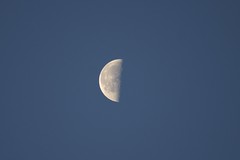
Got a nice view of the Moon yesterday morning around about halfway from a full to a new moon.
This shot also doubles up as an attempt to post to Blogger direct from Flickr. I think I might stick to the more conventional method for posting, although the picture above does link straight to the Flickr original.
We made the now-traditional pilgrimage to London for my birthday yesterday to take in some of the current art exhibitions and to catch up with friends. This year we were able to take in five ...
This was probably the best exhibition that we caught. Basically a mixture of amateur and professional photographers and a range of subjects, from traditional "natural" landscapes to those dominated by human activity. The descriptions next to each image were very interesting at times: some photographers staked out a location for weeks or months until the ideal opportunity arose, while others caught a lucky break. Another thing we spotted was that quite a few of the more professional shots made use of long exposures with water to create that milky effect. I reckon that I'd need a neutral density filter for that sort of thing. Anyway, overall it was an enjoyable show.
Moderately interesting this one. I've been to a couple of Warhol shows over the years, but this one paid more attention to his work in the 60s with film than I've seen before. Although, that said, I can't say that I'm a huge fan of this side to his work. I think it's very much of-its-time: nothing much to write home about now, but really quite unusual and interesting when it was originally done. Other than these, they had a modest selection of other works (paintings, photographs, interviews), and there was certainly an attempt to show off the breadth of his work. Useful for someone like me, but I've seen more comprehensive treatments before, and I suspect that many people might, seeing the films, just leave the show with the view that Warhol was a fraud confirmed.
Another photographic competition, again with a mixture of professional and amateur photographers. Not quite as diverse a range of styles as we saw last time, but still worth a look. As I'm not a portrait-taker myself, I've not really got a good eye for this, so I'm not a good judge to say the least. Still, the range of subjects always makes this prize worth a look, even if many of the portraits appeared quite pedestrian to my badly-schooled eye.
I've seen individual Bacon works on and off for years in galleries, but this is the first time I've gone to an exhibition devoted solely to him. He's probably most famous for his series of "screaming pope" works, and they're certainly pretty striking. Generally, his works seem to convey a rather nightmarish vision of the world, in which his subjects are frequently "caged" within framing structures used in the paintings. The use of dark backgrounds, contorted or ambiguous facial expressions and occluded subjects all add up to convey a rather malevolent tinge to his pieces. They're sometimes physical, conveying activity with blurred or distorted bodies; particularly in one interesting piece which depicts a dog apparently wrestling with something. A few of the images, particularly those in "Three Studies for Figures at the Base of a Crucifixion", verge on depicting truly nightmarish monsters (or biomorphs). In some respects these sorts of images reminded me of Gerald Scarfe, who may well have been inspired by Bacon. Anyway, overall, while I wouldn't go so far to say that I actually liked Bacon's paintings, I certainly admired them. Interestingly, while many artists change either their style or subjects over their careers, I didn't feel that Bacon did. I could imagine shuffling the order of his paintings and not really noticing. That's not a criticism, but it's relatively unusual in my experience of art. Most artists show gradual trends in their works that stand out in retrospectives like this one, in the case of Picasso, he seemed to undergo several reinventions.
As usual for the Turner, a bit hit and miss. In part, I go to see the Turner as an instinctive reaction against the dismissive recoil from modern art that's popular with conservative cultural commentators. The prize is pretty much an annual blood sport for them, but the arguments are always the same, and I don't buy them. More or less, their standard critical questions boil down to: (1) is it pretty?; and (2) could my 5 year old do it?; to which the "correct" answers are, respectively, "yes" and "no". And while I do have similarly reactionary responses to some artists (Rothko anyone?), I always like to be challenged with something new or unusual. I don't always respond positively, but I do like the challenge. The winner this year was, to me anyway, easily the best of the bunch, at least in terms of the material on show. He had a mixture of rather interestingly projected films and photographs, of which the latter was a nice rip-off of the "photograph exploration" scene from Blade Runner. I don't think that the winner was quite as impressive as some of those from other years, but the work was at least a bit interesting. The others consisted of: (1) rubbish geometrical sculpture and weak photo-montages; (2) a literal pile of rubbish - well, found objects arranged inexplicably; and (3) a series of three incomprehensible films, of which only one (of some Heath Robinson device) was even vaguely interesting.
In passing, post-art, we caught up with Ann, Andrew and Sarah, and wound up dining in a somewhat bizarre Polish-Mexican restaurant. Not fusion food, although that could have been interesting, but an apparent confluence of two separate restaurants or something.
Today was NOCS's annual Christmas Quiz. We came in second place last year, and had high hopes of winning this time around. Unfortunately, an ignominious upper quartile placing resulted. However, the real insult to injury is that I was accidentally responsible for our crashing and burning. As team captain, I had to pre-select an unidentified round as our joker round. Reasoning that the first round was likely to be for warm-up purposes, that's the one I picked. Instead, it was non-general general knowledge one, in which the highest score recorded by any team was only 4/10. We scored 1/10. The subsequent rounds on which we could have played our joker instead netted us 9/10 and 10/10 (we did particularly well on the opening sentences of novels). Had we placed our joker on either of these, we would have won the quiz by a point or two. Gutted doesn't begin to describe it.
While they're not the cheapest Christmas lunch option, we've gone there for the previous two lunches on account of the location and quality, and yesterday didn't disappoint. For once we were just one of several parties, but that didn't affect the experience at all. If anything, it created a nice background Christmas bustle.
Post-meal saw us (briefly) in what used to be the Cork and Bottle pub, before we finally ensconced ourselves in our traditional bolt-hole, The Platform. Packed as usual, but a good venue. Even if they did, latterly, have some live jazz.
A photographic record of the event can be found over at Flickr.
A different kind of review this time: a computer game rather than a book or a film. I mostly make do with old favourites like Half-Life 2: Deathmatch, but I get through a couple of new titles each year. However, though I pick carefully, they're rarely as interesting as BioShock. At first glance a first-person shooter (FPS) with role-playing (RPG) elements, there's a bit more going on in this title.
BioShock begins with a spectacular plane crash into the Atlantic ocean which deposits the player amidst burning wreckage but close to a mysterious mid-ocean lighthouse. Investigation of this reveals a bathysphere that takes the player to the underwater city of Rapture. However, Rapture is in trouble and is now far from the utopia that its founder, businessman Andrew Ryan, envisaged when he secretly began its construction in the aftermath of the Second World War. Framed as a refuge for scientists, artists and entrepreneurs from the evils of government and God, it initially attracted the great and the good, including Bridgette Tenenbaum, who pioneered massive advances in genetic engineering. However, its isolation from the outside world also attracted less desirable elements, such as the gangster Frank Fontaine, who created a black market that risked Ryan's control of the city. The resulting war between these men devastated the city, killed Fontaine and left behind a violent mixture of genetically damaged Splicers to control Rapture's ruined structures. The war also led to escalations on both sides that saw desperate depredations on the inhabitants of Rapture, including the enslavement of female children.
This is the world the player is thrown into, but with the help of Atlas, a survivor trapped in another part of Rapture who communicates via radio, the player is led through what remains of Rapture and gradually introduced to the story of its rise and fall. The player is introduced to Adam and Eve, the factors that allow genetically-based powers to be acquired and fuelled, and also to a range of weapons that can be used for defence against the dangerous Splicers. Most significantly, the player quickly encounters the Little Sisters and their guardians, the Big Daddies (see picture), who come to play key roles both practically and morally in the game. Furthermore, as the player advances through Rapture, it becomes clear that all is not as it seems, and that the player character is more connected to Rapture than even he himself understands.
Judging the game in conventional terms, it's a very playable FPS with a large and complex environment to explore, and with an impressive range of weapons/powers to assault enemies with. Visually, Rapture is an extremely well-realised city, with brilliant Steam/Diesel/Biopunk flourishes spread across a series of diverse habitats (gardens, hydrothermal power stations, medical facilities and even a museum). Being damaged, and located on the ocean floor, it's also running through with water, and displays some really nice tricks to convince the player of this. Water's not often modelled well in games, but it's done very well here (though obviously not as impressively as ICOM). Attention to detail is extremely good, with Rapture heavily art deco styled (I was reminded most of works by the artist Tamara de Lempicka), and with a lot of period detail (the game is set at the very end of the 1950s). These features alone make it a more interesting title than those that occupy more conventional futuristic or dystopian environments.
In terms of its gameplay, BioShock has quite a good mix of exploration and combat. There are a lot of interesting things to see, and frequently-found tape recorders play out the story of Rapture in an atmospheric way. Just as well really, since as a FPS fan, I don't usually pay a whole lot of attention to the scenery (unless it's hostile), so specific verbal cues about the backstory suit me. On the whole, combat works pretty well, although I did take a while to get used to routinely using my genetic powers. My first port of call was typically projectile weaponry until I realised that if I immobilised (with electricity) or terrorised (with fire) my enemies, I could finish them off more easily. That some of the enemies have similar powers mixes it up nicely, although I was only rarely subjected to the same treatment that I routinely doled out to my Splicer foes.
There were a couple of problems with combat, however. First of all, with both weapons and powers, sometimes a fight got messy as I struggled to select exactly the one I wanted (refusing, as I do, to use the keyboard to select things properly). Frequently I wound up photographing my enemies as they were bludgeoning me. This is compounded by weapons which have multiple ammunition types that require panic-inducing periods of time to switch. Secondly, death isn't actually all that big a deal in BioShock. Most games will throw you back to your last save-point and cost you all of the progress you've made since then, but BioShock resurrects you in a "Vita-chamber" and allows you to continue where you left off (much as with the Grand Theft Auto series). This has a number of problems:
it means you can then track down and finish off more easily the now-damaged foe who killed you
as dying has no major consequences, letting it happen saves you from having to use up valuable health kits to save yourself (i.e. encourages you do go down guns blazing rather than carefully extricating yourself from fatal situations)
only you can do this - no-one else you meet and kill seems to know about these handy Vita-chambers, which seems at least a little unfair
Generally, the Vita-chambers make gameplay a little too easy, although I'd certainly accept that the more standard alternative, Quicksave, carries its own limitations. Finally, while it sometimes took me a while to work the best way to kill an enemy, once I'd done it, combat became a little bit of a chore, especially where I was only confronted by a single foe at a time. For Splicers, electroshocking them or icing them, followed by a shotgun blast to the head, typically sorted them out (and it became child's play once I had the crossbow). Initially difficult, Big Daddies became very easy to take down once electric gel and RPGs came into my possession. And the final boss battle I finished first time by applying my Big Daddy tricks.
However, notwithstanding the above, BioShock holds up as an atmospheric and entertaining game. It does take a bit of getting into, and there's a lot to learn about its world, but these are often good things as far as I'm concerned. Fantastical books like Northern Lights and The Lord of the Rings don't lay everything out on a plate for you right at the start - you've got to work through them gradually to understand the worlds they're creating (except the former's film, which does exactly this to the film's detriment). So BioShock's something of a winner, which will come as no surprise to anyone who's been reading its reviews for the past year (... while I was awaiting the purchase of a computer fancy enough to play it on).
On top from the above, there are two other quite special aspects to BioShock not yet touched on. First, the game heavily co-opts the 20th century "philosophy" of Objectivism formulated by the Russian-born writer Ayn Rand. To the extent that several characters have names derived from Rand or her works, including Andrew Ryan (= Ayn Rand), Frank Fontaine (= The Fountainhead) and Atlas (= Atlas Shrugged), and the backstory of Rapture's origins is lifted her magnum opus, Atlas Shrugged. During the game, Ryan is frequently heard extolling an essentially Objectivist worldview, and the unregulated (= "free" for Objectivists) technological innovation in Rapture is in keeping with its tenets. I mention this as special, since I don't think I've ever played a game which wears its intellectual origins upfront to this degree, nor integrates them into the plot and setting so well. All that said, BioShock could easily be read as a scathing critique of Objectivism. Instead of the planned utopia, Rapture is quickly reduced to a nightmarish dystopia, both physically and ideologically. Ryan starts by creating somewhere that scientists and entrepreneurs can run free and unbridled by government, but winds up a tyrant presiding over a state in which science is twisted to malevolent ends, and where murderous anarchy is the prevailing civic order.
The other notable aspect is its handling of the morality of the player's actions in the game. It doesn't take this very far (and it has very few practical consequences), but set against the majority of other titles where morally ambiguous (or even actively immoral) behaviour is common, this still marks it up as noteworthy. Basically, as already alluded to above, key actors in Rapture are the Little Sisters, who act as agents for collecting Adam from the city's dead. Their protection by the Big Daddies means that they can represent quite a danger to the player should they be antagonised in some way. When the first Little Sister is encountered in the game, Atlas strongly advises the player to "harvest" (= kill) her to secure her supply of Adam and to gain enhanced genetic powers. However, the player can also "rescue" the Little Sister from the modifications made to her by Ryan's scientists, but this provides only a small Adam reward to the player. At this early point in the game, the player has very little information on the Little Sisters, and the decision is largely left to the player's innate judgement. When I reached this part of the game, the fact that the Little Sister wasn't hostile towards me, plus that she was clearly a child, made me choose to save her. And I continued to do this throughout the game, coming to see it as my duty to rescue them as I heard more and more about the wrongs inflicted upon them (in that special sense of "duty towards virtual characters in a fiction"). My "reward" for being nice was only, as far as I can tell, a different end sequence upon completing the game ...
However, it still makes a change to have a game that's at least keeping tabs on how I'm treating NPCs.
The handling of morality in the game could also be read as a further critique of one particular (narrow?) reading of Objectivism. While it would serve the player best to treat the Little Sisters as a harvestable resource (c.f. "his own happiness as the moral purpose of his life"), the game rewards, albeit with just a pat on the back, sacrifice on the part of the player for them. This is in conflict with certain core Objectivist ethics - so, needless to say, appeals to me. Although my own views occasionally overlap those of Objectivism, I don't believe that its extremism would actually work successfully in the real world (much as with the related political movement of Libertarianism). Among other things, I think there are good biological reasons to believe that (self-interested) altruism plays a significant role in many organisms including humans, and that it's possible that facts of human evolution (evolving in small, tight-knit communities) mean that we're more indiscriminately altruistic than one might otherwise expect.
Anyway, enough pontificating already. This was just supposed to be a computer game review!
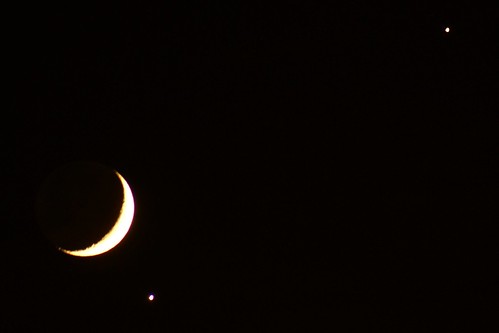
Yesterday evening saw an occultation of the planet Venus by our Moon. While I had heard about this, I completely forgot on the day. However, while cycling home, I did spot something interesting around the Moon ...
Although the occultation was passed, Venus was still visible just to the lower right of the bright limb of the Moon. On top of that, Jupiter (top right) was also in close proximity to the Moon, making for a nice triple. The above is my attempt to capture this from the front garden (full size version).
Thanks to Simon (former professional, now amateur astronomer) for identifying Jupiter for me.
An interesting book this one: The White Tiger, by Aravind Adiga. It's this year's winner of the Man Booker Prize, and the first that I've read from the shortlisted titles (I'd expected to see Netherland there, but it didn't make it).
The novel is constructed as a series of seven letters written nightly by the protagonist, Balram Halwai, to Wen Jiabao, the Premier of the People's Republic of China, soon to visit India. The letters present Balram's rise in Indian society (or wealth at any rate) as a model of entrepreneurial culture in modern India, one that Balram believes that the Chinese Premier should adopt. The letters tell the tale of Balram's rise from a poverty-stricken background in the "Darkness" of rural India, to his position as director of his own small company in Bangalore. From the outset, Balram admits to being the murderer of his former employer, and his letters gradually reveal how this came to happen. Along the way he describes a very different India from the one that presents itself to the outside world, the one that Wen Jiabao will see. Balram describes a future-less life of penury and servitude in the Darkness, one that he escapes from through luck and guile, only to take up a similarly put-upon life in Delhi. In this new life, Balram reflects on the inequity and corruption that surrounds him, and comes to understand the features of public life in India that preserve the status quo for the rich. This realisation prompts Balram's murderous assault, and the initiation of his new life.
It's not immediately obvious how this novel came to win the Man Booker. It's not a particularly literary novel in terms of its writing, and in large part is driven by events in Balram's life. However, it does have a rather striking narrator who, though something of a self-aggrandising monster, is surprisingly engaging. And although Balram's story is heavy on event, the novel contains a vivid if excoriating portrait of modern India. Needless to say, the Indian tourist board won't be proudly parading this novel as an example of a culturally strident nation. Having not been to India, I can't attest to the veracity of the novel, but it paints a fairly convincing picture, and one that's liable to keep me away from India!
Overall, while having initial misgivings (did I really want to read a book narrated by a rather opinionated murderer?), I really quite warmed to it as I went along. It does conjure a fairly dystopian India, but does so in a fashion that's never uninteresting. Though it is frequently unpleasant (there's a rather repellent description of the cockroaches with which he shares his Delhi hovel). I suspect that its exotic nature won over the Man Booker judges, but it's certainly a lot more engaging than other prizewinners that I've read over the years (The Sea, for instance ...).
Interestingly, the novelist was on the radio the other day talking about the recent terrorist attacks in Mumbai. While he presents an extremely negative picture of India in the novel, in talking about the attacks he was quick to emphasise its essentially liberal democratic nature, somewhat at odds with his scathing portrayal of its politics as terminally corrupt. I guess that while recognising its faults (to understate the case!), he still harbours a love for his home country.
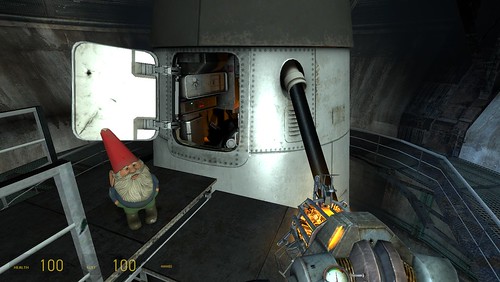
Hiding my "addiction" well, I don't much mention computer games here. However, in "testing" our new PC I played through Half-Life 2: Episode Two again, but this time tried to complete one of its most awkward achievements: Little Rocket Man ...
Basically, one has to transport the garden gnome pictured above through the entire game from start to finish (echoing the travelling gnome prank popularised in the 2001 film Amélie). The ultimate aim is to place the gnome in the pictured hatch so that he can be launched into space, thus playing his own small role in this particular battle against the Combine.
Anyway, though tiresome at times, it was actually fairly easy to do, although the gnome doesn't make for a particularly good projectile weapon (he's not really heavy enough). Aside from accidentally leaving the gnome in a location that can't later be accessed (the section involving retrieving the car springs to mind), the only really awkward portion was driving with the gnome. The game designers need to put a proper boot (or doors!) on the car - the gnome continually falls out of the car whenever you reach, say, 5 MPH. As a result, you wind up punting the gnome, shot put-style, then driving to where he's landed and then repeating the procedure. Annoying in usual conditions, highly frustrating when a helicopter gunship is roasting you at the same time.
One of the books I tagged up in my list of Top Ten Books was the 2006 novel The Lay of the Land by the American author Richard Ford. The book is a rich examination of the inner life of realtor Frank Bascombe, but one in which only a limited number of external events occurs. Reading his earlier novel, 1986's The Ultimate Good Luck, is an altogether different experience.
Set in a then-contemporary Mexico, the novel tells the event-filled story of Harry Quinn, a Vietnam War veteran all at sea in the city of Oaxaca. He has travelled there to expedite the release of a former girlfriend's drug-running brother from prison. Sonny, as well as being caught carrying cocaine by the untrustworthy local police, is suspected of trying to cheat the shady local crime boss that employed him. As a result, Quinn finds himself caught between the corrupt legal authorities and the violent henchmen of Sonny's employer. To further complicate the situation, Quinn's former girlfriend, Rae, is travelling to Oaxaca to see her brother, posing both concerns for her safety and emotionally unsettling questions for Quinn. Against this dangerous foreground, the lawlessness and casual violence of Mexican life unsettle all bets on the outcome.
The preceding cliché-ridden summary probably doesn't do the novel any favours, but it covers the bases, at least in outline. What makes the novel more successful and interesting is that Ford brings his literary style to what is an otherwise conventional noir setting. So although the novel is given shape by the events that Quinn finds himself amidst, Ford gives a strong voice to Quinn's perceptions and his memories. While not entirely resolving the plot in a convincing fashion (unless I missed something!), he does a good job using it to ratchet up the tension. Quinn is forced down a twisting path where his available choices and his freedom for action are continually narrowing.
Given Ford's Frank Bascombe books, its interesting to read quite a different sort of novel from him. Certain things remain constant, principally the introspection of his central characters, but it's pleasing to see Ford successfully handle a more plot-driven piece too. Time to check out his other work.
In passing, given that this is the work of a literary giant and that it has a relatively straightforward plot, I'm amazed that an indie film director hasn't picked it up yet ... Actually, a quick look at the IMDB finds the Ford-penned Bright Angel, which seems to borrow somewhat from The Ultimate Good Luck. So there goes that idea for my entry into the upper echelons of Hollywood.
We went to another of the Christians in Science biannual seminars last night. This one was given by an OU historian of science called Colin Russell, and was entitled "Science and Faith at War: Myths and Fables, Old and New". It focused on the so-called conflict thesis of the relationship between science and religion.
Essentially the thesis is that, both historically and theoretically, these two cultural forces are irrevocably at war with one another. The thesis is pretty mainstream in the culture, but the contention of the speaker is that it is both founded on myths and has no theoretical basis. This latter view, of course, doesn't sit well with the likes of Richard Dawkins or A.C. Grayling, while the late Stephen J. Gould proposed the concept of non-overlapping magisteria (NOMA) to try to diffuse the purported conflict.
The speaker's main strategy was to cast doubt on the historical basis for the alleged conflict. This, actually, is quite successful, since ostensibly famous examples such as Galileo and Darwin (both discussed by the speaker) turn out not to be quite as straightforward as the conflict narrative has handled them. This isn't to say that there was no conflict in their lives with religion (there obviously was some), but that building the case for the conflict thesis around them is misplaced.
That said, while the speaker was somewhat successful is dismissing aspects of the conflict thesis' case, he seemed (to me, anyway) to go far too far the other way, and blithely ignored or discounted the somewhat weaker evidence that the examples he dismissed still provided. Generally, there was something of a whiff of a straw man about the presentation of the conflict thesis by the speaker. It was almost as if he was arguing against the great proponents of the thesis by (rightly) countering their overstated bluster with his own.
However, where the speaker really came unstuck was on the topic of present day creationism. Possibly because he realises that it truly does represent a latter day conflict, he essentially dismissed it as some sort of fringe activity that wasn't representative of current religious thought. While he's right that many religious figures and organisations have disavowed it, it was a bit disingenuous of him to write it off just because he doesn't happen to believe it. He provided no grounds for an impartial observer to favour his view of religion over that of the literalist creationists. Instead he seemed to just imply that they're luddites who haven't yet come to understand his much deeper comprehension of the Christian faith.
Although I think that they're at best simply ignorant, I do think that the creationists have got something here. While they go to absurd lengths of fantasy to justify a literal reading of Genesis, they recognise that once you start labelling a religious text as a mixture of metaphor and literal truth, you're on something of a slippery slope. That said, while I don't buy it (= understatement of the year), I think that it's perfectly possible that a metaphorical Genesis gave way to a literal Jesus. But given that almost all religions deal with events that can't now be objectively verified or which occurred before accurate or comprehensive records were maintained by historians, the factual basis for any of their wilder claims is never going to materialise (short of divine intervention, of course).
Anyway, after this, the speaker dissolved into a long series of platitudes and the sort of "neither metaphor or literal" gibberish that appears common in these lectures. The latter is like a red-rag to me - it might play well with the faithful masses, but it's (a) ineffective and confusing; (b) a deliberate misuse of language to muddy the intellectual waters (c.f. Garrett Hardin's "literate filter"); and (c) leaves me with the suspicion that an otherwise intelligent person realises that there's no empirical basis for their faith (surely the definition of faith?) but that they won't come out and say so. Basically crazy-talk.
In passing, regarding the speaker's presentation style, he was clearly born and educated not only long before the Powerpointocene Epoch, but actually prior to the Overheadozoic Era. It was a classic talking-only lecture. Which, unfortunately, didn't suit the speaker's memory. There were a couple of occasions where he seemed to lose the thread of his argument, despite the fact that this was an overview talk rather than something very specialised or detailed. This wasn't important to me, since I know a bit about what he was talking about, but must have been a bit confusing for people less familiar with the ideas.
Anyway, all that said, while I profoundly disagreed with the thrust of what he said (though I completely accept the overstatement of the conflict thesis), he was certainly one of the more honourable of the speakers that Christians in Science have attracted. No McGrath-style duplicity and lawyering here.
P.S. I forgot to add above (probably because it's just so ridiculous if taken at face value) that the speaker identified Jesus' resurrection as the most historically verified event ever. Or something like that. It's possible that he meant only the subcategory of "events that happened to Jesus", rather than "events that have occurred in the world at some point". But he wasn't exactly clear on this point.
I think this was the moment, and it's affected all of the speakers in this series of lectures, when he "jumped the shark" and used the authority that he'd built up during the lecture to dress up his personal faith in Christianity as if it were a hard, undeniable fact. Even though all of the speakers have had some connection to science, at some point in the evening they make a non-sequitur where suddenly the mythology underlying their particular beliefs suddenly becomes empirical truth.
This is the kind of thing that should cause cognitive dissonance, but all of the speakers have been able to "hold it together". Speaking as a heathen, I read this "leap" as a declaration of their faith, although all of them have presented it in quite different terms. It's almost as if, as scientists, they know that they can't join-the-dots from base reality to their particular beliefs, and that they know that this is a major stumbling block. If they can't make the connection, how do they know that their beliefs are the correct ones? So, to get around this, they baldly state that (their particular flavour of) Christianity is plainly and unimpeachably a fact of the universe. No supporting evidence; no suggestion that this is an article of faith; just a straight "I'm a scientist, so this must be true" statement. If you say it often enough to yourself maybe it even becomes true and no longer requires a leap?
C was telling me yesterday about a feature that appears in her work newsletter in which senior management figures list their top ten books and describe why they like them. Avid reader that she is, she's already got a top ten and was thinking about whether to submit her books to the newsletter for universal acclaim/derision.
Not to be outdone, I had a think about what I would pick. It was quite a bit of a think since I tend to forget even great books (at least from my working memory). Anyway, in purely chronological order (ranking is dangerous), and strictly for today (might be different tomorrow), my top ten would be ...
The City and the Stars, Arthur C. Clarke, 1956
A bad sign: starting with science fiction. Still, this is definitely a classic of the so-called "golden age" of the genre. It sports robots, aliens, a disembodied and benevolent AI, a deep mystery, a journey between the stars and tantalising glimpses of Grander Things. Marvellous.
Breakfast of Champions, Kurt Vonnegut, 1973
A very difficult book to describe, and not one that would sound that appealing from a plot summary. A salesman gradually becomes insane, believes the writings of a hack science fiction writer are factual, and runs amok at a literary convention. But Vonnegut's writing (and drawings!) is melancholically brilliant and surprisingly humane. And he carries off introducing himself as a character fantastically.
Use of Weapons, Iain M. Banks, 1990
One word here: structure. While set within the science fiction utopia of the Culture, this novel uses an impressive jumbled narrative to both take its central character on a journey to seek redemption, while delving into the reasons why this is required. The handling of its revelations is brilliant, being melded perfectly into the narrative. Not the most "world-building" of the Culture novels, but that's beside the point.
Brazzaville Beach, William Boyd, 1990
A biologically inspired choice here (there's another one later). This follows the life of Hope Clearwater, a biologist, through several strands of her life. Much of the novel takes place in a well-realised Africa, with civil war and Hope's research on primates providing its focus. The novel blends in science wonderfully, and contains some dark truths about the nature of human and animal conflict.
The Tortilla Curtain, T. Coraghessan Boyle, 1995
A great study in contrasts on either side of the wealth divide in southern California. One half of the novel follows a middle class writer, his love of the Californian wilderness and the threats he feels it's under. The other half follows a pair of illegal Mexican immigrants, pressed up against the hard realities of poverty and struggling to make ends meet. They occupy the same living space, but their worlds couldn't be more different, a theme that the novel explores as the narrative gradually weaves the two strands together. Without giving anything away, it ends with a brilliant moral cliffhanger.
Microserfs, Douglas Coupland, 1995
I simply love this novel. It may be that it embodied a time in my life that was particularly significant, but I think it's more than this. It basically tells the story of the lives of a group of Microsoft friends (the Microserfs) who quit that monolith to begin their own start-up company. That sounds rubbish, I know, but it handles the interpersonal relationships between the characters brilliantly (and lovingly), and speaks volumes about our lives today (at least to me). Anyway, it's a novel I've blogged about before (at length).
Prodigal Summer, Barbara Kingsolver, 2000
Another novel influenced heavily by biology. It's spread across three distinct strands: a young hunter drifts into the life of a lone biologist tracking wolves in the forest; a former biologist suddenly has to come to terms with the death of her husband; a pair of antagonistic old timers grudgingly come to terms with one another and their lives. Beautiful writing, with a real sense of nature, but written with a biologist's appreciation of the savageness that underlies its apparent beauty.
Unless, Carol Shields, 2003
While set around the quietly domestic life of a female translator and novelist, the novel is driven by her growing anguish at the apparent breakdown in her relationship with her daughter, and her anger at the casual sexism she encounters in her working life (expressed through a series of letters that she writes during the novel). These themes are not as isolated as they appear, and they are articulated in beautifully written prose. It's a real shame that Shields died shortly after completing this novel.
The Lay of the Land, Richard Ford, 2006
The "conclusion" of a trilogy of novels about the novelist / sportswriter / realtor Frank Bascombe. It probably isn't the best of the trilogy (the second novel, Independence Day, is more solid), but it's the longest, and immersion is the key here. Ford creates an internal life for Frank that's just amazingly well-realised, and the writing describing it is simply sublime. As with the "prequels", the events of the novel take place over only a few days, but the depth and texture of the writing makes it feel like you're with Frank for years (in a good way).
The Yiddish Policeman's Union, Michael Chabon, 2007
Ah, the perils of adding a recently read novel ... I loved this trans-genre work (see here), but it's quite possible that I'll look back in bewilderment at a later date. It tries to take on the crime, noir and (possibly) science fiction genres, weave in some Jewish themes, while using literary flourishes throughout.
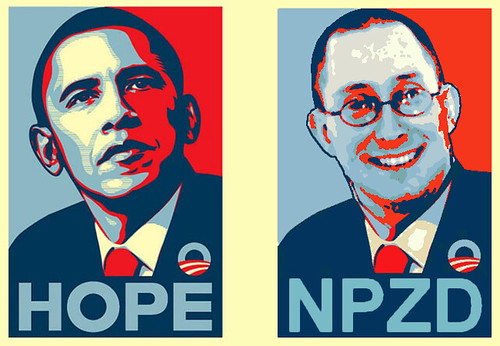
The Grauniad has an item this week about spoofs of Obama's rather stylish "HOPE" poster. Never having been one to miss a chance to goof off with Paint Shop Pro, here's my attempt at spoofing.
Those in the know will immediately understand the significance of my message.
We stayed up late (till 3:30am) to catch the results from the US elections. It afforded us an opportunity to use something that we picked up during our trip to Florida ...
By bedtime it looked pretty clear that Obama was Whitehouse-bound; a result that was predicted by our mug, and confirmed the next morning. Since this outcome had seemed likely for much of the past two months (even if it was loudly denied to beat back complacency), it wasn't quite as exciting a final night as other elections, but it was still a blessed relief.
That said, I do feel a bit sorry for McCain. Until he ran for the Presidency this time, I'd always (inasmuch as one can as a sporadic observer from a foreign land) had time for him, and he was an interesting and moderately non-partisan player in Washington. He'd garnered a lot of sympathy from me because of the dirty tricks played on him by the Bush campaign in the 2000 primaries (which I think many commentators seem to have forgotten about). In fact, because of this, I was initially quite afraid that he might be able to beat the Democrats by playing against Bush and his cronies. But rather than run this way, he gambled instead that he should remain quite anodyne on the Bush administration. As a result, he completely diluted the personal brand that he'd built up over the years, a dilution that was pushed to almost homeopathic levels when he appointed Sarah Palin. While that was a smart move in terms of shoring up his Republican base, it again didn't seem like the kind of thing that "maverick" McCain would have done. He'll doubtless come in for a drubbing from his much-reduced party, but much of that will likely miss the point that the only way he could have won was to play against the existing (and much disliked) party structures.
Anyhow, Obama gets to sup from the poison chalice. I can only hope that the fate that befell 1997's popular UK poll-winners doesn't happen to him. Still, even Blair only made a few significant mistakes but, boy, were they big. Hopefully Obama's cool and collected campaign will be reflected in his tenure in the Whitehouse. We'll see.
Spent Sunday (2nd) to Tuesday (4th) this week in Germany visiting the PI on my last contract. We've got a couple (ha!) of things to sort out on two papers we're preparing, and since he's been AWOL from NOCS for more than 2 years, a bit of face time was in order.
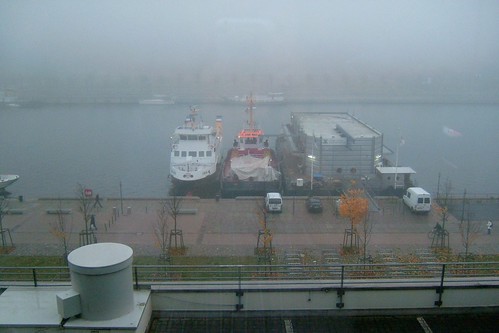
Anyway, my trip took me to IFM-GEOMAR ... ... in foggy Kiel ... Although this was mostly a work trip, I did get a chance to wander around the city a bit. It's of comparable size to Southampton and shares many other features, like being a working port and having the crap bombed out of it during the Second World War. The latter means that a lot of it is relatively new, but there's still a lot of interesting stuff to see. Here's one of several sculptures I came across ... There's a more complete set of pictures up on Flickr.
After getting a bit lost last week in the New Forest, we returned today to make best use of the continuing good weather. This time we brought our bikes, so heading off down lanes of unknown length posed less of a problem for getting back to the car.
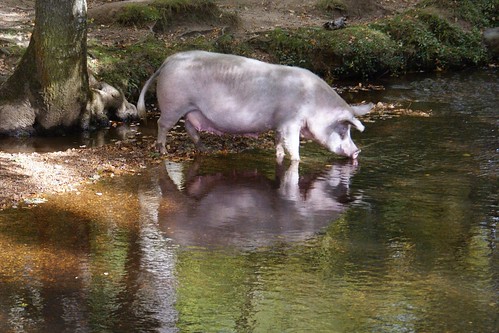
Having complained to Adrian about never having seen any wild pigs in the New Forest, this trip furnished a whole herd of them ... ... although the rings through their noses were suggestive of them either being Goths or less wild than their reputation suggested. They were quite impressively sized beasts either way.
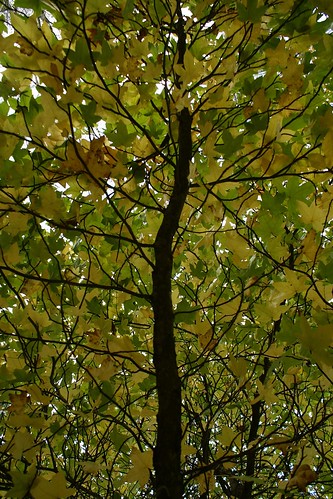
We also took in the arboretum down Ornamental Drive for some autumnal colour (plus, obviously, lemon meringue ice cream from the car park). The latter can be seen here, but here are my "best" shots of deciduous leaf action.
Anyway, these seem to have worked out OK, although there are issues for me to sort out about image rotation and image ordering. Paint Shop Pro 7 strips the EXIF information from my photos, so makes Flickr's job organising my photos difficult. Have to think about that one - Photoshop, a possible alternative package, is a pain in the arse to use (sorry Graham).




 The novel begins with a deadly explosion in the office of a successful mathematics professor at a midwestern university. The neighbouring office houses Lee, a tenured but near-retirement professor who, until the bomb, is slowly drifting into career obscurity. Tired and solitary after two divorces, Lee suddenly finds himself in the public eye. This draws Lee to the attention of the bomber who reveals in a letter to Lee that he was once a colleague. Although not supplying his identity, events in Lee's early career at graduate school furnish an obvious candidate, and one that reopens unhealed wounds in Lee's life. His first marriage, to the now long-dead Aileen, was actually her second. An affair with Lee broke up Aileen's first marriage to the evangelical Christian Gaither, with the repercussion that Aileen never saw her son again. Lee's indifference to this lost son ultimately cost him his marriage to Aileen, the realisation of which gradually dawns on Lee as his thoughts return to Gaither after the bombing. However, embarrassed by these events in his life, Lee withholds the letter from the police and, now lost in reflections on his early life with Aileen, Lee becomes an increasingly isolated figure, suspiciously so to the authorities. Consequently, when Lee's failure to disclose the letter comes to light, they identify him as a "person of interest", a label that attracts the unwelcome attention of both the press and his suspicious neighbours. Forced by twitchy administrators into a leave of absence from his university, Lee is increasingly viewed, de facto, as the bomber, just waiting for his status to switch to "suspect". Backed into a corner in large part by his own actions, Lee decides to track down Gaither by himself, determined to unmask him as the bomber and to lay to rest his ghosts from the past.