Sunday, 20 May 2012

Richard Parker

Thanks to a tip from a former colleague, we caught a great little play last night just over the road at Peartree Church Hall. The play was titled "Richard Parker" and drew on the story of (surprise, surprise) Richard Parker, a cabin boy who was cannibalised by fellow crew after a shipwreck off the coast of South Africa. More specifically, as this unfortunate sailor shared both the name and fate of a character in a novel by Edgar Allan Poe published several decades earlier, the play dealt with the phenomenon of coincidences, and spun this out in a two actor, two act play.

We weren't quite sure what to expect given the rather curious premise of the play and its extremely local venue, but it turned out to be a real treat. As well as touching on the coincidental fate of both Richard Parkers, fictitious character and real cabin boy, the play drew on quite a few other compelling stories of famous (and less famous) coincidences, including the purported parallels between the lives and deaths of US Presidents Lincoln and Kennedy. And it did so really well, extracting a lot of dark comedy from these usually fatal coincidences, and ultimately spun all of this into a nice twist directly affecting the play's two characters (and Richard Parkers).

The play certainly seemed to go down well with the Peartree audience, and its humour was particularly appreciated - especially when it veered into an extended diatribe against "shitting seagulls". The only qualification I'd make - and it's one that applies to everything I've ever seen on stage - is that is was a little, well, stage-y. For all the visceral fun of seeing something live, I never get absorbed into it in quite the way I find with cinema, and never entirely forget the obvious fact that I'm watching actors on a stage. Anyway, hopefully the evening will have raised a good bit of cash to help the play's writer and cast travel to the Hollywood Fringe festival. The play has already done the rounds at UK festivals, but they're hoping that it gets some wider attention stateside. So good luck to them.

Warwick reunion (with added cricket)

After a heavy funding meeting in a small, subterranean dungeon at the Royal Society, I had the good fortune of a Friday night out with some of the EAMG crowd. Our get-together was triggered by a rare(-ish) visit from St. Ben of Cooper to viva a thesis in Brother John's group (though not one of his students, fortunately).

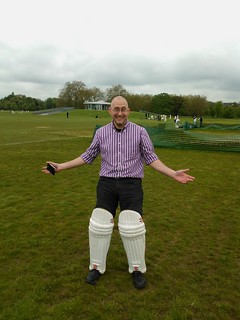
Because the evening began with the same group engaged in a cricketing deathmatch against hated institutional enemies (social scientists of all things), we arranged to meet in the "sports section" of Regents Park, and I planned to finish reading my book while they knocked chunks out of each other. Unexpectedly, however, John's team was down a player, so I wound up taking to the field for my first proper game of cricket ever. They even had shin pads and gloves! Anyway, while I was only able to contribute a handful of runs (4, I think), I did manage to bowl out one of the rival batters. Embarrassingly, it was his first game too, and I put him out immediately - not very sporting of me. However, it was a necessary breech in the "have a go" spirit, and led - in a small way - to the defeat of John's hated rivals. Hurrah.

Anyway, we finished the evening off in a good nearby pub, broaching traditional topics of conversation such as "yes, you could see them from behind" and "what, you voted for Boris?". Happy days.


WP_000312
About to take the stump


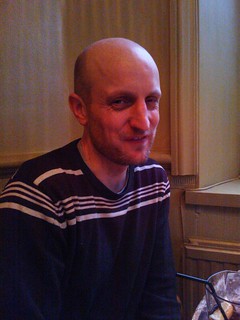
WP_000313
Glowering, but not blinking


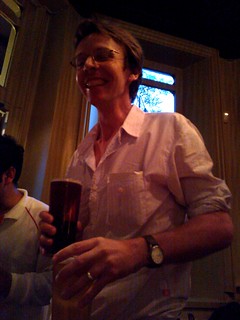
WP_000314
Wishing Chris were here


WP_000318
Fresh from a triumphant viva

Sunday, 13 May 2012

The Departure ... from form

Back to Asher-land. This time with the first entry in a wholly new series of novels based around a character who appears in several of his short stories, The Owner. No sign of the Polity this time round ...


On an increasingly overcrowded and resource-strapped Earth, the ruling world government, the Committee, is planning a "final solution" to stabilise the planet. In orbit, a massive satellite network has been built that will allow its tyrannical controllers to exterminate the viciously oppressed majority judged surplus to requirements by the Committee. Meanwhile, an ignored Martian colony is informed by the Committee that it is to be mothballed until events on Earth have stabilised and that it, too, is at the limit of its resources, and that only a managed depopulation will save it.

In the build-up to the planned events on Earth, Alan Saul, a rogue scientist, awakes in Calais on a conveyor belt feeding him into the town's incineration plant. Escaping from his immediate predicament with help from Janus, an internet-bound artificial intelligence that mirrors his own mind, Saul quickly and deliberately becomes a fly in the ointment for the Committee. After tracking down an old colleague and girlfriend, Hannah, Saul seeks out the black market and the technology that will allow him to fuse his organic mind with that of Janus to massively enhance his powers. Suitably "powered up", he travels to Minsk to hijack a spaceplane to, in turn, commandeer Argus Station, the hub of the Committee's satellite network. The latter proves a substantial challenge, and Saul's ruthless determination to succeed whatever the cost, as well as his ambiguous fusion with Janus, lead Hannah to question what he has become.


While I've never been entirely won over by Asher's charms, I've always found his novels and stories to be at least enjoyably trashy reads (even for science fiction!). Every so often he's surprised me with something more substantial, but even when he hasn't, I've always left satisfied with a baroque slice of sub-Banks adventure.

Here, not so much. Which is doubly unfortunate since he's actually tried something new here. Leaving his Culture-esque Polity universe, he's struck out on a completely new course, albeit one that's previously been touched upon in some brief short stories. We don't actually reach the point in time that these stories dealt with, by the climax of The Departure firmly establishes Saul as The Owner.

So what went wrong? Better to start with what didn't go wrong - since it's the smaller list. What's still good here - if a little overdone - is Asher's robustly violent science fiction action. Particularly so when Saul co-opts Argus Station's legion of repair robots as an impromptu army capable of some inventive, non-repair-related mischief. While he does revel in it too much for my liking, he does write his action scenes well.

Where Asher first goes wrong for me is in his presentation of the Committee. While it sits not uncomfortably within the well-worn trope of oppressive authoritarian regimes that populate dystopias, Asher can't help but use it as a stand-in for the EU, like some demented UKIP demagogue. For all is many flaws, the EU is nothing like the Committee in terms of action or outlook, but whenever he can, Asher squeaks in some sort of parallel. Admittedly, UKIP-ophobe that I am, perhaps I'm a little over-sensitive, but it's difficult not to get annoyed by Asher's stream of miscued political asides.

I was also a little miffed at how he handled his Martian subplot. At first it seemed like this would assume equal prominence to the events playing out on Earth and in low Earth orbit. But Asher only devotes a small fraction of the novel to this, and it's a pretty dull fraction at that - largely just a much smaller and much less significant insurrection on a limply imagined Mars. Worse, Asher commits something of a science fiction cardinal sin for me by having the uprising on Mars led by Saul's sister. Did he learn nothing from Star Wars pivoting galactic-scale events around a single dysfunctional family?

More seriously, he also makes something of a mistake with his central character, Alan Saul. Asher's narrators, even the white hats, are often rather gruff characters who're not entirely sympathetic (and he even has a habit of rehabilitating his ostensible black hats). But here he goes off at the deep end with a "hero" who's entirely unsympathetic. While arguably the closest thing to a "good guy" here, Saul is pretty much an Objectivist tyrant, concerned far more with his own ambiguous need for self-determination than anything else. Asher was probably aiming for a conflicted grey hat, and - to be fair - he does imbue Saul with occasional self-consciousness and second thoughts, but to me the novel played out as a battle between a faceless collective despotism and an ugly individualist despot.

All that said, this is seemingly the first novel in a planned trilogy. It may well be that Asher's treatment of Saul here is simply setting the stage for subsequent developments in character. But that's awfully hopeful of Asher given that characterisation has never been his strong suit. Still, I will almost certainly be continuing to read the saga of The Owner when these latter titles appear. I may leave this somewhat disappointed, but The Departure is still a lot less of a disappointment than my last science fiction read.

Saturday, 12 May 2012

The Fear Index

A new novelist and new sub-genre this time: an airport novel. Actually, that's probably more than a little bit rude, but I'm pretty sure that The Fear Index, by the British author Robert Harris, has probably sold a lot of copies at Heathrow. Hang onto your hats, we're in techno-thriller territory now ...


Set over 24 hours in Geneva in the cross-over world between high energy physics and high risk finance, the centre of the novel is Dr. Alex Hoffman. An ex-physicist now running a hedge fund, his company's success is driven by VIXAL, an "algorithm" that Alex designed to profit from fear in the market. The novel opens with a night time break-in at the luxury home that Alex shares with his wife, and incipient artist, Gabby. Defying seemingly impregnable security, the intruder appears set to murder the couple before he is disturbed by Alex, escaping into the night after knocking Alex out. This opening event is just the first in a succession of unexpected setbacks that begin to assail the life and career of this Master of the Universe. The next day sees the intersection of a new infusion of cash to his hedge fund from unscrupulous magnates, Gabby's first exhibition of work, and an incipient market crash. But Alex is unable to focus on any of these pivotal events as an unseen and unknown assailant continues to needle him from afar. Worse, a nervous breakdown from his past at CERN is brought to the attention of his friends and the police, fostering doubts that the conspiracy that he claims is enveloping him exists outside his own mind. But as financial meltdown threatens the world's markets, while VIXAL coldly plots a perilous series of trades, Alex begins to discern an underlying cause for his life's sudden reversal.


The Fear Index is not going to win any prizes from the literary establishment, but this is a proper page-turner, very efficiently written and pushing a number of zeitgeisty buttons. Harris sets off at a great pace and never really lets up as Alex is drawn into the bottomless rabbit-hole of a seeming conspiracy that amplifies his paranoia and threatens his sanity.

It's difficult to really care about the central character, Alex, as he is clearly "on the spectrum", and very much at the belligerent, self-entitled end. While VIXAL began as an academic project in artificial intelligence, it's clear that Alex's already narrow interests have narrowed further to see only its skill as a golden goose. Actually, his focus and lack of consideration for others is unlikeable to the extent that one questions the realism of the relationship with his wife.

But such matters of characterisation are quickly swept out of consideration by the blisteringly-paced plot that unfurls in more or less a single day. Of which, Harris does a great job rolling out more and more mysterious hurdles for Alex to clear. Along the way, Harris does a serviceable job at introducing the reader to some concepts from hedge funds, and while he never makes the banker characters worse than amoral, it's difficult to come away with a positive impression of the "trade". He also briefly touches on CERN, does a good job with Gabby's art, and even spends some time on the distorting impact of banking on Geneva's housing market.

There are a few plot strands that aren't entirely resolved [*], but there's enough going on that one doesn't mind to much - or actually notice too much until the final page is reached. It's one of those stories where mysterious events ramp-up the reader's apprehension extremely efficiently, but which don't actually quite stack-up once the curtains are pulled back. But Harris tells his story so well that it's only now that I'm reading a new book that some of the "holes" are obvious to me.

While some aspects of the novel's close were a little unexpected, I did particularly like the closing accommodation that Alex's business partner comes to with VIXAL. He clearly arrives at an appreciation for what it actually is, and accepts its violations and intrusions because of its power and its skill at making obscene amounts of money, regardless of the human cost. It's difficult not to read this as a wider statement about how bankers view the systems and schemes that make them money. But - nicely - Harris trusts the reader enough not to bludgeon them with any explicit socio-economic sniping.

Overall, a lightweight but very enjoyable yarn. It's not wholly without substance, but its observations about the questionable value of banking are clearly second in line to entertainment for Harris. Which is absolutely fine. And while it doesn't need them, it gets bonus points from me for some long-distance flirting with a favoured science fiction theme, but this shouldn't put anyone averse to that genre off this book. Definitely worth a look up if you're in the mood for a palate-cleanser between more weighty literary dishes.


[*] SPOILER! For example, as the novel opens with Alex harbouring not the slightest of slight suspicions, it's not obvious why VIXAL targets him. If Alex was already wondering about its behaviour, perhaps discussing this via e-mails that it then reads, this could have been a jumping off point. Instead, VIXAL pretty much kicks-off a series of events that ultimately lead to harm (albeit quite limited harm) to itself. For something whose main strength lies in predicting, this seems a little daft. But, as I mention above, Harris' novel is sufficiently skilful that this only really occurred to me long after it actually mattered.

Monday, 7 May 2012

Dear Douglas and Whit ...

At the moment, my reading material is Player One by lapsed-favourite Douglas Coupland. Today, I saw the film Damsels in Distress by the inveterately infrequent director Whit Stillman. I've loved the work of both in the past, particularly Coupland's Microserfs and Stillman's Barcelona. And while both of these two recent titles by Coupland and Stillman still have plenty to like about them, both also seems to suffer in comparison to earlier work in quite a similar way. Basically, they seem to have forgotten all about plot.

Not plot in terms of a densely but carefully constructed narrative, nor plot in terms of an enjoyable pot-boiler, but plot in terms of something that does more than intersect with reality at a tangent. In previous works, both Coupland and Stillman coupled their (respectively) philosophical and whimsical sides to narratives that bore more than a fantasy relationship with reality. But here, while both have pleasingly held true to the styles and tropes that first got me hooked, both have abandoned any pretence that the worlds they build and populate have more than a passing correlation with our own.

True, that's laying it on a bit thick, but what was wrong with sticking to situations and characters that touched base with the real at least once in a while?

Sunday, 22 April 2012

Singularity Sky

Another quick delve into "the pile", Singularity Sky by the British writer Charles Stross. One of the last books I read - but haven't blogged - had a quote from him on its cover and, one quick Wikipedia trawl later, I latched onto this one because of its intriguing set-up ...


After triggering a technological singularity, humanity is suddenly the recipient of an unexpected and undesired diaspora. Relocated by the inscrutable actions of the Eschaton, the godlike AI created by the event, humans find themselves spread across distant worlds throughout the galaxy. Gradually, the dispersed shards of humanity find their feet and begin to re-establish contact, but the Eschaton also spread humans across a few hundred years of time, resulting in a range of societies at different developmental stages. This baroque galactic landscape includes recognisable futures, but also a diverse range of imperial, communist and anarchist offshoots, united only by a warning - engraved in large letters on mountains - from the AI ...

I am the Eschaton. I am not your God.
I am descended from you, and exist in your future.
Thou shalt not violate causality within my historic light cone. Or else.


Against this backdrop, the novel is centred on a conflict between the New Republic, a totalitarian empire, and one of its outlying provincial colonies, Rochard's World, which has accidentally seceded after a run-in with the Festival, a post-human shard with an interest in performance art. Completely failing to grasp the nature of the "rebellion", the New Republic flies off the handle and immediately dispatches a powerful task force to restore its hegemony. Intent on nipping the Festival's seditious activities in the bud, the fleet is sent into the past with the aim to arrive at Rochard's World just ahead of the Festival. To achieve this, an engineer specialising in the necessary FTL travel, Martin Springfield, is recruited to outfit the task force, only to himself unwillingly dragooned into service. But the New Republic's bold plan violates the Eschaton's warning, and a secret agent from Earth, Rachel Mansour, is infiltrated into the fleet with the mission to prevent such a misstep and to avoid the AI's wrath. Stars have been induced to go supernova for less after all ...


What a disappointment.

As I hope I've succeeded in conveying above, the novel has this brilliant premise of a future humanity dispersed by a mysterious AI for mysterious reasons, and then fractionating into disparate societies. But in focusing on a narrow, local conflict - and doing so almost to the exclusion of this wider backdrop - it leaves its promise completely unfulfilled. Infuriatingly the Eschaton barely makes an appearance, and when it does, it's solely through intermediaries (as far as one can judge). Worse, Singularity Sky is written from the perspectives of a series of easily interchangeable characters - they shouldn't be, but they are. With the result that it's too easy to get lost as the novel messily jumps between a succession of confusing strands.

In its defence, the novel is unusually humorous. Britishly so, in fact. There are frequently amusing lines, and the set-up contains a number of what are actually quite good gags - for example, the Festival is chased by the Fringe, a ragtag collection of appreciators of its work. It also has the amiable Asher-esque quality of letting likeable characters survive amidst violence. But all of this actually works against it, since it acts to erode both the seriousness of the situation in which the characters find themselves - potential supernova, anyone? - and makes it difficult to get concerned about characters you know will survive. And, again, it all just serves to overshadow the neat central mystery of what the Eschaton is up to.

So a big thumbs-down for this one. True, it's not terrible (and certainly isn't a disaster), but it's rare to read a novel that so comprehensively fails to live up to its initial promise. It may be that a sequel (of which, there's one) does the business, but it seems unlikely, and even if it did, it would just jar with this novel. Why completely sidestep a pivotal, galaxy-scale mystery in one novel only to completely resolve it in the next? That would be dumb - though that might be exactly what Stross does. I think I might just read the summary on Wikipedia and be done with it ...

Thursday, 19 April 2012

A real "science fiction classic"

In all genres of fiction, there are a few novels that are (relatively) widely recognised as classics. Science fiction even has several series of "masterworks" that aims to shoehorn all of these into single published runs. As it takes time to sort the "classics" from the "pulp", these runs are often dominated by novels from the middle decades of the 20th century, with the result that rather anachronistic titles often remain in public view despite the years. One thing that I've frequently found when reading through these latter titles is really quite grating sexism, to the extent that I almost expect it now when reading anything published prior to the 1980s. All of which is to lead into asking where this leaves the 1969 novel, The Left Hand of Darkness, written by an American woman, Ursula Le Guin, and now labelled a "classic of science fiction".


Set on the glaciated - and appropriately named - planet of Winter, The Left Hand of Darkness is the story of the visit of an envoy from Earth to invite Winter's inhabitants to join the wider galactic community of human societies, the Ekumen. As well as its forbidding climate and extreme isolation, Winter is notable because of its herm- aphrodite human population, in which all individuals can alternate gender to either bear children or to father them. Switching between narrative strands from the envoy, Genly Ai, a member of Winter's nobility, Therem Estraven, and recounted folklore tales and Ekumen field reports, the novel describes the transition of Ai's mission from one of cordial diplomacy to a life-or-death adventure. This switch has its origin in Winter's political division into two mirror-opposite states, and the fears of both sets of leaders that contact with the galactic community which Ai's arrival heralds will utterly change the planet's balance of power.

Ai's first host, Karhide, is a feudal monarchy with a suspicious king who, even after two years of contact, still vacillates on the offer of galactic membership communicated by Ai. Fearful of change, the king makes one of Ai's Winter contacts and supporters, Estraven, an enemy of the state, forcing him onto the run. Ai, now concerned for his own safely, travels to Winter's other major society, Orgoreyn, a socialist bureaucracy that, while ostensibly progressive, is actually corrupt and totalitarian. Though warned by Estraven, who has also travelled to Orgoreyn, Ai fails to comprehend the political machinations of his new hosts, and before long finds himself imprisoned in a labour camp. Steadily ground down by the camp's brutal regime, Ai is only saved when Estraven executes a brazen rescue. But their escape places them in immediate danger, and they reluctantly decide to journey to comparative safety over Winter's ice cap, the Gorbin Ice. This stretches the endurance of both humans, and its culmination back in Karhide is both tragic and hopeful. The long journey also sees Estraven enter kemmer, the sexually active state, which casts a new light on the relationship between the pair as Ai sees the female side of Estraven revealed.


Now this really is a proper "classic". Bar one minor aspect - which I'll touch upon later - it really doesn't put a foot wrong. The novel sets up an intriguing premise of first contact with a long-isolated society on a hostile planet. It allows the reader to explore its setting via a character who is also seeing and understanding for the first time. Said character is then thrown into a plot full of political intrigue and adventure. And the whole thing is capped off by a brilliant exploration of Winter's not-quite-alien gender balance. This last aspect is probably the novel's strongest point - partly because this is a relatively rare theme in science fiction, but mostly because Le Guin takes it so seriously and treats it so carefully. As the novel progresses, Ai's initial perception of Winter's population as superficially male gradually erodes as he comes to understand the full implications of a hermaphrodite society, both intellectually and emotionally. He also comes to realise that his own unisexualism - and permanent kemmer - is equally alien to Winter's citizens.

But the rest of the novel is uniformly excellent too. From the great field reports made by covert Ekumen observers, through the beautifully described details of life on Winter, to the brilliant bits of invented folklore for the culture, Le Guin really does a superlative job of imagining the planet's society, and making it feel like a living and breathing place. Things do become a little less vibrant during Ai's imprisonment in Orgoreyn, but that's in keeping with his dire situation there. And Le Guin's "two state solution" for Winter is a little too obviously a nod to then-contemporary Cold War politics (did you see what I did there?), but I am saying that with the benefit of considerable hindsight. Overall, while I guess that the slower, introspective pace may not suit readers more in the mood for some laser-and-space-alien action, it's not like there's any real shortage of such novels for those who're interested. This is a much rarer beast, and is all the better for it.

Interestingly, the novel resembles, but largely surpasses, two of Iain M. Banks' Culture novels, The Player of Games and Inversions. The former, in particular, has quite a number of parallels with The Left Hand of Darkness including, most significantly, a civilisation in which sexual biology deviates from our own. Banks' novel differs in having a three-sex system instead of hermaphroditism, but it similarly dwells upon the imprint this biology leaves on its society. And the novel's accidental hero, Jernau Gurgeh, undergoes a not dissimilar transformation from guileless envoy to political foil as does Genly Ai here. To be sure, there are plenty of pretty significant differences, and Banks goes on to explore quite different themes, but the parallels are still strong. And as much as I love The Player of Games, it does pale a little in the face of the ambition of The Left Hand of Darkness.

Wearing my geeky Earth scientist hat, another aspect that I really quite liked was the off-handed skill by which Le Guin introduces and explains Winter's climate. Icy science fiction worlds are such a familiar staple that, ordinarily, they never receive - nor seem even to require - a word of explanation. But Le Guin delicately touches on the orbital dynamics of the planet, noting how its seasonality is caused not by planetary obliquity as on the Earth, but by pronounced eccentricity that gives Winter global, rather than hemispheric, seasonality. And there's even space in the novel for some musings on Winter's ongoing ice age, and of its potential transitioning out of it. Neat!

To touch back onto my opening paragraph, it's difficult to believe that The Left Hand of Darkness was actually written before my personal bête noire of "science fiction classics", Ringworld. Though widely granted "classic" status - largely, I guess, because of its eponymous, and inspirational, artifact - this latter novel is a pretty unreconstructed slice of ripe sexism. Sure, it's not the worst example - science fiction is, after all, a rather male-dominated form ... with all which that entails - but it's easily the worst that I've read in recent years, and pretty shockingly so given the reverence in which it seems to be held. In this context, and in spite of confirmatory cases like Ringworld, Le Guin has certainly upset my default prejudice about mid- to late-20th century "classics". Pleasingly so.

Anyhow, overall a great read, eminently worthy of "science fiction classic" status. Though given the aforementioned company that it finds itself keeping with that label, perhaps it needs to distance itself a bit from some of its fellow "classics"!


The "minor aspect" is personal to me, and sufficiently tangential to the novel that it doesn't really detract - even for me. Basically, whenever I read of telepathy, I reach for my gun. It's one of those tropes of science fiction that, when presented as a natural phenomenon of otherwise ordinary humans, just ticks my "annoy" box - repeatedly. It's largely just me being a pedantic biologist - our conscious experiences are such a complex and distributed phenomenon that I simply refuse to accept (even in a novel) as decipherable by similar brains. And don't even get me started on the physical nature of the senses that would be required to peer into - and make sense of - the byzantine electrochemical chaos of organic minds. I'm happy to accept that vastly complex - and appropriately equipped - artificial intelligences could peer into and begin to understand the contents of my skull, but another brain like mine, one that's already processing its owner's experiences, no - get out of here. Anyway, nit-picking rant over.


Wednesday, 11 April 2012

Daffodils

While I've taken the odd movie of phototropism, I've not had a look at flowers before. (Pedants: I am aware that the opening of flowers is not an example of phototropism.) But some cut daffodils that C bought the other day are perfect ...

Tuesday, 10 April 2012

Ready Player One

Though there's a seemingly thriving market in novels based on their intellectual property (cf. Halo, Mass Effect), videogames seem to have otherwise had relatively little impact in other media. Sure, there are rare films like Scott Pilgrim vs. The World (massively underrated IMHO), and the occasional tangential appearance in (non-science fiction) novels - Complicity by Iain Banks, for one - but otherwise they're pretty thin on the ground. So Ernest Cline's debut novel, Ready Player One, isn't exactly bursting into an overcrowded scene.


Set in a near-future US crushed by social, economic and environmental problems, the novel is narrated by teenager Wade Watts, who scratches an itinerant existence in what remains of a trailer park in Oklahoma City. Wade spends as much time as he can hooked into OASIS - the virtual reality simulator that provides much of the world's entertainment, as well as Wade's education. But alongside his studies, Wade - or Parzival as he's known by a handful of friends in the virtual world of OASIS - is engaged in a quest to solve a puzzle left by the creator of OASIS, James Halliday, on his death. Whoever solves the puzzle will gain a controlling stake in OASIS, but several years in no-one seems to have made the slightest of headway. That's all about to change. When Wade follows a few pop-cultural clues left by Halliday and solves the first part of the puzzle, he then finds himself in a race with millions of fellow competitors, as well as corporate participants IOI who have an eye on winning to milk the OASIS cash cow. And in this weak-government, strong-corporate future, IOI are prepared to do more than just cheat in the virtual world of OASIS - a state of affairs that soon has Wade running for his life.


First of all, it's important to make clear that this is a top-to-bottom geek-a-thon. This novel can - and should - be completely avoided if you have no interest in videogames, virtual worlds, Japanese robots, or the pop-culture of the 1980s. It is simply stuffed to the gills with an extraordinary amount of, well, the stuff that falls into that broad category. And even if you do have an interest in some or all of these things, it may still be worth quickly skimming the first few pages to see if you'll get along with the book. I reckon that, conservatively, at least 95% of the (reading) population will simply be appalled.

Though I am in the remaining 5%, I definitely wouldn't say that I'm a total cheerleader for this book. True, I have an unhealthy interest in videogames, but even I baulked at the sheer depth of trash-culture referencing going on here. However, in spite of this, and in spite of my better judgement at times, I still enjoyed this book - albeit as a totally throwaway read. I'm really not sure who I'd be recommending it to - even fellow videogame players!

Anyway, on the plus side, as well as taking videogames and virtual worlds (semi-)seriously for once, the novel is so full of love for the geeky trash-culture of a particular time (the 1980s) that it can easily carry one along. It's structured not dissimilarly to a videogame, with a succession of progressively harder puzzles to be solved, and passes enjoyably enough with a number of stereotypical gamer characters and a couple of nice setpiece twists and turns. On the down side, it's a little predictable to say the least - there's never seriously any doubt about how it's ultimately going to work out. To be fair, it's not structured as continuous progress to a goal - Wade does wallow quite a while in the various set-backs that he suffers.

One aspect that really did tire me after a point was its total reverence for 1980s videogames, and even then for a particular subset of them. Having revisited the games that I played back then from time to time, I've come to realise how hopelessly simplified most of them are relative to modern titles. With a few exceptions - Damocles being a personal favourite - it's just not possible for games that sat comfortably within a RAM space of 64KB to provide anything near the broad experience of something that occupies 1GB. Sure, some eminently satisfying titles are sufficiently simple that they simply don't need such resources - Dropzone springs to mind - but they're rare beasts. So, eventually, Wade's unending enthusiasm for 1980s title after 1980s title seriously began to grate on me.

Anyway ... it is absolutely safe to say that with such a premise this book will only ever appeal to a small minority of readers. And then, once this small population starts to read it, it will likely appeal to an even smaller minority of them! But I did enjoy it's overbearing enthusiasms, its sappy love story and its predictable ebbing and flowing. But I'm deleting it from my memory right now.


Finally, I just have to say that, while totally geeky myself, I simply cannot see the slightest interest in Japanese robots. WTF?

Blah ... Rebus ... Blah

Number 7 in Ian Rankin's series of Inspector John Rebus "adventures", Let It Bleed starts with a fatal set-piece on the Forth Road Bridge and culminates with Rankin's gruff hero gruffly accosting hitherto untouchable authorities. I read this quickly, completely enjoyed it - as usual - and then have largely forgotten it. Which is not at all a reflection on either Rankin in general or this novel in particular. It's just that it is yet another well-written crime yarn that continues to flesh out Rebus. I've actually gotten a little tired of singing Rankin's praises - each novel is more or less as good as, or better than, its predecessors. Arguably better, since Rebus' world becomes more and more complete each time.

The Holy Machine

Now, this one, The Holy Machine, by UK social worker and lecturer Chris Beckett, didn't at all go where I expected.


Set in a future in which nation states have collapsed into religious barbarism, the novel is centred on George, a citizen of the city-state of Illyria, the sole refuge for rationalism in the world. Unsuccessful with women, and still living with his virtual reality-obsessed mother, George feels thoroughly disconnected from his secular haven. Lonely, he turns to Lucy, an android sex worker, and slowly discerns that her artificial mind is developing complexities and an awareness that is prohibited by Illyria's authorities. To avoid her shutdown, George flees the city with Lucy, hoping to pass her off as human in the superstitious Outlands.


What surprised me about this novel was how, except for a few dalliances, it spends relatively little time considering either sentient machines or the eponymous Holy Machine. The latter, in particular, is dealt with quite cursorily, and doesn't at all live up to its thematic promise. Instead, and it's not at all unwelcome, the novel focuses on Illyria's hardline anti-religious stance, and on the relationship between George and his mother.

Rather than being a secular paradise, Beckett is keen to show Illyria spiralling toward the same intolerance that it detests in the surrounding Outlands. It may have started as the last best hope in a world self-harmingly shedding rationalism, but Illyria's leaders are shown to enforce a conformity that undercuts the progressive spirit in which it was established. I read this as Beckett responding to the earnest rejection of religion by the so-called New Atheist movement. Although I can understand this - I, too, think Dawkins is often a dick - I found myself tut-tutting at Beckett's throwing out of the baby with the bathwater. And it's not helped by Beckett soft-pedalling at times in the Outlands. But it was still good, and pleasing, to be challenged this way.

The sections that deal with George and his mother are much more unexpected. At first she just seems to be a peripheral character, present only as a placeholder to emphasise the growing disconnection between people in Illyria. But as the novel continues, her descent into a cosy, virtual reality infancy appears to be Beckett articulating fears about our latter-day absorption by virtual worlds and social media. (Fears that I'm sure he'd think I'd personally realised!) I actually found this a very interesting and satisfying theme, and Beckett explores it to a surprisingly moving conclusion.

All that said, the juggling of these two major themes with infrequent forays into machine sentience is unequal to say the least. Beckett doesn't entirely neglect the latter, but I was left thinking that he didn't give it its dues. He clearly thinks that it's interesting, and has a few really good scenes in which he explores it, but then he largely drops it for most of the novel. It might actually have been better if he didn't have artificial intelligence in the novel at all, and instead stuck with his two major themes. That could definitely have worked fine, and it might have avoided the somewhat unsatisfying mix in the finished novel.

However, overall, I enjoyed The Holy Machine. Largely because Beckett took me places I'd not been expecting. But I just wish he'd given AI, and Lucy, the attention they deserved. And he really did miss a trick with the Holy Machine itself. But there's always his next novel ...

A (boring) Week in December

A great big disappointing "meh". I came to Sebastian Faulks only relatively recently, but quite enjoyed the two books of his that I've read (here and here). And this one, A Week in December, sounded good and got off to a pretty promising start. Basically, one of those state-of-the-nation novels, with a diverse cast of characters, that tries to span the whole of society while saying something zeitgeisty. That's my reading of what I think Faulks was up to at any rate. Where I think he went off the rails was to cram together stories and characters that are a little too diverse, with the result that the novel is less than the sum of its parts. Individually the stories are interesting, and actually are quite zeitgeisty (drugs, terrorists, bankers), but they're simply too disparate, and the attempts to tie them together just fell flat for me. And it certainly doesn't help that the characters are generally unsympathetic and occasionally annoying.

Overall, a thumbs-down from me.

A dose of Asher

A return to Strange News' pulp science fiction favourite, Neal Asher. As usual, we're back in Polity territory, but The Technician sees Asher doing another of his one-off tales in his fictional universe. In the past, these have been among the best of his books (which may not be saying that much for most people), and I'm pleased to report that this one is no exception. Though a one-off, it actually returns to Masada, location to one of the main sequence of Polity novels, The Line of Polity, but picks up a largely new cast, and throws completely new light on some of the fallout from that earlier novel.

As usual, Asher jumps around a generally violent set of plot lines populated by noble Polity agents, nefarious rebels, cryptic aliens and wryly amusing AIs. But he actually centres the book on Jeremiah Tombs, a leading theocrat responsible for oppression in the previous novel, and someone the Polity thought was dead, a victim of Masada's shockingly horrific top predator. However, for a reason the Polity only dimly perceives, Tombs survived this encounter, but with mental "scars" that might not entirely be damage. Keen to discover their meaning, Tombs' Polity jailers release him to explore a changed Masada with the hope that it shocks him back into sanity and elicits some bean-spilling. But alongside its hostile ecology, Tombs' past actions have made him plenty of other enemies on Masada, and the Polity has its work cut out for it if it is to spare Tombs and reveal the reason for his survival.

Overall, another fine pulpy romp from Asher. While the novel is a one-off, it returns to his long-standing quest to tie up loose ends in his fictional universe. This has annoyed me a little bit in the past, but here I actually found its mystery-busting a whole heap of fun. Similarly, while Asher makes Tombs another of his "bad guy" rehabilitation projects, again, I didn't mind at all. Though Tombs starts the novel as someone that you'd be happy to turn into Gabbleduck fodder, Asher actually does a good job of gradually making him less reprehensible as he comes to understand his former crimes.

So, though pulp, not bad at all.

The Pile

"The Pile" has grown well passed the 10 book stage. Its accumulation started in 2011 (hey - is it my fault that New Vegas and Liberty City were so compelling?), and it now teeters at the edge of vision whenever I'm seated in front of our computer. A long overdue purge is required to get me back to writing up books when I read them rather than prevaricating for months, mesmerised by the daunting size of the stack. This isn't going to be pretty, it almost certainly won't do some of them justice, but let's see how many I can get through today.

Thursday, 5 April 2012

Thanks be to Tumblr


Thanks to continued interest from the good folks at Tumblr, C's photograph has today crested 1K hits and is comfortably (possibly forever) the most viewed item in my Flickr collection.

Sunday, 1 April 2012

Destination Docklands

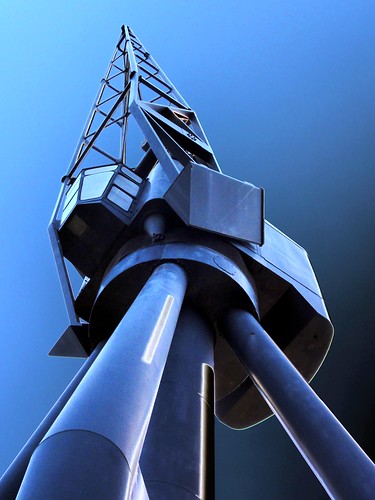
DSC02807B by Dr Yool
DSC02807B, a photo by Dr Yool on Flickr.
While at the Planet Under Pressure conference this week, I took a bit of time out to explore the dockland surrounds of the ExCeL Centre. It's built on the northern margin of Royal Victoria Dock, and while a lot of the original buildings have been swept aside for expensive-looking condos and hotels (one of which provided my digs), there's still quite a lot of the older stuff to see. And, what with it juxtaposed with various modern buildings, there's plenty of photo-ops going. Which, needless to say, I was unable to resist. My full set of photographs can be seen here.

The Earth Hums in B Flat

Overlooking "the pile", I thought I'd turn to my most recent read, The Earth Hums in B Flat, by the Welsh novelist Mari Strachan. Based, in part, on my initial impressions of it, C has picked it for her book group in April, so I thought I'd better get recording my own thoughts before they get melded or overwritten by those of a rival blog ...


Growing up is never easy, but Gwenni, a dreamy twelve-and-a-half year old, is making particularly heavy weather of it. At night, she dreams of flying over her village, and spends her days trying to fly while awake and obsessing about releasing the soul of the fox fur wrapped around a neighbour's neck. Constantly surrounded by the gossipy, close-knit community of her small Welsh hometown, her candidly outlandish tales, told to all and sundry, are making her mother, already twitchy, even more so. Her older sister, with whom she shares a bed in their cramped home, is entering adolescence and is tired of Gwenni's childish fantasies. And her best friend, formerly a source of companionship, has begun to notice boys and to view Gwenni's obsessions as "queer". Against this backdrop, the father of two young girls that she babysits suddenly disappears, and Gwenni, devoted to his wife who allows her to borrow books, sets out to solve the mystery. But her meddling draws further unwelcome attention to Gwenni's otherworldliness, and unearths hints of a family secret that imperils her mother's uneasy grip on sanity. Buffeted by her mistakes, as well as revelations about her family and her community, Gwenni begins to dimly perceive the complex adult world that she is soon to enter.


First of all, I have to report being pleasantly relieved that the novel's early promise - upon which hangs the enjoyment of C's book group - was ultimately fulfilled. Of course, it might yet go down like a bomb with the group's seasoned readers - it certainly wouldn't be the first time that something that I've liked has been cast out of the temple. But I can at least say that my early hopes for The Earth Hums in B Flat panned out nicely.

Comparison is probably not the fairest way to write up a novel, but I was most reminded here of The Curious Incident of the Dog in the Night-Time. And not primarily because of the plot device of a central mystery. While Gwenni isn't as unique a narrator as Christopher in that novel, The Earth Hums in B Flat shares the earlier novel's skilful framing of events by a mind not (yet) at the same wavelength as that of the characters that loom large in her world. This does, of course, mean that Gwenni can be annoying at times, particularly in her obstinate obsessions, but it's in the service of capturing a child's askew view of reality, so fits the novel perfectly.

While the "mystery" plot does unfurl nicely - though tragically - there were a few parts of the novel that didn't quite work for me. One was the resolution, of lack thereof, of the fox fur subplot (to misname it). Perhaps I just missed something, but I thought that the fate of the fur's owner was a little under-explained given what actually happens. Of course, maybe there was something in the novel that was supposed to be obvious to an adult reader but not to a child? If so, d'oh! There's also something odd with a character who "likes" Gwenni but who gets summarily drummed out of the plot rather oddly. Either this is a quasi-realistic version of how one's romantic interests come and go while very young, or a clumsy bit of plotting. I'd like to think the former, but while reading it felt like the author was simply "tidying" an unhelpful plot strand while wrapping up.

One aspect that worked particularly well for me was the novel's brilliant job on conjuring up the gossipy nature of small towns. While the details obviously differ [*], the novel chimes perfectly with my own experience of growing up with half-heard and wholly-speculated tales about other people in my home town. More generally, of being raised in an insular community where everyone seems to know everyone else - sometimes going back generations - and, more importantly, where trading idle gossip in other people's business is the norm. Interestingly, the gossiping in the novel sits alongside a pivotal strand about its opposite, the burial of family secrets. Which of these competing adult approaches to introducing children to the world is to be favoured isn't something that's entirely resolved in the novel, but concealing painful secrets is clearly a bad idea.

On that note, I'll be interested to hear what C (et al.) make of the novel's treatment of mental health. The gossipy characters clearly stigmatise it, as one should probably expect for the 1950s, but Gwenni's family is a lot more sensible and modern about her mother's fragile state. It's also interesting that the medical profession - and intervention - of the time is presented so positively. They're clearly invested in chemical treatments, but these seem to be gratefully received by Gwenni's father and grandmother. My immediate thought was that drugs were much more of a blunt instrument in those days.

In passing, one thing that I didn't clock till quite a few pages in - of which my late realisation amused me afterwards - was that the novel is set firmly in the past. Probably reflecting an unconscious prejudice borne out of my own upbringing in a small Scottish town (he says, getting his excuses in early), I at first mistook 1950s rural Wales for something much closer to the present day. In my defence, this is at least in part because Gwenni's reporting of the world is from an age at which it's more easy to imagine a lack of interest in consumer goods and mobile phones, but I'm clutching at straws here. That said, I had something of a similar experience with the Wales-set film Submarine, which, though set in the somewhat-more-recent past, also seems somewhat timeless (and is similarly told from a young adult's perspective).

Overall, my complaints are too minor to detract from my enjoyment of The Earth Hums in B Flat. I've enjoyed other book group books more (here, here and here, for instance) but I'd still rate it pretty strongly. I'd say an easy 7/10, but given that I might wind up being its only defender, I'm going to bump up a bit to 7.5/10 (I think that I'm allowed half-marks aren't I?). And I will be looking forwards to hearing what praise (or punishment) is dealt out later this month. Unfortunately, I can't make it to London that day, so this will have to stand as my testament to the book.


[*] Though not entirely. In my own life, one of my highschool teachers tragically killed himself after a short spell in our local "funny farm". Even now I can remember the morbid fascination with details of his death, which was pretty unpleasant, and with the subsequent speculations about the state of his marriage. It may well have just been my family and my peers, but I seriously doubt it. Looking back on these events now makes me a little less displeased that I live in a more atomised manner now, largely separated from my immediate community. Sometimes a bit of distance is a good thing.

Friday, 23 March 2012

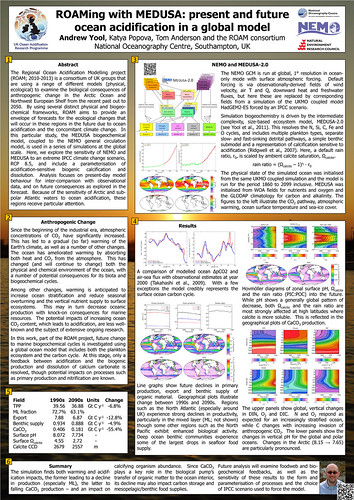
ROAMing with MEDUSA

PUP poster FINAL

Finished (well, printed) my poster for next week's international Planet Under Pressure conference today. It makes use of my recent (and surprisingly quite successful) simulation of MEDUSA-2.0 under RCP 8.5 forcing from one of the UKMO's IPCC runs. After a bit of a graceless start - largely down to disequilibrium caused by the carbon cycle's initial condition - MEDUSA managed to knuckle down and start behaving itself by the middle of the 20th century, and became nicely acidified by year 2100. The run has one acidification feedback in it (calcium carbonate production), so there were some moderately interesting points to pull out of the run in the end. EKP has spotted a few features of the run's Arctic performance that she's not especially happy about, but we might be stuck with those because of the forcing we're wedded to. We had enough trouble getting that to give us sensible ocean circulation, so I'm not confident about finessing NEMO's physical performance.

Just the actual conference to look forwards to now. It promises to be one of those strange marriages between science and politics, so I'm not holding my breath. But, as such, it'll at least be quite different from the usual run of the mill. There are a number of big political names down to speak or to host, but given the lack of urgency with which the body politic deals with environmental concerns, it may just be more talking the talk.

Anyway, given that I may be returning to no job after the conference, my lofty scoffing might be entirely academic. It'll be difficult to be quite so environmentally scrupulous if I find myself sans employment.

Wednesday, 21 March 2012

And it's not even mine

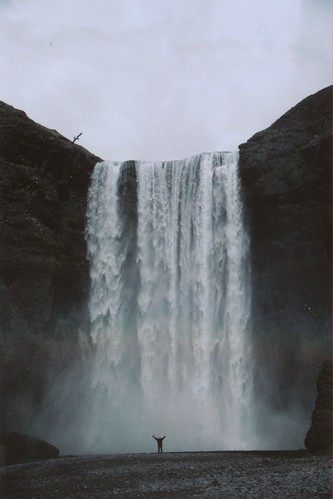
Courtesy (probably) of the chaotic intricacies of the interweb, this past week has seen this photograph ...

Skogafoss

... shoot up the popularity charts of my Flickr account. Prior to last week, it was sitting on only a handful of hits, but something happened on the 15th March and since then it's sky-rocketed to 720 viewings (the "second best" photograph in my Flickr collection is sitting at 298 viewings) ...


It's all calming down now, but along the way the photograph has also been "favourite-ed" 30 times by a slew of Flickr members I've never met before (thanks, by the way).

So, what gives? The clue [*] seems to be in the appearance of Tumblr in the referring website list. While I'd only faintly heard about this site before, a perusal of one of the referrers reveals it as some sort of recycler of images, where people can repost things they've seen and liked into a stream of (visual) consciousness. Or something.

Anyway, it looks like this image of Skógafoss has been sucked up into Tumblr and passed around various of its members, many of whom have kindly visited the original and bumped up my Flickr viewings count (not that I'm counting, OK). But, like the epidemic of an infectious disease, this surge has now run its course, and the photograph can probably now pass into oblivion once more.

The worst bit is that it's not even one of my photographs (... as is probably obvious from the fact that I appear in it).


[*] It can only reasonably be described as a "clue" by those, such as me, who are generally clue-less about social media sites such as Tumblr. Everyone else would just view that as an indication of the bleeding obvious.

Saturday, 3 March 2012

Metrics of redundancy

The end is nigh. Almost. Earlier this week we received our classifications as either support or "leading" scientists, as well as the appropriate pro forma that accompanies this diagnosis. I'm in the latter (though most of what I do is grunt-work) so my fate dangles uncomfortably on my publication record and the clawing in of cash. The former is a perfectly acceptable metric to judge a scientist on, the latter, while not terrible, can miss the point a bit in our organisation since we're largely supported by core funding that (largely) obviates the need to apply for cold hard cash. Needless to say, while I have been flailing about unsuccessfully for money, it hasn't been a priority for me.

Anyway, as part of this pro forma I've been cobbling together stuff on my less-than-stellar publication record. The Web of Knowledge has a subsection to help with this so yesterday I set myself up with a profile and linked together my ISI-recognised list of papers. This lets me calculate something called the "h-index" for myself (14, apparently), and produce a whole load of faintly interesting graphs about my work.


This one shows how I'm accumulating citations since I burst onto the "scene" back in 1998 (Lamarck and prions). At first glance it looks pretty good. But even a cursory second glance makes it look like I've peaked - and am possibly on the way back down! :-)


This second one shows where I'm being cited, or, rather, what keywords are associated with the places I'm being cited. Interesting that oceanography comes in second, but I guess that some of the journals I'm published in (e.g. GBC) aren't strictly ocean-only. I've no idea why my work is quite so appealing to geology, but I'll take citations wherever I can get them. Especially at this point!

Anyway, our pro forma summaries have to be in by the 12th March (perfect timing given I'm off on holiday until then), and then the judging process begins. D-Day for our fates is the 28th March (again, perfect, since I'm at a conference then). Just in time for Easter and the resurrection of "the departed" into glorious new careers. It's going to be a bad month whether I survive or not.